What November 3 means for the Fed's rate path and the US Dollar

The US Dollar (USD) faces a decisive period ahead of the November 3 midterm elections. While markets anticipate another interest rate increase from the Federal Reserve (Fed) in December, the battle for control of Congress could reshape fiscal policy expectations and, indirectly, the path of US monetary policy in 2027.
The stakes extend well beyond the political confrontation between Republicans and Democrats. US President Donald Trump's ability to pursue his economic agenda, the evolution of the federal deficit, and the bond market's reaction could influence the Fed's next decisions and determine whether the US Dollar maintains its upward momentum.
The election comes at a particularly sensitive moment. Inflation remains elevated, energy pressure linked to the Middle East conflict are complicating the economic outlook, and US Treasury yields have reached levels not seen in more than two decades.
November 3: A political vote with monetary consequences
On November 3, American voters will elect all 435 members of the House of Representatives and 35 senators. The outcome will determine whether Republicans retain control of Congress or Democrats take over one or both chambers.
Prediction markets currently give Democrats a substantial advantage. According to Polymarket odds displayed on Wednesday, a Democratic sweep of both chambers is the leading scenario, with a 63% probability, compared with 28% for a Democratic House and Republican Senate. Republicans retaining both chambers carry just an 11% probability.
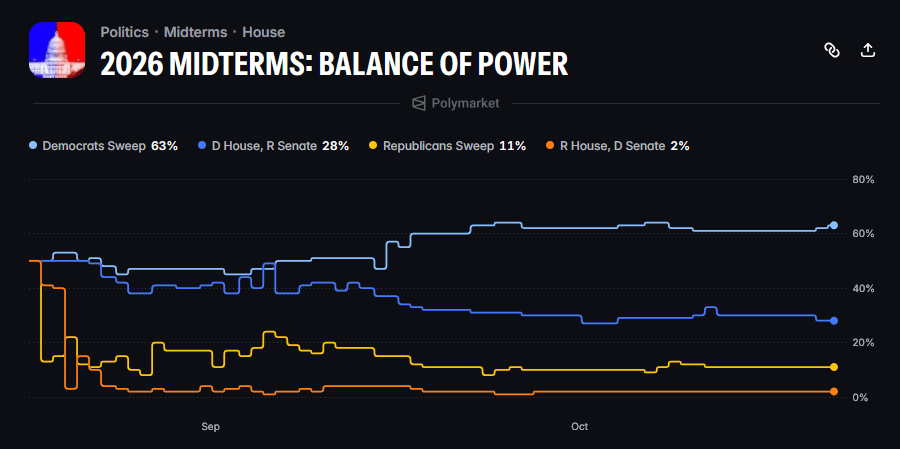
These probabilities, which reflect prediction market positioning rather than certain forecasts, suggest that investors are already preparing for a reduction in Donald Trump's legislative power.
For the Fed, the result does not constitute a monetary policy mandate. The central bank retains its institutional independence and makes decisions based on its dual mandate of price stability and maximum employment. However, the next Congress's fiscal decisions could change the economic conditions to which the Fed must respond.
A more expansionary fiscal policy could support growth but also prolong inflationary pressure and justify keeping interest rates elevated. Conversely, legislative gridlock could limit additional fiscal stimulus, weaken growth expectations, and reduce the need for further rate hikes. Control of the Senate also carries important institutional implications, as it has the authority to confirm presidential nominees to the Fed's Board of Governors.
History suggests the Fed prefers to wait, but inflation can change everything
US monetary history shows that the Fed generally avoids changing interest rates immediately before elections. However, this tendency is far from an absolute rule. A recent study from CME Group examined 27 US election cycles between 1972 and 2024. It found that the Fed left interest rates unchanged in 52% of the periods between September 1 and Election Day. When the analysis focuses exclusively on the period from October 1 to Election Day, that proportion rises to 67%.
The pattern is similar during midterm elections. Across the 13 cycles examined, the Fed kept interest rates unchanged 54% of the time. Excluding the exceptional year of 1982, that proportion increases to 62%.
Previous rate hikes near midterm elections, particularly in 1978, 2018 and 2022, were primarily associated with inflationary pressure.
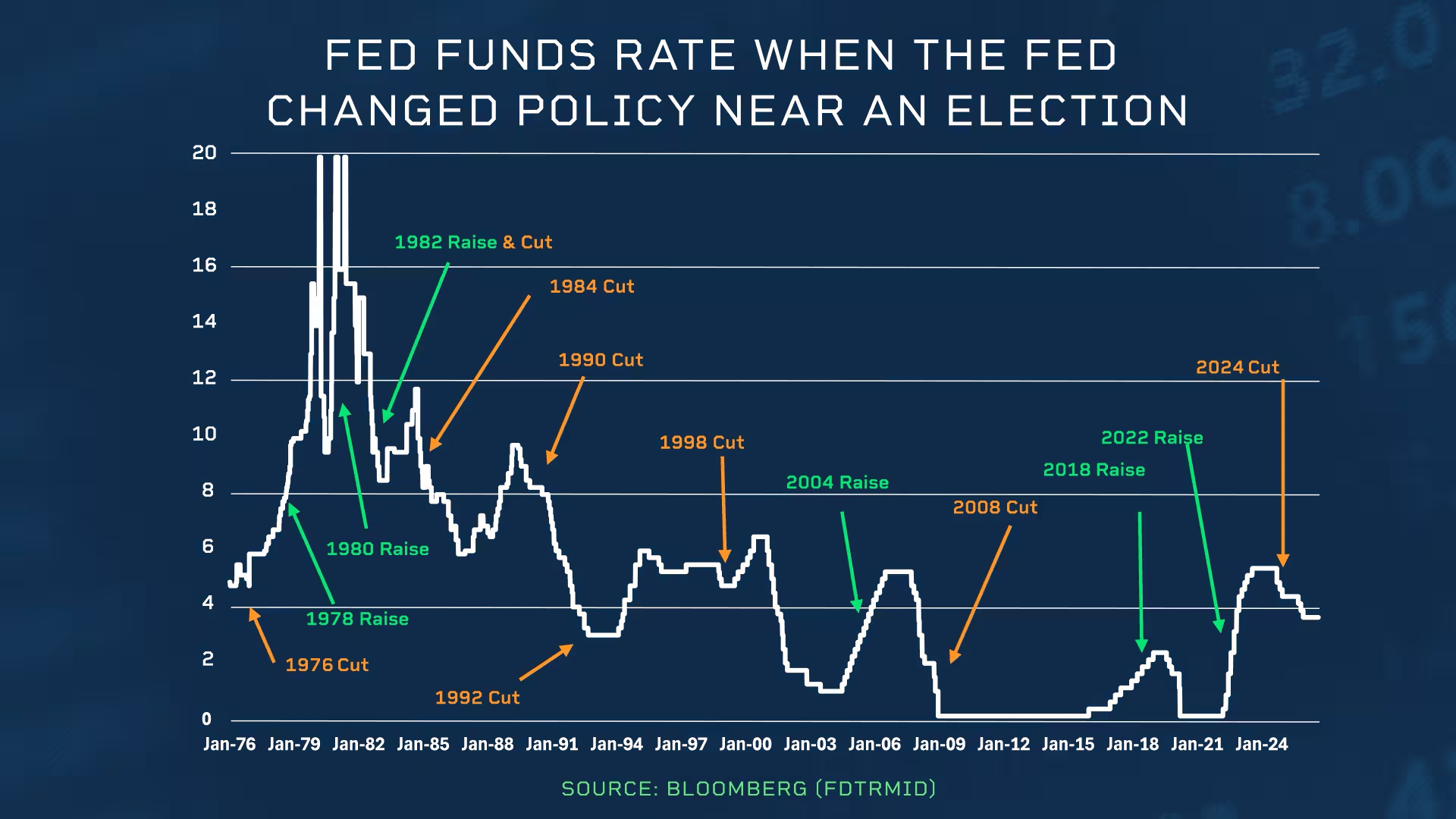
These findings suggest that the proximity of an election does not prevent the Fed from acting when economic conditions require it. In the current environment, an October 28 pause would, therefore, be consistent with historical patterns. But it would not necessarily signal the end of the tightening cycle.
According to the CME FedWatch Tool, markets currently assign a 15% chance to the Fed leaving interest rates unchanged at its October meeting, while the chance of a rate hike in December stands near 88%.
The central question then becomes not only what kind of economic policy will emerge after November 3, but also how the election outcome could reshape interest rate expectations for 2027.
Three election scenarios, three possible paths for the Dollar
The different political outcomes could trigger significantly different reactions in Treasury markets and the US Dollar.
1. Republicans retain Congress: Higher rates, stronger US Dollar?
If Republicans retain both chambers, Donald Trump would have greater freedom to pursue his economic priorities, particularly regarding taxation, defense, deregulation, and trade policy. This scenario could strengthen growth and inflation expectations while increasing concerns about federal deficits.
ING estimates that the 10-year US Treasury yield could break above 5.5% and remain elevated, while the 2-year yield could approach 5%. Such a development could reinforce monetary tightening expectations and support the US Dollar, at least initially.
However, a rise in yields driven by deteriorating public finances could gradually become a negative factor for the currency.
2. Democrats win the House: Gridlock reshapes rate expectations
A Democratic House of Representatives alongside a Republican Senate would limit the administration's ability to pass ambitious new fiscal measures. This gridlock could reduce expectations for additional government spending and moderate growth prospects, thereby diminishing the need for further rate increases.
According to ING, short-term Treasury yields could gradually decline, while 10-year yields would remain within a 5.25%-5.5% range. The US Dollar could experience a relatively limited reaction, as investors weigh reduced fiscal stimulus expectations against the risk of renewed political confrontations.
Brown Brothers Harriman also expects the fiscal impulse to remain modest over the coming years, potentially encouraging a downward repricing of interest rate expectations and weighing on the US Dollar.
3. Democrats sweep Congress: A dovish repricing ahead?
A Democratic victory in both chambers would represent the most significant political shift. Congress would gain greater leverage to challenge presidential initiatives, strengthen oversight of the administration, and complicate appointments to key positions, including at the Fed. Donald Trump's legislative room for maneuver would be substantially reduced, although his veto power and executive authority would continue to limit Democratic influence.
Investors could initially anticipate reduced fiscal stimulus expectations, lower Treasury yields, and a less restrictive monetary policy outlook. ING expects the US Dollar to weaken modestly under this scenario, while 10-year Treasury yields could approach 5.5% without breaking above that level.
However, a Democratic victory would not guarantee an improvement in public finances. Disagreements over social spending, defense, and taxation could prolong fiscal tensions.
November 3 is only the first test: December and 2027 come next
The November 3 election could ultimately mark the beginning of a period of reassessment rather than trigger an immediate change in market direction. Investors will quickly need to focus on several major deadlines.
Temporary federal government funding expires on December 11, opening the possibility of renewed and difficult budget negotiations. The Fed will then make its final monetary policy decision of the year, with a 25-basis-point rate increase widely anticipated. The new Congress will take office on January 3, 2027, before facing the next round of negotiations over the federal debt ceiling.
These events will help determine whether the elections actually lead to a meaningful change in the economic and monetary outlook. The most supportive scenario for the US Dollar in the short term would involve a resilient economy, persistent inflation, and a Fed maintaining a restrictive policy stance.
Conversely, slower growth, a reduction in rate hike expectations, or mounting concerns about debt sustainability could weaken the US currency.
The conclusion is, therefore, more complex than assuming that a Republican victory would automatically strengthen the US Dollar or that a Democratic victory would necessarily weaken it.
November 3 will determine who controls Congress, but the fiscal consequences, interest rate expectations, and bond investors' reactions will ultimately determine the US Dollar's trajectory in 2027.
The story was corrected on October 21 at 14:00 GMT to clarify the headline.)
Author

Ghiles Guezout
FXStreet
Ghiles Guezout is a Market Analyst with a strong background in stock market investments, trading, and cryptocurrencies. He combines fundamental and technical analysis skills to identify market opportunities.















