The US Oil reserve hit a 44-year low. Now the barrels are coming back
Washington lent out a third of the Strategic Petroleum Reserve this year rather than selling it. The loans come due from now to 2029, and after the midterms, the reserve has nothing left to hold fuel prices down.
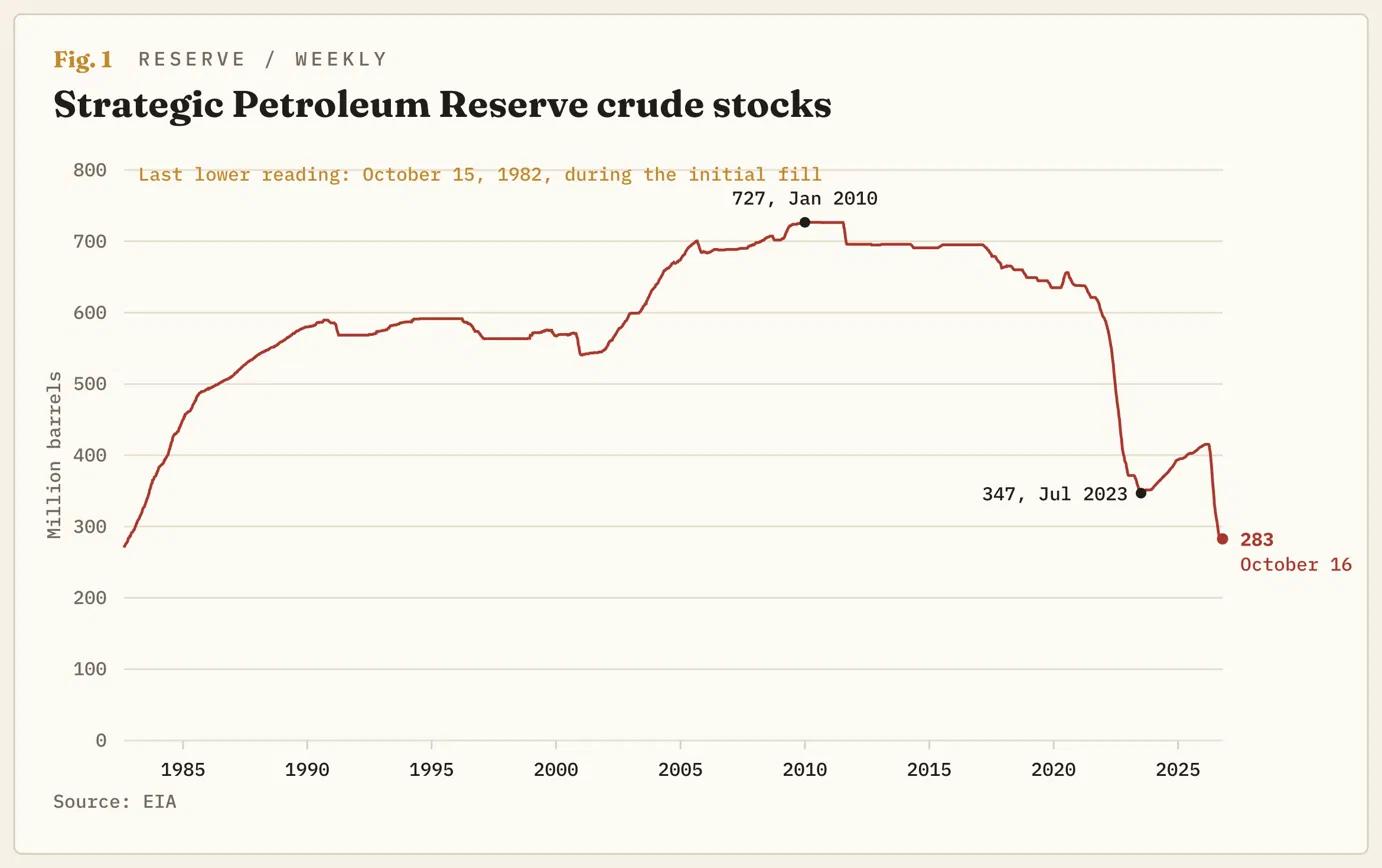
The US Strategic Petroleum Reserve (SPR) held 282.7 million barrels in the week to October 16, down another 300K, and lower than at any point since October 1982. It has lost 132.8 million barrels, a third of what it held, since the war on Iran began on February 27. None of that Oil was sold. Every barrel went out as a loan, with interest due in barrels, and the first repayment dates have arrived.
The reserve that supplied the US market with up to 1.4 million barrels a day in May now supplies about 40K a day, and over the next three years the contracts run the other way. For West Texas Intermediate (WTI) Crude Oil, trading near $97 after a run at $100, the emergency stockpile has stopped being a reason for prices to fall, and after November 3 the administration has nothing left in it to use.
Lent, not sold
Past emergency releases were sales. The 17 million barrels of 1991, the 30.6 million of 2011 and the 180 million of 2022 all left for good, the government kept the money, and refilling was a separate decision the Department of Energy (DOE) took later, at its own pace and its own price. This year the department chose the exchange, a tool it had used for hurricane outages and, once, for 32 million barrels in 2021. A refiner now takes Crude Oil from the salt caverns and must deliver the same barrels back, plus extra, on a contract date. The extra barrels are the interest. DOE quotes a blended premium of 25% and says the arrangement saves taxpayers more than $3 billion. It saves them on Oil it doesn't have back yet.
The borrowers thinned out
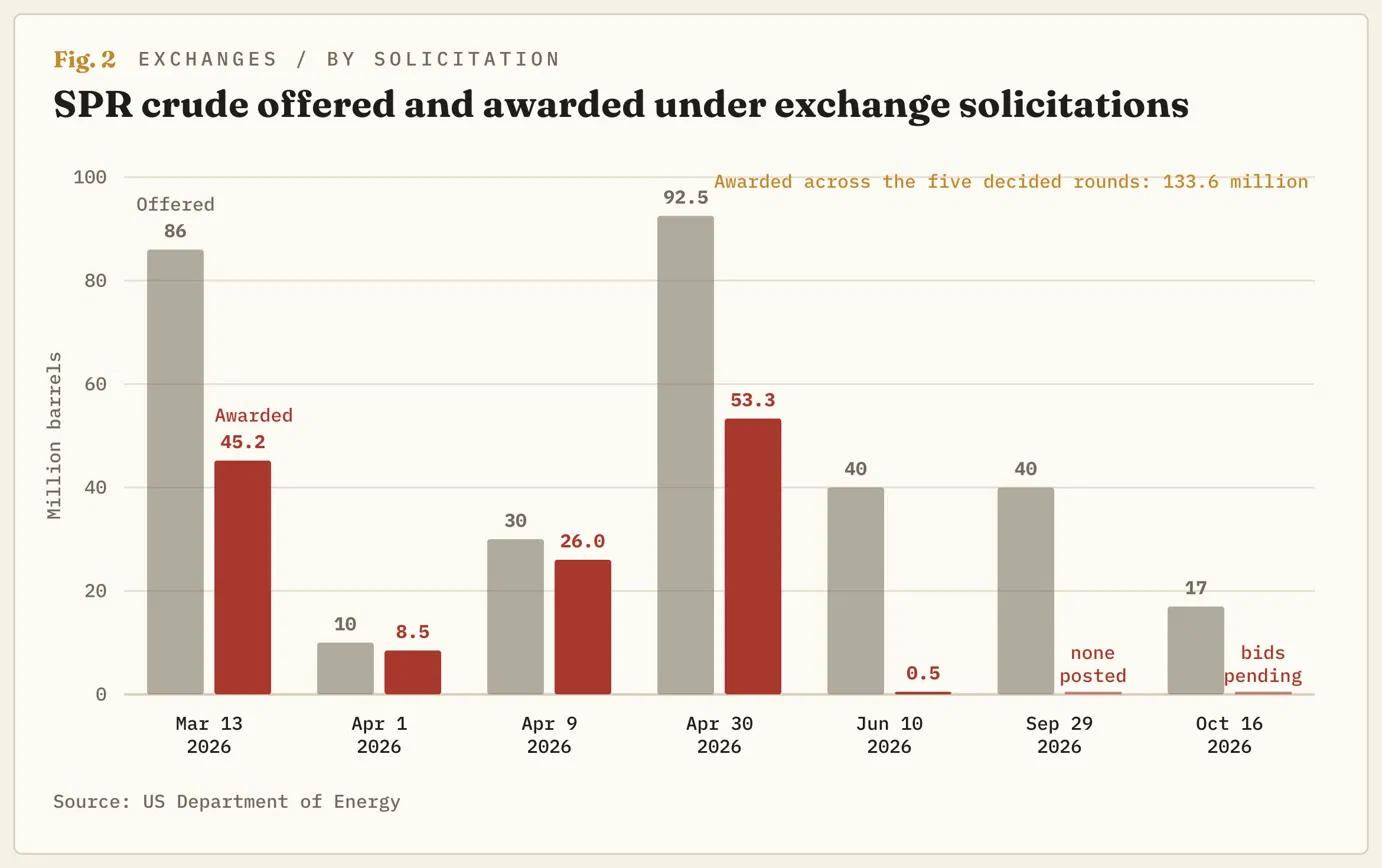
The loans came in waves, and the waves got smaller. By May, the department had placed 133 million barrels across four rounds. In June it offered 40 million and one trading house took 500K of them. A fresh 40 million offer went out on September 29. Three weeks later, the department's exchange page carried no award, while each earlier round had posted its award within two weeks. The department offered another 17 million on October 16, with bids due Wednesday. On Wednesday, the department also opened a fourth window, offering to lend up to 315K barrels from the 1 million-barrel heating-Oil reserve in the Northeast.
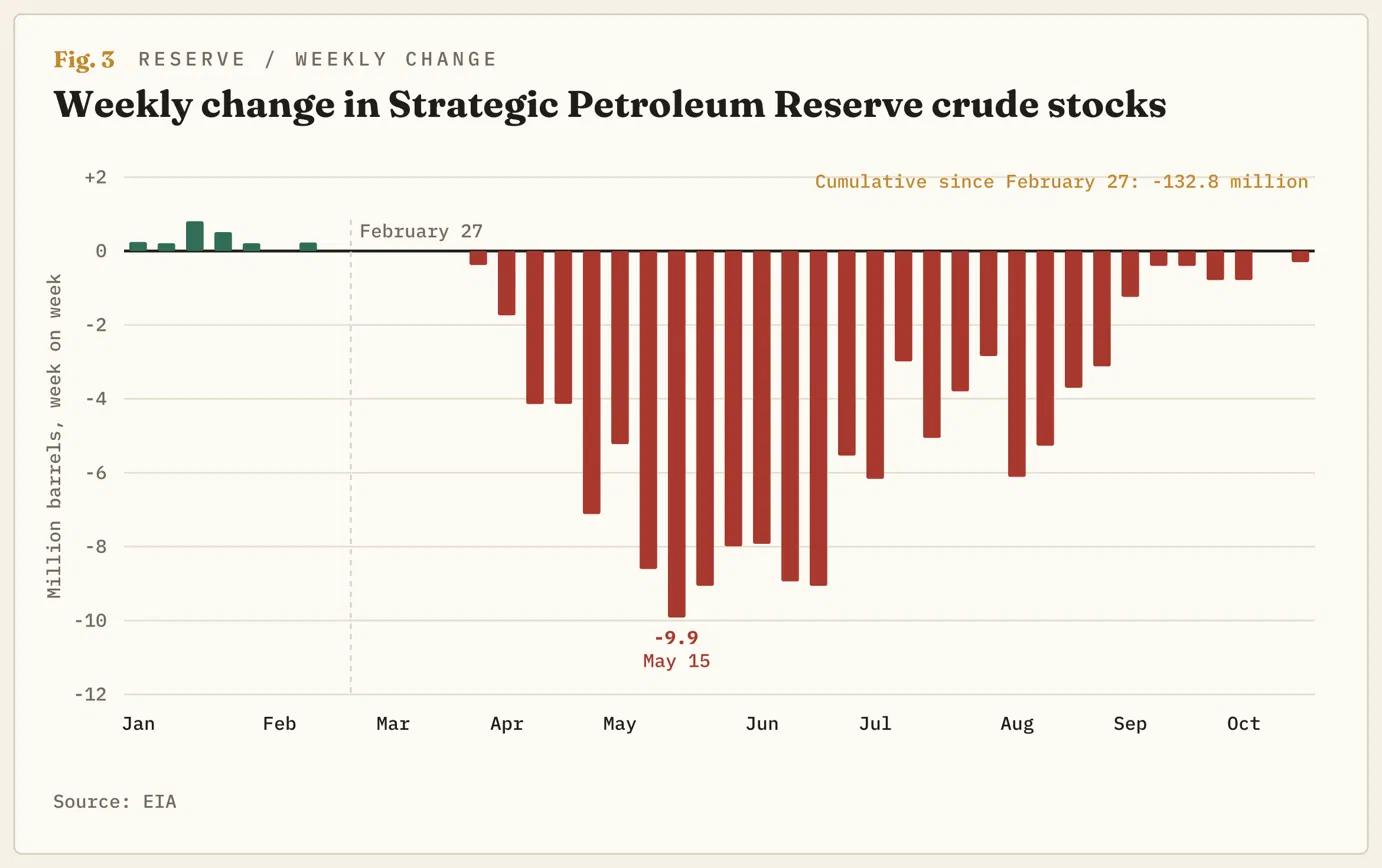
The weekly figures say the same thing. The reserve lost 9.9 million barrels in the week to May 15 and has lost under a million in every week since early September. That is the last of the awarded Oil being delivered. For WTI, the reserve is now a rounding error in supply. The price hasn't moved on it because Hormuz is the bigger number: the International Energy Agency (IEA) counted 10.9 million barrels a day through the strait in September, against about 20 million a day in 2025.
Due dates
The contracts say when the Oil comes back. The March loans are due between September 1 this year and September 30, 2028, depending on the site. The April and May loans come back between January 2027 and July 2029. Anything placed from the September and October offers returns in 2027 and then between October 2028 and December 2029. Energy Secretary Chris Wright said in March that the 172 million barrels would come back as more than 200 million within a year. The contracts his department signed run to the end of 2029.
On the premiums in those contracts, the 133.6 million barrels placed so far will return as roughly 165 million, plus the 4 million lent to ExxonMobil (XOM) and BP (BP) after the October 10 Gulf storm. Each returned barrel is one the borrower has to buy on the Gulf Coast, where the loans went in the first place, and pump into a cavern instead of a refinery. Spread over three years, it is a small number for a country that uses 20 million barrels a day, roughly 150K a day. What changes is the direction, not the size.
DOE has moved these dates before. The 32 million barrels it lent in 2021 and 2022 were due back by 2024. It pushed 8 million out by a year. Then in 2024 it pushed 15.3 million of what remained out by up to two years, to July-October 2026, saying it wanted to take advantage of stable Crude Oil market windows. The window it picked turned out to be months five to eight of a war, and the reserve hasn't risen in a single week since it opened. The department hasn't said whether those barrels were deferred a third time.
A reserve that pumps at half speed
The reserve couldn't have kept up the spring pace anyway. The Government Accountability Office (GAO) reported in June that the SPR was designed to deliver 4.4 million barrels a day for 90 days. As of December, it could manage 2.7 million barrels a day, 61% of its design capacity, with more than a quarter of its Oil unreachable. The auditors counted 16 major equipment failures since 2013 and a $230 million maintenance backlog, and DOE staff told them the hardware was held together with Band-Aids. Through that hardware, the department then offered 172 million barrels for loan.
Filling is slower than draining. GAO put the effective fill rate at 440K barrels a day, 56% of design, so taking back 165 million barrels is more than a year of continuous pumping before any new loans. The return windows stretching to 2029 aren't generosity to refiners; they are what the plumbing allows. GAO's other finding matters more for the price: the drawdown limits get worse as the inventory falls, so each barrel lent this autumn makes the next emergency release smaller.
What the pump price has left
Regular gasoline is $4.26 a gallon on the AAA average and diesel $6.32, against $3.05 and $3.62 a year ago. The reserve was the administration's only domestic tool to counter those numbers. What October has produced instead shows the tool is used up: an order on October 16 waiving some sanctions on Russian diesel imports, an IEA decision on October 15 to speed up the 100 million barrels its members still owe from March, and Wednesday's heating-Oil loan, announced on the day the weekly report showed distillate stocks up 1.7 million barrels against a forecast 1.2 million draw. President Donald Trump said on October 8 there would be no attacks on Iran before the November 3 election, and on September 9 that Oil prices would fall right after it. Iran's foreign minister offered on October 18 to reopen the strait within six days on conditions Washington hasn't accepted, including lifting the blockade and removing Oil sanctions.
For WTI, only one thing can move the price down from here: the strait. The reserve isn't on the list. At 282.7 million barrels and 61% of its design pumping rate, the next release would be smaller, slower, and borrowed, and the first thing the reserve does from here under its own contracts is buy.
The map
WTI has risen roughly two-fifths from its July low near $68, and the October leg took it from about $86 to a test of $100 in three weeks. The daily Stochastic Relative Strength Index (Stoch RSI), a momentum gauge, has climbed from near zero at the start of October to the high 60s, so the leg has room before it is stretched. Since July, the pattern has been higher lows above a rising 50-day average, with 100 capping the price in September, a gain since Monday, and spring highs in the mid-100s above that. Wednesday's inventories lean the same way: commercial crude down 3.1 million barrels vs. a forecast 0.1 million, and gasoline down 3.0 million vs. 0.4 million; the one soft spot is Cushing, the WTI delivery point, which built 1.0 million for a second week. $100 is the level.
The lean is long above $90, where the 50-day average now sits, just above the base the October leg left behind. A daily close above $100 takes the argument to the spring highs near $105, and nothing the reserve can do stands in the way. The case is wrong below $90 on a closing basis. That is Hormuz reopening, the only branch that gets Oil to the Gulf Coast faster than the reserve ever could, and it is also the branch in which DOE enforces its return dates, and the reserve starts buying into a falling market. Either way, the reserve's next job is taking Oil in.
Author

Joshua Gibson
FXStreet
Joshua joins the FXStreet team as an Economics and Finance double major from Vancouver Island University with twelve years' experience as an independent trader focusing on technical analysis.
















