USD/JPY Forecast: Ready to rally after overcoming two shocks
- USD/JPY has recovered from the attack in Saudi Arabia, and the Fed rate cut.
- US GDP, Durable Goods Orders, and trade top the agenda.
- Late September's daily chart is pointing to further gains.
- The FX Poll shows that experts are bearish and see a continuous fall.


The safe-haven yen has proved its strength as traders flocked to it in the wake of the attack on Saudi installations. However, it gradually recovered amid the Fed's hawkish cut. The last full week of the third quarter features top-tier US data, trade developments, and more.
This week in USD/JPY: Gapping lower and recovering
A brazen drone attack knocked out 50% of Saudi oil output – or 5% of global production. Yemeni Houthi rebels took responsibility, but fingers were pointed to Iran – Saudi Arabia's regional rival. The shock sent traders to safe-haven assets such as the yen as the week began and USD/JPY saw a substantial gap lower.
As time passed by, the Saudis were able to restore some of the lost production, and it seemed that the US was hesitant to escalate tensions by attacking Iran. As oil prices dropped, the yen was sold off as well.
These Mid-East tensions grabbed headlines for a couple of days but then made way for the all-important decision by the Federal Reserve. The Fed cut rates by 0.25% as expected, but its forecasts for future moves included no further reductions in 2019 – nor 2020. The statement included only minor changes and a split Fed also showed that the world's most powerful central bank would likely think twice before raising rates.
However, what seemed like a hawkish message was somewhat diminished by Jerome Powell, Chair of theFederal Reserve. In the press conference that followed the decision, Powell left the door open to further monetary stimulus if data – or trade uncertainty – warrant it. USD/JPY jumped in response to the decision and then pared some of the gains.
And on the trade front, the US and China continue talking. Both Vice President Mike Pence and senior adviser Larry Kudlow have expressed optimism about reaching an accord. On the other hand, another adviser – Michael Pillsbury, has warned that the administration may slap new tariffs on China if talks are unfruitful.
The Bank of Japan left its interest rates unchanged less than 12 hours after the Fed made its move. Governor Haruhiko Kuroda seemed hesitant about further monetary stimulus but pledged to battle low inflation. The BOJ has limited tools as the interest rate is negative, and the bank's bond-buying scheme is massive. The Tokyo-based institution's reluctance to act while other major central banks are stimulating strengthens the yen.
US events: Trade talks continue, US GDP, and more
China celebrates 70 years to the revolution in early October, and officials are on holiday all week. That may accelerate trade talks in the upcoming week. Any comments by officials from the world's largest economies may move markets. If reports on progress emerge – USD/JPY has room to rise. If acrimony replaces signs of progress – the currency pair may drop. The Twitter accounts of Hu Xijin – editor of the Chinese outlet Global Times – and President Donald Trump may be of higher interest to short term moves while official announcement may have a more prolonged impact.
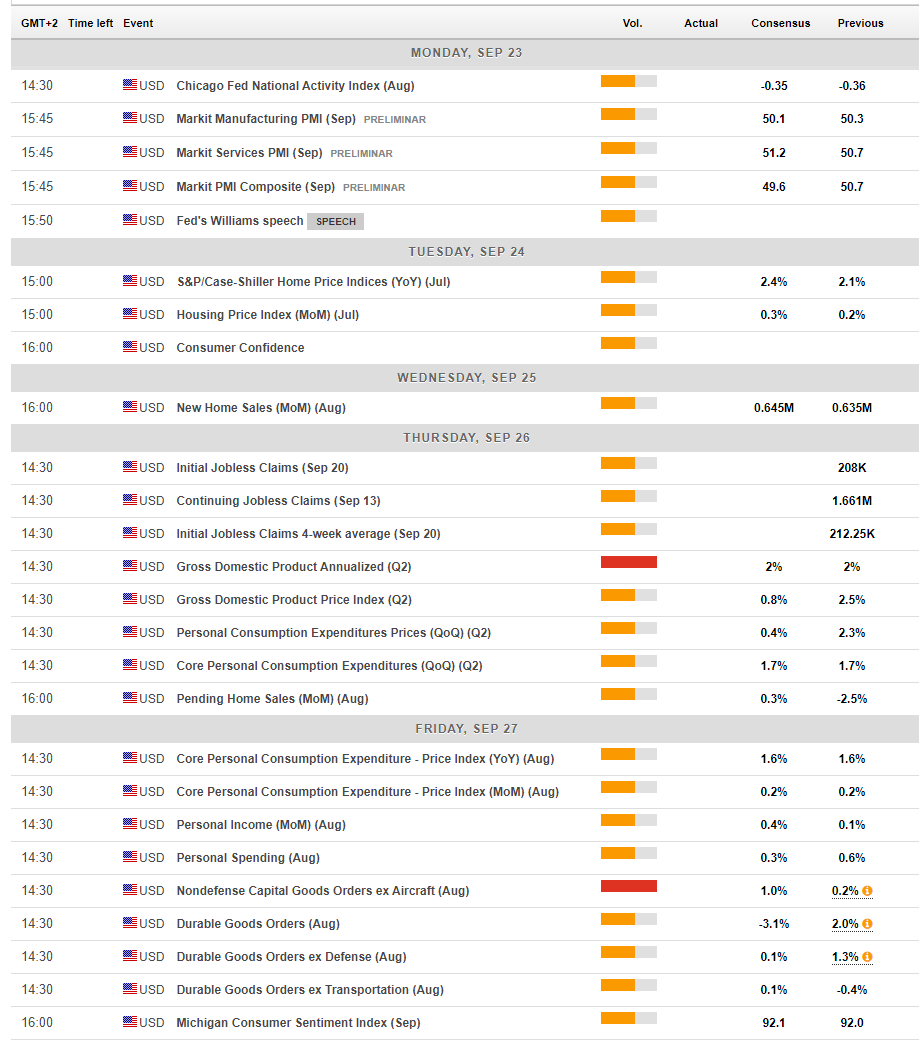
The economic calendar features important information almost every day. Markit's forward-looking Purchasing Managers' Indexes (PMIs) are of interest on Monday. Data for the more vulnerable manufacturing sector may have a greater impact than for the services one. After Building Permits, Housing Starts, and New Home Sales beat expectations in the past week, House Price indices and New Home Sales may also show a recovery in the sector.
The Conference Board's Consumer Confidence gauge is likely to remain at high levels – consumption has been leading the economy forward.
The most significant release is Thursday's final GDP report for the second quarter. It will likely confirm the previous read of 2% annualized growth. Changes in personal consumption and investment will be closely watched.
Friday is packed with top tier figures. Durable Goods Orders for August feed into third-quarter GDP – and also provide an updated picture of investment. The focus is on nondefence ex aircraft orders – aka "the core of the core." At the same time, the Fed's preferred measure of inflation is also released. The Core Personal Consumption Expenditure (Core PCE) for August is projected to remain at 1.6% YoY despite an increase in the Core Consumer Price Index (Core CPI). Subdued inflation has been one of the reasons for the two interest rate cuts.
Other figures such as Personal Spending and the final Consumer Sentiment Index from the University of Michigan all promise a busy end to the last full week of the third quarter.
Here are the top US events as they appear on the forex calendar:
Japan: Fresh inflation figures in focus
First and foremost, the Japanese yen has strengthened its position as the ultimate safe-haven asset after the attack in Saudi Arabia. An escalation in the Middle East or around Noth Korea may strengthen the Japanese currency.
The Bank of Japan's meeting minutes are of interest and may expose divisions within the BOJ. Governor Kuroda and some of his colleagues will be speaking, and they may also shed light on future policy.
Inflation figures from the Tokyo region may have an impact as well. These are early numbers for September and tend to have a more considerable influence than the national ones. Inflation excluding fresh food is set to decelerate from 0.7% to 0.5% – moving further away from the BOJ's elusive 2% target.
Here are the events lined up in Japan:

USD/JPY Technical Analysis
USD/JPY been trending higher since hitting a low in late August. On its way up, the currency pair has topped the 100-day Simple Moving Average and is enjoying rising upside momentum. The first attempt to break above a downtrend resistance line has failed, but USD/JPY has not fallen too far from this line.
Looking up, resistance awaits at 108.50, which capped the pair in mid-September. Further above, 109.35 was a swing high in early August. It is followed by 109.80, which capped a recovery attempt in May, and then by 110.65, which held it back earlier.
Support awaits at 107.20, that was a support line in mid-July. Further down, we find 106.70 that was a stubborn cap on several days in August. Below, 105.75 was a support line in early September. Next, we find 105.05 and 104.50.
-637045880354312839.png)
USD/JPY Sentiment
Assuming no significant escalation in the trade war or a real war in the Middle East, USD/JPY has room to rise. US data will likely be sufficient to keep the momentum.
The FXStreet Poll is pointing to the other direction. Experts see gradual falls in the short, medium, and long terms. The short-term target has been marginally downgraded while the other targets have barely moved. It seems that forecasters were unmoved by the recent shocks.

Related Forecasts
Author
Yohay Elam
FXStreet
Yohay is in Forex since 2008 when he founded Forex Crunch, a blog crafted in his free time that turned into a fully-fledged currency website later sold to Finixio.

















