EURUSD Forecast: Set to suffer with forward-looking gloom and below downtrend resistance
- EUR/USD has been trading in a limited range after the Fed's hawkish cut.
- Top-tier euro-zone surveys and trade developments stand out on the agenda.
- Late September's daily chart is painting a mixed picture.
- Experts foresee sideways movement for all time frames.

Markets may never be satisfied with central banks – as the Federal Reserve failed to convince markets – just like the European Central Bank. For EUR/USD, the result is a standstill. The last full week of the third quarter features new forward-looking data in Europe, trade developments in the US, and also other events.
What just happened: Hawkish Fed cut
The Federal Reserve has cut interest rates by 25 basis points – as expected – but stopped there. The central bank's forecasts for future rates reflect no new moves – this year or the next. Moreover, the Fed made minor changes to its assessment – modifications that balanced each other. On the one hand, the Fed is more content about the labor market and rising wages.
On the other hand, the bank is more worried about investment. The new wording only reflects data that had already been published. The greater surprise has come from the growing level of dissent – two members opposed the cut, and one voted for a double dose of stimulus – a 50bp cut.
The US dollar initially advanced, but Jerome Powell, Chair of the Federal Reserve, refused to commit to any scenario. He stressed that the Fed is following trade, geopolitics, and economic data – taking decisions on a meeting-to-meeting basis. His words took some of the stings out of the dollar's rise.
US data was mostly upbeat. Housing Starts, Building Permits, and Existing Home Sales have all come out above expectations – showing a recovery in the sector. Lower long-term rates may have had a positive impact.
In Europe, both central bankers and economists reacted to the ECB's decision to cut rates and introduce more bond-buying. Several hawkish members of the Frankfurt-based institution said the bank had gone too far in stimulating the economy. Others repeated the message that fiscal stimulus is needed. Bruno Le Maire, France's finance minister, also called for European-wide help from governments, and so did David Sassoli, President of the European Parliament.
The repeated message helped the euro recover. If governments step in to boost the economies of the 19-country bloc, the ECB may step back and reduce its money printing scheme. Germany may finally open its purse strings by investing in green initiatives.
The German ZEW Economic Sentiment for September has come out at -22.5 – above expectations for a change – but still reflecting pessimism. More significant forward-looking figures are due out now.
Euro-zone events: Looking forward
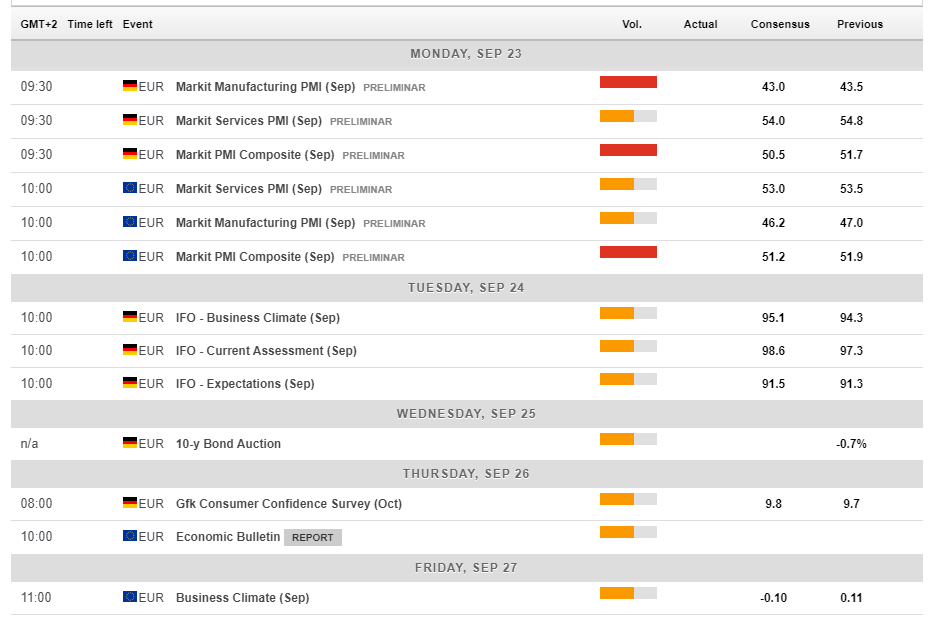
Markit's preliminary Purchasing Managers' Indexes (PMIs) for September kick off the week. The most critical figure is Germany's Manufacturing PMI. The continent's largest economy leans toward exports of manufactured goods – and the slump in industrial activity has brought the economy to the verge of recession. The most recent figure for August stood at 43.5 points – well below the 50-point threshold, separating expansion from contraction. Another slide is on the cards.
The services sectors in Germany and elsewhere are doing better. It will be necessary to see if they are not dragged lower by manufacturing. The euro-zone Composite Index has been positive in August with 51.9 – reflecting slow expansion – and also here, another decline is on the cards.
Another forward-looking index for the German economy is scheduled for Tuesday – the German IFO Business Climate has been falling, hitting 94.3 points in August. However, economists expect a rebound here – similar to the ZEW number. A recovery could boost the euro.
The ECB's Economic Bulletin may also be of interest. It consists of the data the bank had before its eyes before taking its decision.
Here are the events lined up in the euro-zone on the forex calendar:
US events: Potential trade developments and GDP
China will be celebrating 70 years to the Communist revolution on October 1, and the nation will enjoy a week-long holiday next week. This leaves the upcoming week like the last one to have technical conversations ahead of the high-level meetings later in October.
Reports that both sides are closing an interim deal would boost the dollar as the Fed could refrain from cutting rates further. However, if such an accord is limited in scope and leaves room for uncertainty, the dollar could struggle. It could fall if the talks break up.
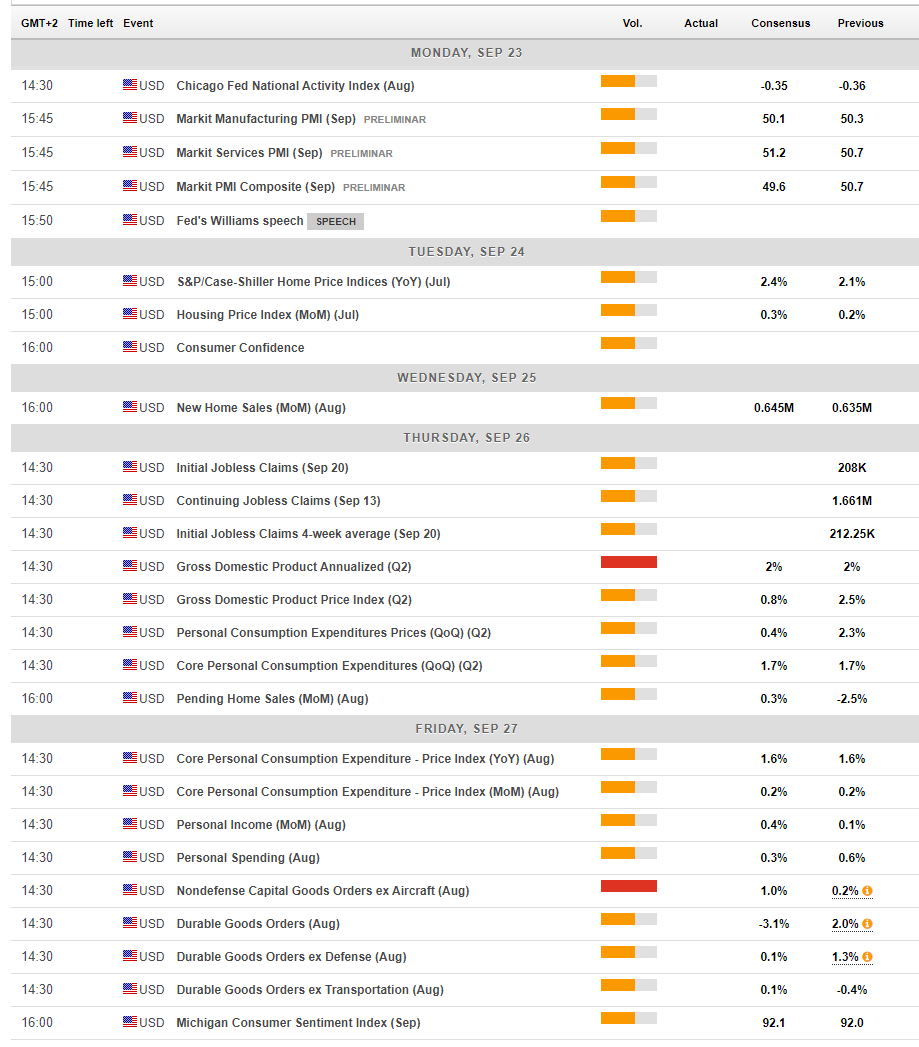
The economic calendar features Markit's preliminary forward-looking indexes at the beginning of the week. John Williams, President of the New York branch of the Federal Reserve – considered No. Three at the bank – may also move markets.
Another forward-looking gauge is due out on Tuesday – the Conference Board's Consumer Confidence measure for September. It will likely remain upbeat. Housing figures are scheduled for Tuesday and Wednesday, with a projected increase in house prices.
The most significant data points are due out later in the week. The final GDP read for the second quarter is expected to confirm the 2% annualized growth reported in the previous publication. Assuming no major surprise, markets will probably examine the components – falling investment dampened some of the consumer-led expansion.
On Friday, the US releases figures that already feed into third-quarter growth – Durable Goods Orders. Investment has been slumping in recent months, and investors will want to see if it has picked up in August. While headline orders are set to fall, the Nondefense ex-Air component – the "core of the core" – is set to advance.
The Federal Reserve's preferred measure of inflation is also scheduled for Friday. Core Personal Consumption Expenditure (Core PCE) is forecast to have risen by only 1.6% year on year in August – repeating July's rise. These projections come despite an increase in the parallel Core Consumer Price Index, which has already hit 2.5% YoY.
Here are the scheduled US events on the economic calendar:
EUR/USD Technical Analysis
The trend on the daily chart is to the downside. EUR/USD is capped by a robust downtrend resistance line that accompanies it since mid-June. Moreover, the pair suffers from downside momentum and trades below the 50, 100, and 200-day Simple Moving Averages. The Relative Strength Index (RSI) is flat.
Overall, bears are in control.
Support awaits at 1.1015, which provided support twice in September. It is closely followed by 1.0985, that was another support line during this month. The next line is critical – 1.0926 is 2019 low and also a double bottom. Further down, 1.09, 1.0820, and 1.0780 await EUR/USD.
Resistance awaits at 1.1085, which was a swing high early in September. Next, we find 1.1115, that is September's high. It if followed by 1.1165, which was a high point in late August, and by 1.1245, a peak earlier that month.
-637045692728838629.png)
EUR/USD Sentiment
The ECB is leading in the race to the bottom against the Fed and may resume its falls. However, European fiscal stimulus and a lack of progress in US-Sino trade talks may counter the downtrend.
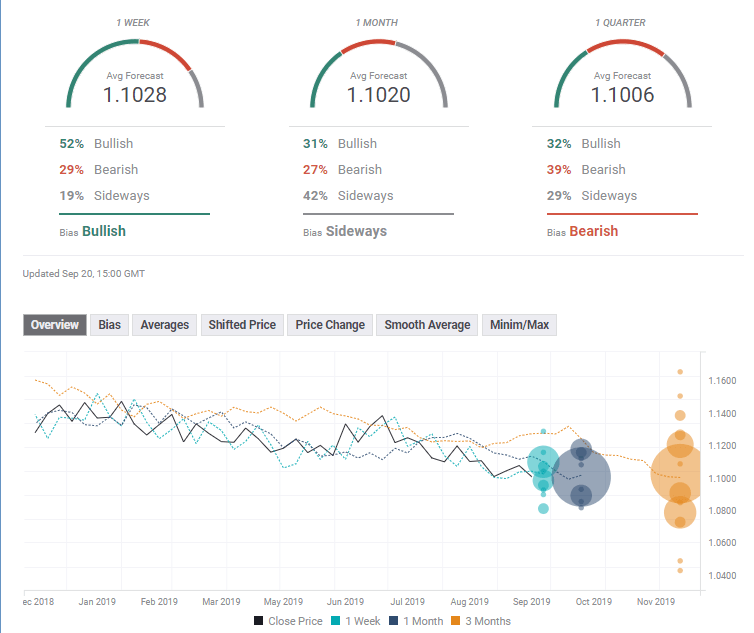
The FXStreet Poll is showing that experts are bearish in the short term, see sideways movement later, and are bearish in the long term. However, a closer look reveals that the targets are within 22 pips from each other – echoing the limited volatility that the pair experiences.
Related Forecasts
- USD/JPY Forecast: Ready to rally after overcoming two shocks
- GBP/USD Forecast: The deal is not done, but cable can further run
Author

Yohay Elam
FXStreet
Yohay is in Forex since 2008 when he founded Forex Crunch, a blog crafted in his free time that turned into a fully-fledged currency website later sold to Finixio.















