USD/JPY analysis: a batch of Japanese data to make it or break it

USD/JPY Current price: 111.65
- Busy Japanese macroeconomic calendar includes Tokyo inflation and March Industrial Production.
- Wall Street and depressed government bond yields dragged USD/JPY to fresh 2-week lows.
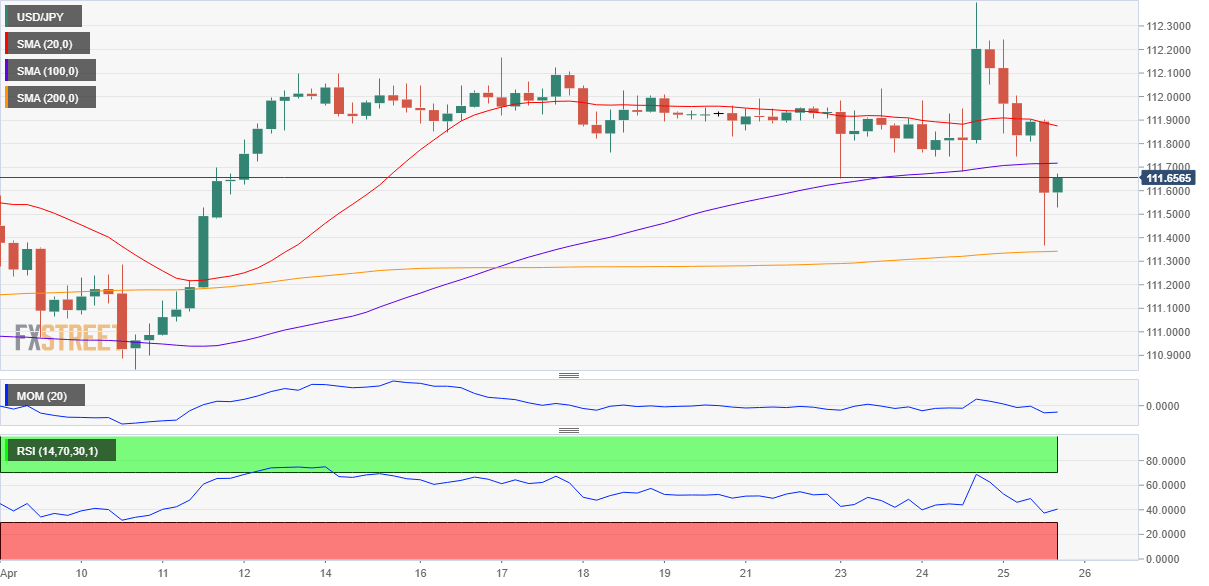
The USD/JPY pair retreated from the yearly high posted late Wednesday at 112.39 to its lowest in 2 weeks at 111.36. The positive momentum of the pair faded early Asia despite dollar's prevalent strength, as equities and government bond yields remained depressed. The BOJ triggered Yen's demand amid its safe-haven condition, as the central bank Japan left its monetary policy unchanged as expected, but, for the first time, it put a time frame on its forward guidance. Governor Kuroda said that global economic uncertainties had drawn policymaker's attention, and therefore, "wanted to clarify that we will keep rates low for a very long time." Rates will be maintained at current levels at least until the spring of 2020, but the timeframe could be much longer than that if the economy weakens. The declined gained momentum with Wall Street, as US indexes plunged at the opening, leading to the test of the mentioned low. The following recovery in equities helped the pair bounce and settle at around 111.65.
Action is not over around the pair, as during the upcoming Asian session, Japan will release Tokyo April inflation, seen up by 0.8% YoY, March unemployment rate, expected to have ticked up to 2.4% from the previous 2.3%, preliminary Industrial Production, and Retail Trade, these last, seen declining.
From a technical point of view, the pair is poised to extend its decline after the failed attempt to break higher ended with it settling below the base of its latest range. In the 4 hours chart, the pair is now below its 20 and 100 SMA, while the 200 SMA offered an intraday dynamic support at around the daily low, still lacking directional strength and therefore relevance. Technical indicators maintain sharp downward slopes at their lowest in two weeks, also skewing the risk toward the downside.
Support levels: 112.00 111.60 111.25
Resistance levels: 112.40 112.85 113.10
Author

Valeria Bednarik
FXStreet
Valeria Bednarik was born and lives in Buenos Aires, Argentina. Her passion for math and numbers pushed her into studying economics in her younger years.