|

USD/CHF got rejected at 0.8317, and we see room for a third leg down

USD/CHF has seen a fresh drop from the 0.8317 area, where the previously broken channel support line acted as nice resistance. We think there is now a risk of deeper declines, and looking at the overall structure, it seems that a third leg down could be in the cards.

We are talking about wave C, which could start targeting lower prices near 0.8100 next week, where wave C could potentially be equal to wave A. On the 4-hour chart, the pair is already back near the 0.8207 support line.
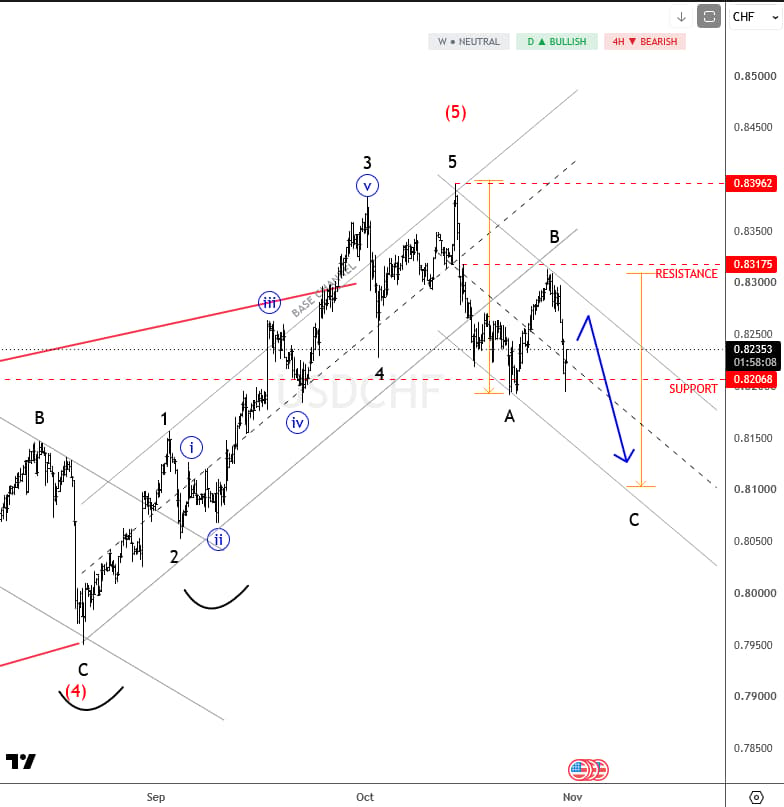
USDCHF 4-hour Elliott Wave chart, October 30, 2026

If we see any new recovery, the 0.8317 area would be important resistance to watch. For now, USD/CHF looks neutral or even bearish, especially if we get more evidence that a higher-degree leading diagonal has topped out. An important top would be confirmed if the market breaks well below 0.8110. Until then, we prefer to treat any bounce as a possible retest of resistance rather than the start of a new rally.

In the bigger picture, on a higher-degree chart, we see an ongoing triangle, with price now moving into the lower side of the range, where support sits near the 78.6% Fibonacci retracement around 0.7700.

Next week, the US jobs report on Friday, November 6, at 14:30 CET will be the key event for the dollar side of this pair, and it could easily speed up the move toward 0.8100 or cause a temporary pause along the way.


Get Full Access To Our Premium Elliott Wave Analysis For 14 Days. Click here.

Author

Gregor Horvat

Gregor Horvat

Wavetraders

Experience Grega is based in Slovenia and has been in the Forex market since 2003.

More from Gregor Horvat
Share:

Editor's Picks

AUD/USD edges higher as hot CPI inflation and hawkish RBA lift rate hike bets

The AUD/USD pair gathers strength to near 0.7035 during the Asian trading hours on Friday. The Australian Dollar edges higher against the US Dollar as hotter Australian CPI inflation data has bolstered expectations of Reserve Bank of Australia rate hikes.

Japanese Yen stays resilient after BoJ maintains status quo

The Japanese Yen stays resilient against its major rivals on Friday, with USD/JPY trading in negative territory below 157.50. The Bank of Japan (BoJ) decided to leave monetary policy settings unchanged at the October meeting, as expected. In the post-meeting press conference, BoJ Governor Ueda reiterated that they will continue to raise the policy rate and adjust the degree of monetary easing in reponse to economic activity and prices.

Gold bears retain control below $4,000 as hawkish Fed bets back further losses

Gold extends its intraday breakdown momentum below the $4,000 psychological mark through the early European session on Friday, eyeing the monthly swing low amid hawkish US Federal Reserve expectations. US macro data on Thursday pointed to resilient economic growth and persistent price pressures, solidifying bets of an imminent Fed rate hike in December. This is seen as undermining the non-yielding bullion for the second straight day and backing the case for further depreciation.

The hawkish Fed can't lift the US Dollar anymore
About three more Federal Reserve hikes are already priced in, and the central banks behind the Euro, Pound, Yen and Loonie are raising rates or about to. That leaves the US Dollar Index with little to gain if the Fed keeps leaning toward higher rates.
Binance hack shakes crypto, but XRP pullback may not be so bearish
Crypto markets were hit by a big headline overnight. Binance confirmed a security incident in which a compromised engineer's laptop led to unauthorized withdrawals, with an estimated impact of around $6.3 billion. About $3 billion has been frozen so far, Binance says it will cover the losses, and withdrawals were paused while security checks are completed.
A hot US economy is supposed to sink Gold. It didn't. Here's why
Gold (XAU/USD) remains under pressure near $4,000, as stronger-than-expected United States (US) economic data reinforce expectations of another Federal Reserve (Fed) interest rate hike in December. Economic growth is accelerating, inflation remains elevated, and borrowing costs could rise further.