The hawkish Fed can't lift the US Dollar anymore
About three more Federal Reserve hikes are already priced in, and the central banks behind the Euro, Pound, Yen and Loonie are raising rates or about to. That leaves the US Dollar Index with little to gain if the Fed keeps leaning toward higher rates.
The US Dollar Index (DXY) climbed more than 3% in the month after the Federal Reserve (Fed) raised rates on September 16, and it hasn't made a new high since October 14. It hit that high on the day US inflation came in at 3.7% and then gave the spike back, slipping after a Fed meeting where two officials voted for another hike, as traders already price in about three more hikes and most other central banks in the index are raising rates too. What moves the index from here is mostly European news, and the Euro makes up 57.6% of it.
The European Central Bank (ECB) kept its deposit rate at 2.5% on Thursday, with markets still expecting a December hike. ECB President Christine Lagarde told the Governing Council the same day that she will step down on February 7, 2027, almost nine months before her term ends.
Three hikes priced, and a Fed that won't hint at a fourth
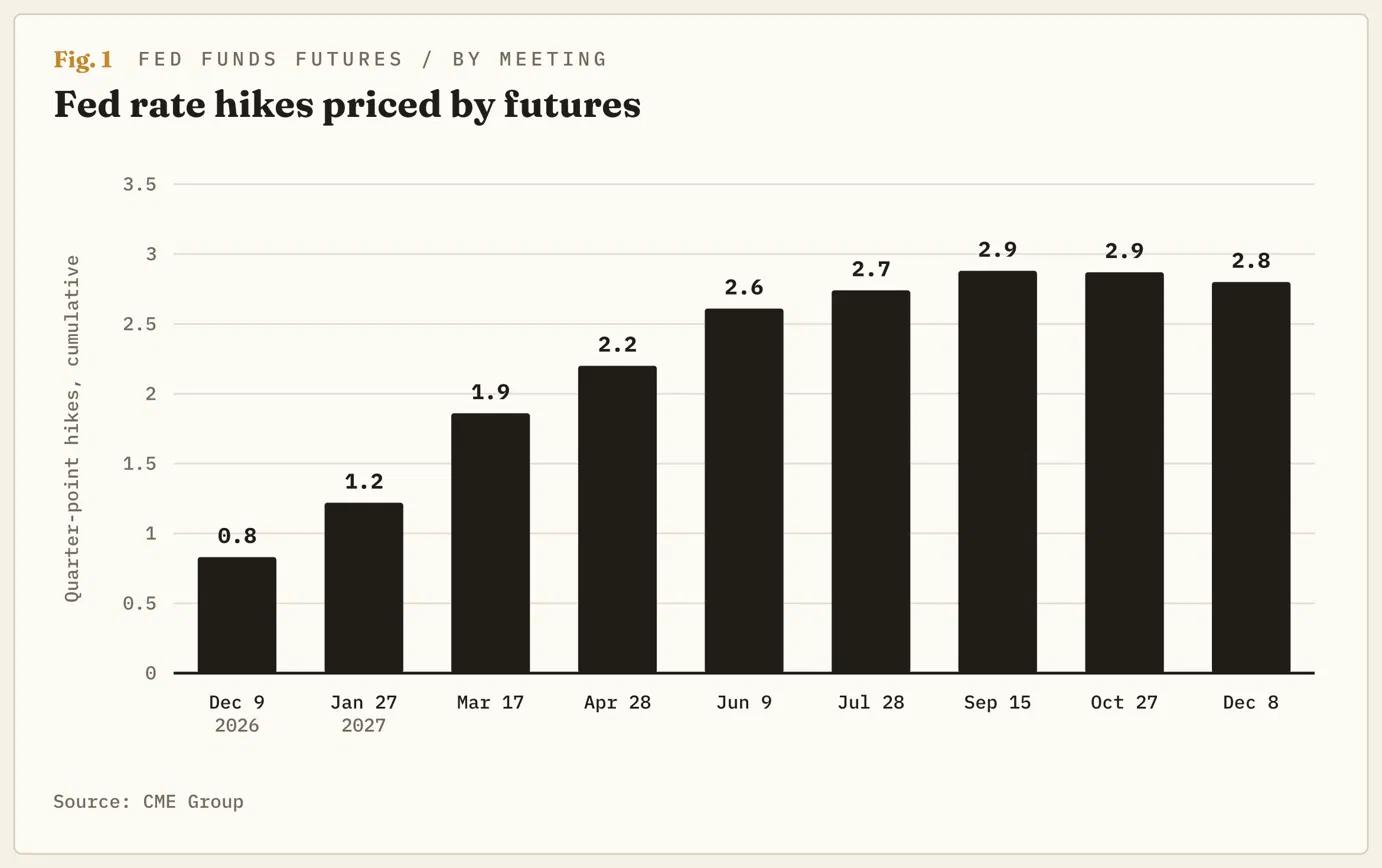
Futures prices, as read by the CME FedWatch tool, put the odds of a December 9 hike near 83%. Added up meeting by meeting, the odds come to about two more hikes by March 2027, two and a half by June and close to three by September. The single most likely rate by June is 4.50%-4.75%, three quarter-point hikes above the current 3.75%-4.00%.
For the Fed to lift the Dollar from here, it has to signal a fourth hike, and Fed Chair Warsh has made it a policy not to say what comes next. He repeated on Wednesday that he doesn't favour signalling the path of rates, so his press conferences can confirm what futures already price but can't add to it. Fed Governor Lisa Cook and Cleveland Fed President Beth Hammack voted for a hike, the most hawkish vote at the meeting, and the index fell during the press conference that followed.
The Fed also said on Wednesday that one of its eight 2027 meetings, in the autumn, won't include a rate decision, and that it expects six rate decisions in 2028 instead of eight. That's two fewer scheduled chances in 2028 to surprise anyone.
The other central banks are hiking or about to
The ECB's deposit rate is 2.5% after hikes in June and September. The Bank of England (BoE) is expected to raise its 3.75% rate on November 5, with about four hikes priced within a year. The Bank of Canada (BoC) raised its rate to 2.50% on Wednesday and said it may need to go further, and markets give the Bank of Japan (BoJ) roughly a three-in-four chance of hiking in December.
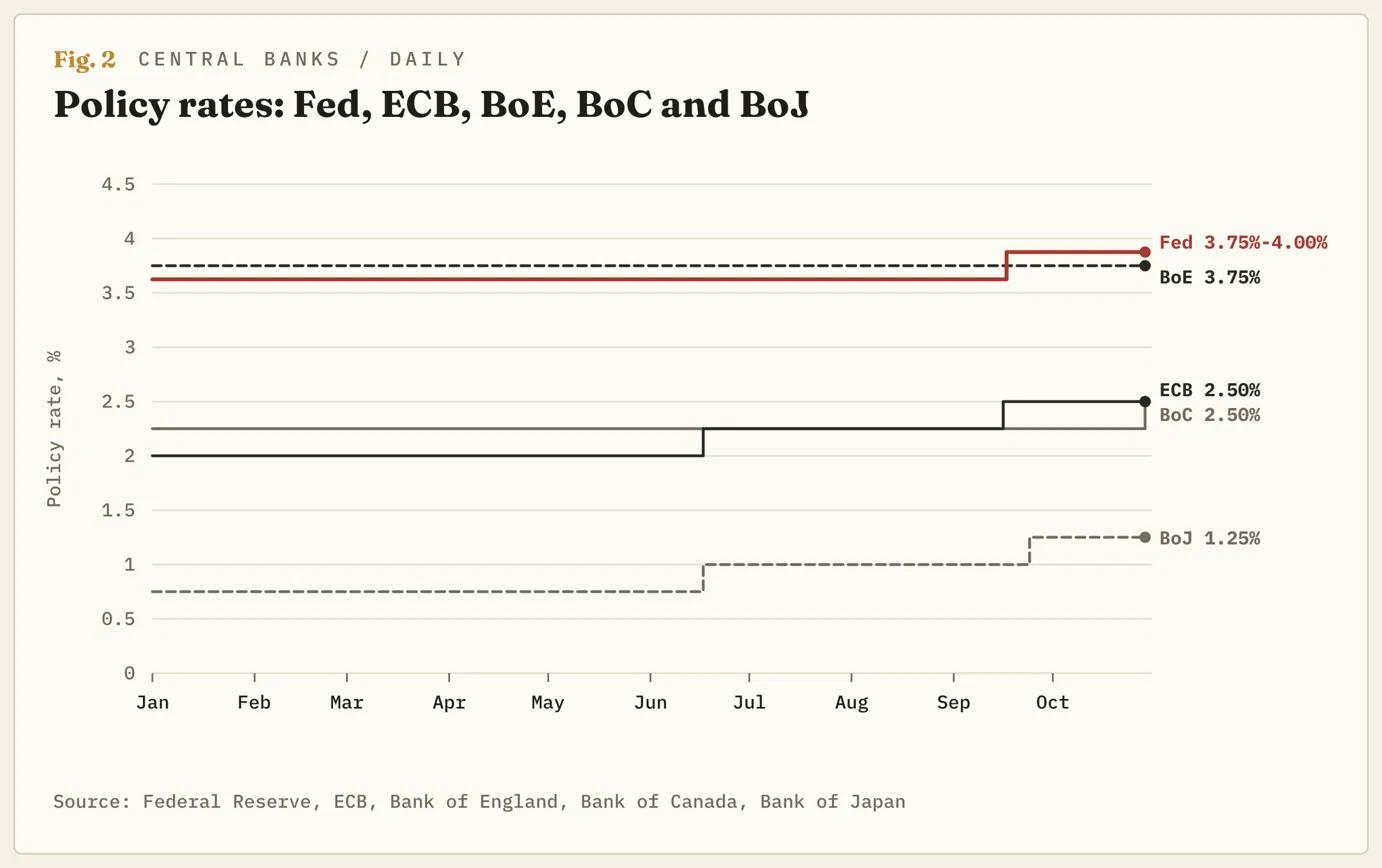
Those four currencies make up 92% of the Dollar Index, and their central banks are priced to raise rates about as fast as the Fed. The Fed is priced for close to three more hikes over the next year, and the BoE for about four. The gap between US rates and everyone else's is what pulls money into the Dollar, and it isn't priced to widen.
The index stopped short of 103.00 and hasn't been back
The index climbed for a month from near 99.00 in mid-September, the week the Fed raised rates, to just under 103.00 on October 14, the day the Consumer Price Index (CPI) showed US inflation at 3.7%. Its highest level since April 2025 lasted less than a session. The index has traded between 101.50 and 102.50 since, and its push into the Fed's decision stopped near 102.50, below the October 14 high.
The daily Stochastic Relative Strength Index (Stoch RSI), a momentum gauge, topped out in early October and is now at the bottom of its range, so the stall began well before Wednesday's decision. Both the 50-day and 200-day averages are rising and the index is still above them, so the longer trend hasn't turned. A daily close below 101.50, the October low, would turn the stall into a fall.
Yields are rising for reasons that don't help the Dollar
The 10-year Treasury yield reached 5.31% on October 5, its highest since 2002. Fed Governor Christopher Waller said in mid-October that US government debt has lost some of its standing as the world's safe asset, which he estimated could add half a point or more to yields. That's at least twice the size of the September hike.
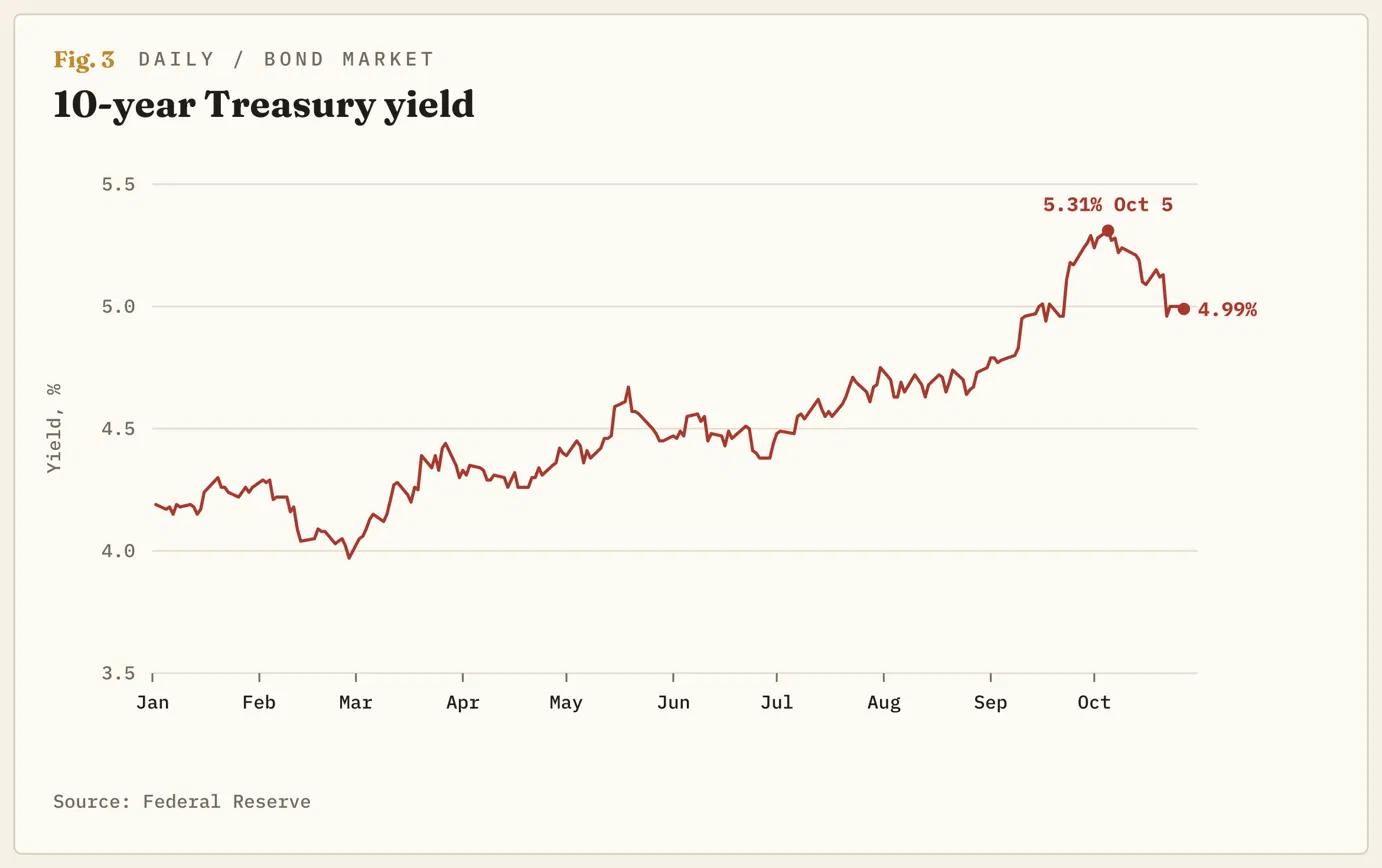
During Wednesday's press conference, two-year yields fell and 10-year yields rose. That pattern looks more like investors demanding extra pay to lend to Washington for ten years than traders betting on more Fed hikes. Higher yields help the Dollar when they come from Fed hikes that other central banks aren't matching, and they hurt it when investors want more to hold US debt. In the week to April 11, 2025, the 10-year yield rose almost half a point and the Fed's broad Dollar index fell 1.4%.
Levels for a Dollar the Fed can't push higher
Rallies into 102.50-103.00 are for selling rather than chasing, because the Fed can't add to what's priced without a fourth hike and the next big news for the index is on the Euro side. A daily close above 103.00, the October 14 high, invalidates the setup, and it probably needs US data hot enough to price in that fourth hike, or a shock to the Euro from French debt or the race to replace President Lagarde.
Below 101.50 on a daily close, the October range breaks and the 50-day average just above 101.00 comes into play, with the 200-day near 100.00 under it.
The dates that matter are November 5 for the BoE, November 10 for US inflation data, December 9 for the Fed and December for the ECB, and the Fed controls one of them.
Author

Joshua Gibson
FXStreet
Joshua joins the FXStreet team as an Economics and Finance double major from Vancouver Island University with twelve years' experience as an independent trader focusing on technical analysis.