USD/CAD Forecast: Symmetrical Triangle bullish breakout opens risk to 1.3630s, fundamentals apply (but so far marry-up)

This was the week: A resurgence in the greenback and a dovish turn from the BoC, oil prices losing the bid into the close
The attention was on the greenback and the BoC in the main. There has been a switch up in the markets which is compelling. Risk-off flows have benefitted the greenback, in part related to Brexit and Italian government risks, then USA trade policy risk and a pop in oil which was related to the USA’s Iran policy which had the FX roiled in recent sessions - benefitting the Loonie for a shortlived period - before the BoC stepped in and echoed all of what last week's Bank of Canada Business Outlook Survey had to say:
- The market interpretation that is was a negative report and rates markets rallied and the CAD moved sharply lower - (The BOS provided a crude reminder as to why the market is out of favour with the currency, fading rallies at this juncture). The Spring Business Outlook Survey showed that measures of capacity pressures, inflation expectations and capex intentions all moderated from the last survey.
While the greenback remains the cleanest of dirty shirts in the laundry basket and going by the following BoC outcome, the outlook for medium-term USD/CAD has not changed, and the pair is likely to trade between a range of 1.3100/1.4000 for the year - (Although the balance of risks implies that the pair will spend the majority of its time this year in a narrower 1.31-1.38 range).
Key CAD events:
All eyes were on the Bank of Canada that left the overnight rate unchanged at 1.75%. However, the tone of the communique was decidedly dovish where the outlook had softened since the January MPR. The key takeaways were:
- Trade tension staying a very prominent risk factor in the Bank's global assessment although the offset fell back on oil prices which have been rising steadily, contributing to that recent uptick in CPI inflation.
- However, the BoC still expects inflation to remain around 2% between 2020 and 2021.
- Also, the bank regards the employment growth picture as solid enough to support household spending.
- The Bank made key tweaks to their forward guidance, removing the reference to "the timing of future rate increases". Instead, the BoC guidance states that it "will continue to evaluate the appropriate degree of monetary policy accommodation as new data arrive". So the bank no longer has a hiking bias.
For the week ahead, Industry-level GDP (Feb) will be in view where a flat print would be owing to weakness in the goods-producing sector. Poloz is also slated to speak twice but will likely repeat, if commenting on MP, what we have heard from the BoC last week.
Key U.S. events:
There were three keenly watched events form the US economic calendar this week. Firstly, US initial jobless claims posted a sharp 37k surge, staying within levels consistent with a very strong labour market. Then, March US durable goods orders came in as the largest monthly gain since July 2018, rising 2.7%. Finally, the US GDP increased a stronger-than-expected 3.2% in Q1 which was above expectations for a 2% increase. The data is likely to argue against market pricing implying that the next move is more likely to be a cut than a hike from the Fed and should keep the greenback, and USD/CAD, underpinned.
The key events next week are starting on 1 May with the FOMC Rate Decision and the Funds Rate Target (upper) as well as the IOER Rate - We should expect that Powell will stress the Fed remains ready to adjust policy as needed, and are keeping all options open and in the light of better data this week, Powell should be able to tolerate a Q/A session fixated on a rate cut. Then, the next major event will be ISM manufacturing and nonfarm payrolls on the first Friday of the month. We have seen slightly less supportive regional surveys towards the ISM manufacturing data, so a softer outcome should come at no surprise while as for jobs, the manufacturing sector could weigh on the headline but the key unemployment number and wages data are what to watch in this report.
USD/CAD Technical Analysis
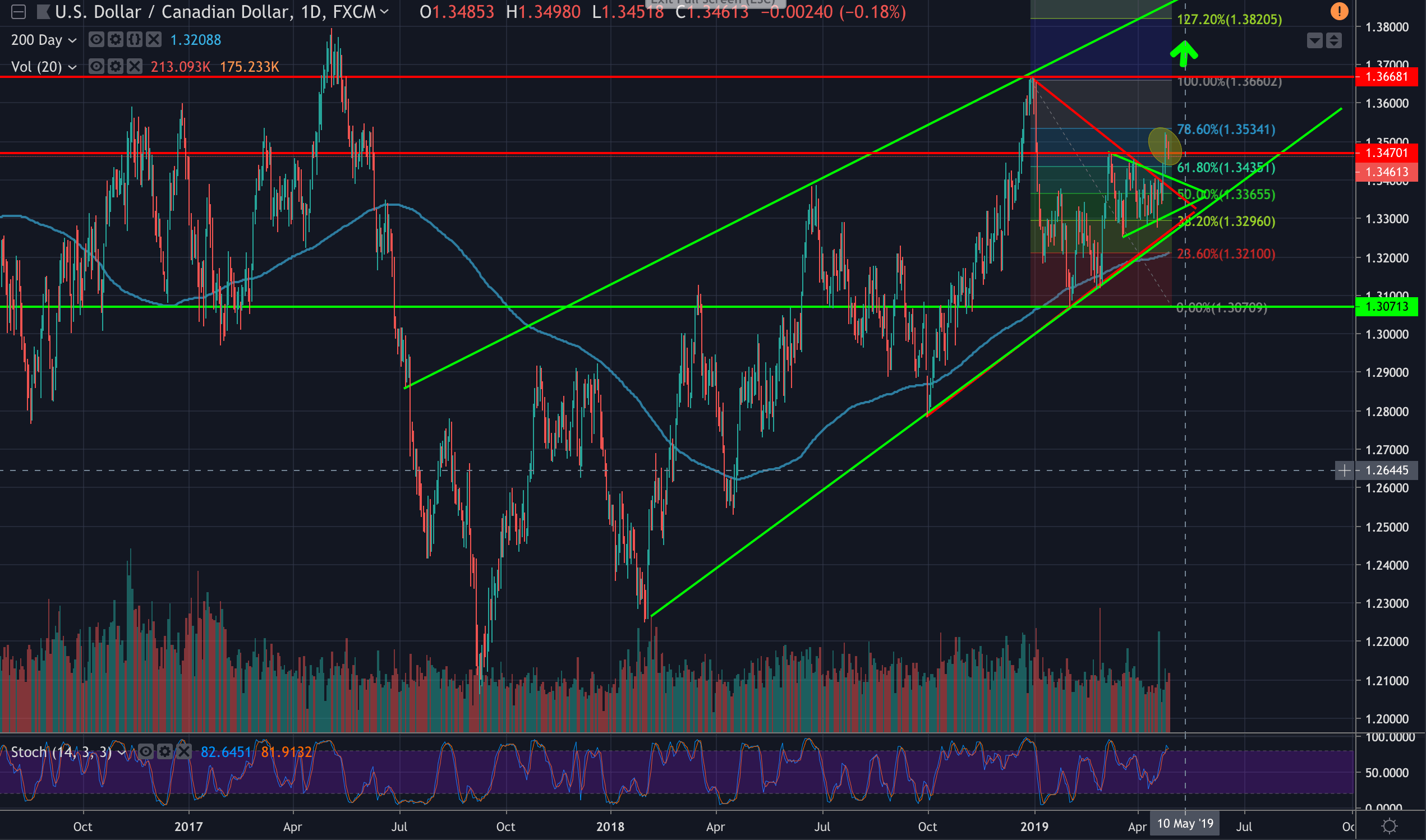
There is was no bias in the pair until either the 38.2% or the 61.8% Fibo gave out, and we have just seen a symmetrical triangle breakout to the upside, that took out the 61.8% Fibo and shot as high as 13 pips below the 78.6% Fibo of the same range. The rule of thumb applied to symmetrical triangle breakouts when looking for a target is equal price movement to the distance from the high and low of the earliest part of the pattern applied to the breakout price point. In this case, 220 pips applied to 1.3416 breakout point = 1.3636.
However, as with most forms of technical analysis, symmetrical triangle patterns work best in conjunction with other technical indicators. There needs to be more bullish volume sustained and with daily stochastics now in overbought conditions with that bearish bar and daily close below the key support line, eyes are on the 61.8% Fibo of which the bulls need to defend with conviction or risk the price running back into the triangle and testing the 50% Fibo and bulls commitments lower down.
However, it is also worth noting that the price and triangle is moving within a broader bullish channel of which the downside was recently exhausted and if price continues to abide by the rules, bulls should stay on course to test the top side of the ascending channel's resistance at the 127.20% Fibo extensions of the range located at 1.3820. On the flip side, however, a break below the 38.2% Fibo that will bring in the 23.6% Fibo and trendline support (and 200-D SMA) where a break out opens risk back to 1.3070 support and 1.2780 below there.
USD/CAD Sentiment
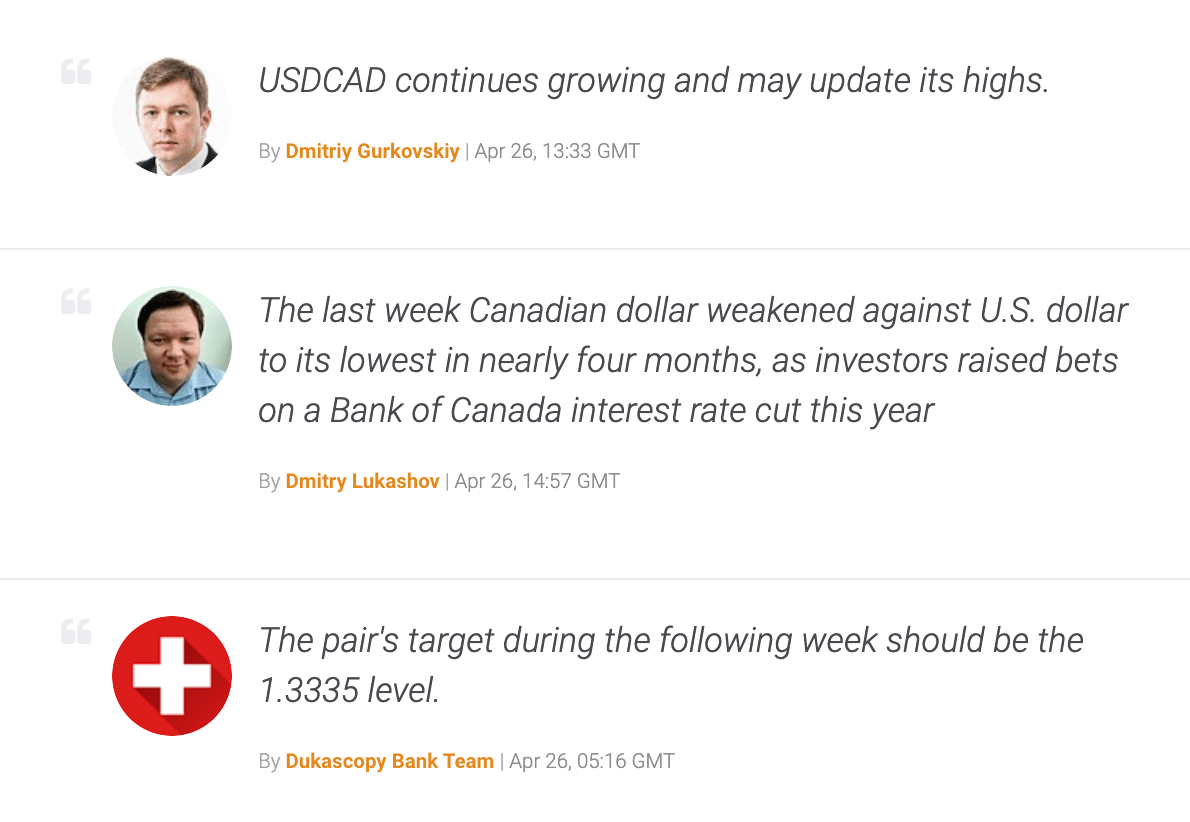
The FXStreet forex poll of experts is a sentiment tool that highlights near- and medium-term price expectations from leading market experts and it shows a bullish bias near term turning bearish over time.
Author

Ross J Burland
FXStreet
Ross J Burland, born in England, UK, is a sportsman at heart. He played Rugby and Judo for his county, Kent and the South East of England Rugby team.