US Dollar Weekly Forecast: Blocked tariffs, resilient Dollar
- The US Dollar rose markedly this week, flirting with four-week highs.
- Firmer-than-expected US data releases underpinned the upside bias.
- The FOMC Minutes unveiled a split Committee regarding the rate path.

The week that was
The US Dollar (USD) reversed its previous week’s decline, managing to stage a meaningful rebound and retesting the area just above the 98.00 barrier when tracked by the US Dollar Index (DXY).
In addition, a persistent move higher in US Treasury yields across various time frames accompanied the Greenback's firm performance.
Looking at the broader picture, the better sentiment surrounding the US Dollar has been underpinned by robust results from the US docket and a still pretty divided consensus regarding the potential rate path from the Federal Reserve (Fed), as shown in the latest Minutes.
Somewhat tempering the weekly uptick in the buck, the US Supreme Court ruled against President Donald Trump’s global tariffs on Friday, reigniting some uncertainty regarding what markets can expect from this in the short term.
Meanwhile, market participants expect the Fed to keep its Fed Funds Target Range (FFTR) unchanged at its March 18 gathering, pricing in nearly 63 basis points of easing this year.
No rush from the Fed as risks ease
The Fed did exactly what markets expected in late January, keeping its interest rates at 3.50% to 3.75%. The decision was uneventful, but the tone was subtly more confident. Policymakers sounded more comfortable with growth and dropped earlier concerns about rising labour market risks.
Chair Jerome Powell described policy as appropriate, pointing to a stable labour market and easing service inflation. He downplayed the recent uptick in headline inflation as largely tariff-driven and reiterated that decisions will remain meeting by meeting, with no preset path.
The Minutes reinforced that message. Almost all officials supported holding rates steady, with only a couple favouring a cut. Further easing is possible if inflation continues to fall, but the Committee is not signalling a one-way move. For now, the Fed remains patient, cautious and strongly data dependent.
Fed divide: Doves talk cuts, hawks hold the line
The latest round of Fed commentary reveals a familiar, but increasingly nuanced, split. Some officials are clearly adopting a dovish stance, leaving the possibility of several more cuts if inflation cooperates. Others are firmly in 'wait and see' mode, warning that price risks and labour market uncertainty argue for patience.
For FX markets, the balance between these camps matters. It shapes how aggressively investors price the next move and how much support the US Dollar can retain.
The dovish tilt
Austan Goolsbee (Chicago Fed, 2027 voter) stands out on the dovish side. He argued that several more rate cuts could be appropriate this year, provided inflation resumes its glide back toward 2%. While he acknowledged firm services prices beneath the latest CPI report, his broader framing suggests confidence that disinflation will reassert itself.
In market terms, that keeps alive the narrative of further easing in 2026, conditional but meaningful.
Mary Daly (San Francisco Fed, 2027 voter) also leans dovish, though in a more measured way. She stressed that inflation still needs to come down but described policy as modestly restrictive and broadly in the right place. With the labour market in better shape after last year’s cuts and tariff effects expected to fade, she implied there is no need for renewed tightening.
Her tone suggests comfort with the current stance and openness to easing if inflation continues to improve.
The hawkish caution
Michael Barr (Board of Governors, permanent voter) clearly leaned more to the hawkish side. He suggested another rate cut was possible in the future, but not immediately. For now, he is comfortable keeping rates where they are, arguing that inflation risks have not fully faded and that the Fed needs more time to read the data properly. His focus on tariff-driven price pressures underlines a simple point: the hurdle for fresh easing is not low.
Michelle Bowman (Vice Chair of Supervision, permanent voter) struck a different but equally cautious tone. Rather than focusing solely on inflation, she questioned the strength of the labour market, describing the latest job report as unusual and suggesting that the headline may not fully reflect the situation. She is not overtly hawkish about prices, but her scepticism adds another layer of uncertainty. If the labour market turns out to be softer beneath the surface, the Fed’s risk balance could shift. For now, though, her message is one of vigilance rather than urgency.
Bottom line
The doves remain open to further cuts, provided that inflation clearly resumes its downward trajectory. The more hawkish voices are anchoring the conversation around patience and risk management.
For the US Dollar, that balance matters. Softer inflation would embolden the doves and likely weigh on the Greenback. Sticky prices or upside surprises, on the other hand, would validate the hawks’ caution, push rate cuts further out and give the Dollar firmer support.
Softer CPI keeps cuts in play, just not yet
Inflation in the US cooled a little more than expected in the first month of the year. Indeed, the headline Consumer Price Index (CPI) slipped to 2.4% YoY in January, while core CPI, which excludes food and energy costs, eased to 2.5% over the same period. In simple terms, price pressures are still heading in the right direction, albeit still above the Fed’s target.
For markets, that was enough to keep the disinflation story intact and gently revive expectations of rate cuts further down the line. But from the Fed’s standpoint, the mission is not accomplished. Inflation is still above the 2% target, and the ultimate impact of US tariffs on consumer prices is far from clear.
So while investors may be tilting towards easing, policymakers are making it clear that caution still has the upper hand.
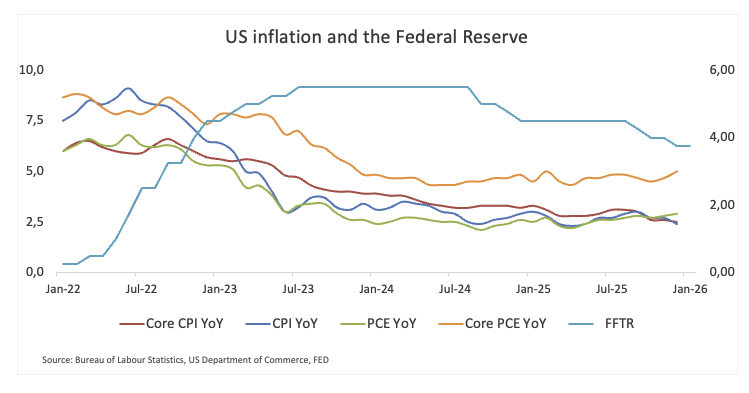
Of note, the latest Personal Consumer Expenditures (PCE) came in above estimates in December, with the headline print increasing 2.9% YoY and the core gauge edging higher to 3.0% from a year earlier. Given the performance of the CPI at the start of the year, we shouldn't rule out a similar trajectory for the January PCE reading.
Dollar shorts trimmed, but bearish bias lingers
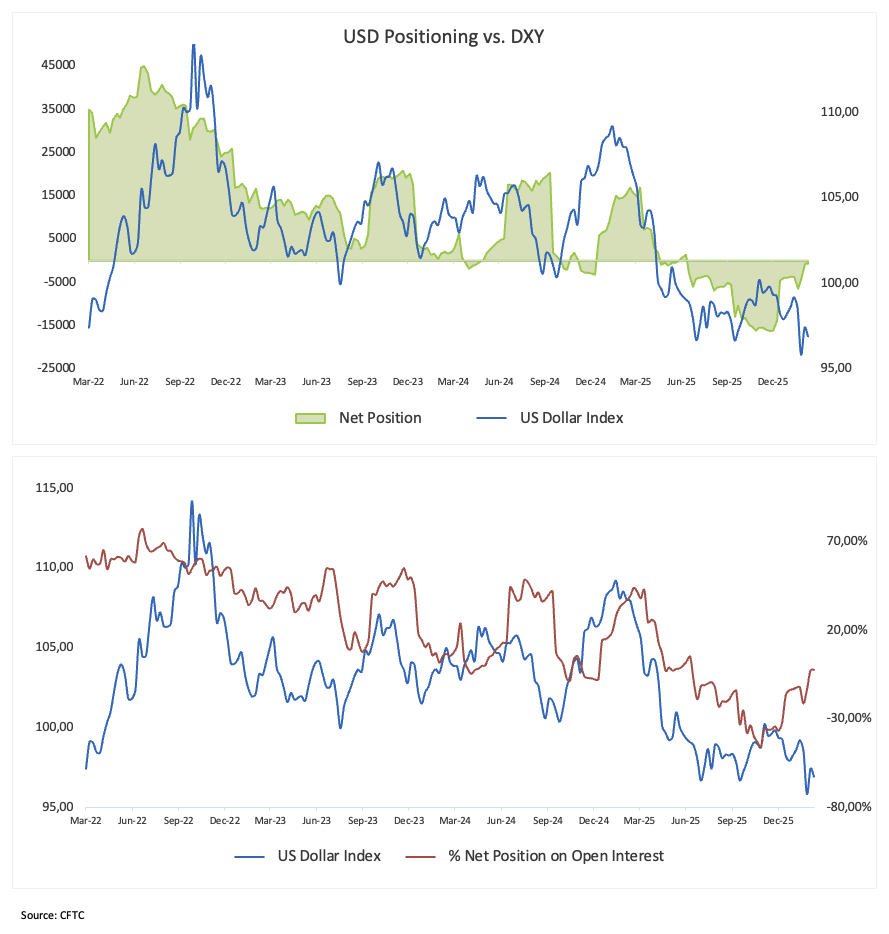
The latest Commodity Futures Trading Commission (CFTC) data tell a quieter but important story about the US Dollar. Non-commercial traders (speculators) have further reduced their net short positions, bringing them down to multi-month lows, around 730 contracts in the week to February 10. That said, the strong bearish consensus that took hold in the summer of 2025 is no longer as convincing.
What is just as telling is that open interest has fallen for a second straight week, slipping to roughly 27.8K contracts. That suggests this is not a sudden rush into fresh Dollar longs. It feels more like traders are tidying up, closing crowded short positions and stepping to the sidelines.
The mood, then, is less aggressively bearish and more cautious. The Dollar has already absorbed a lot of bad news, and its positioning no longer appears stretched or one-sided. That reduces the risk of another sharp sell-off driven purely by positioning.
From here, the Greenback probably needs a new trigger. Without a fresh catalyst, whether from inflation, the Fed, or the broader risk environment, it may struggle to find a clear direction.
What’s next for the US Dollar
Next week feels like one of those quieter stretches for US markets. The main item on the calendar is Producer Prices, which should give us a sense of whether inflation pressures are bubbling up behind the scenes before they reach consumers.
Aside from that, it will be the familiar parade of Fed speakers. In a light data week, even small tweaks in language can move expectations, so traders will be listening closely for any hints on inflation or the rate outlook. If the numbers do not surprise, it may be the Fed’s tone that ends up steering the buck.
Technical landscape
The US Dollar Index (DXY) seems to have met an important resistance zone around the 98.00 region, an area coincident with monthly peaks.
Once the index breaks above this zone, it could attempt a test of the critical 200-day SMA at 98.42, just ahead of the provisional 100-day SMA at 98.59. North from here emerges the 2026 ceiling at 99.49 (January 15), all preceding the psychological 100.00 hurdle.
On the other hand, the breach below the February base at 96.49 (February 11) could pave the way for a move toward the 2026 bottom at 95.56 (January 27), ahead of the February 2022 valley at 95.13 and the 2022 floor at 94.62 (January 14).
Furthermore, momentum indicators seem to favour further recovery: the Relative Strength Index (RSI) climbs past the 54 level, while the Average Directional Index (ADX), above 23, suggests a still firm trend.
-1771610776219-1771610776219.png)
All in all
It is worth keeping in mind that a good chunk of the Dollar’s rebound in late January and early February was not random. It was driven by the data and by the Fed narrative. The move gained extra traction after President Trump named Kevin Warsh as Jerome Powell’s successor, a choice that markets read as potentially less dovish than some had feared.
Now the spotlight shifts back where it usually belongs, on the numbers. Investors will be glued to the US calendar, especially inflation and labour market reports. For the Fed, jobs are still the key pulse check for the economy. Officials are watching closely for any meaningful slowdown, but they are also very aware that inflation is not yet comfortably back at 2%.
Price pressures remain a little too high for comfort. If the disinflation trend starts to lose momentum, markets could quickly dial back expectations for early or aggressive rate cuts. In that case, the Fed would likely double down on patience, and that more cautious tone could gradually offer the Dollar fresh support, politics aside.
Inflation FAQs
Inflation measures the rise in the price of a representative basket of goods and services. Headline inflation is usually expressed as a percentage change on a month-on-month (MoM) and year-on-year (YoY) basis. Core inflation excludes more volatile elements such as food and fuel which can fluctuate because of geopolitical and seasonal factors. Core inflation is the figure economists focus on and is the level targeted by central banks, which are mandated to keep inflation at a manageable level, usually around 2%.
The Consumer Price Index (CPI) measures the change in prices of a basket of goods and services over a period of time. It is usually expressed as a percentage change on a month-on-month (MoM) and year-on-year (YoY) basis. Core CPI is the figure targeted by central banks as it excludes volatile food and fuel inputs. When Core CPI rises above 2% it usually results in higher interest rates and vice versa when it falls below 2%. Since higher interest rates are positive for a currency, higher inflation usually results in a stronger currency. The opposite is true when inflation falls.
Although it may seem counter-intuitive, high inflation in a country pushes up the value of its currency and vice versa for lower inflation. This is because the central bank will normally raise interest rates to combat the higher inflation, which attract more global capital inflows from investors looking for a lucrative place to park their money.
Formerly, Gold was the asset investors turned to in times of high inflation because it preserved its value, and whilst investors will often still buy Gold for its safe-haven properties in times of extreme market turmoil, this is not the case most of the time. This is because when inflation is high, central banks will put up interest rates to combat it. Higher interest rates are negative for Gold because they increase the opportunity-cost of holding Gold vis-a-vis an interest-bearing asset or placing the money in a cash deposit account. On the flipside, lower inflation tends to be positive for Gold as it brings interest rates down, making the bright metal a more viable investment alternative.
Author

Pablo Piovano
FXStreet
Born and bred in Argentina, Pablo has been carrying on with his passion for FX markets and trading since his first college years.

















