US Retail Sales Preview: Consumer confidence equals sales
- Retail sales expected to slip but remain positive in August
- Decline to come after strong June and July numbers
- Wages and jobs continue to back spending

The US Census Bureau will issue its advance report on Monthly Sales for Retail and Food Services for August on Friday September 13th at 12:30 GMT, 8:30 EDT.
Forecast
Retail sales are projected to rise 0.2% in August following July’s 0.7% increase. Sales minus automobiles are expected to add 0.1% after the prior increase of 1.0%. The control group, sales minus building materials, motor vehicles and parts and gasoline and food service spending, which is the personal consumption expenditure of the GDP calculation from the Bureau of Economic Analysis, is forecast to climb 0.3% after July’s 1.0%
Retail Sales, GDP and the Labor Market
Retail sales have been supported for most of the year by the income gains generated by the tight job market.
Annual wage increases have been at 3.0% or better for 13 months, the best stretch in a decade. Headline PCE inflation averaged 1.642% for the 12 months from August 2018 to July 2019 (August’s PCE figures will be released on September 27th).

Reuters
The sharp divergence that began last July between wages and inflation has given US consumers increased disposable income and they are spending. For the past five months sales have topped the consensus estimates in four. In two March and June the forecast was more than doubled, in one July it was more than tripled.
The US economy expanded at a 3.1% rate in the first quarter but shifted down to 2.0% in the second. That lower pace is continuing in the current period with the Atlanta Fed GDPNow estimate at 1.9% as of September 11th.
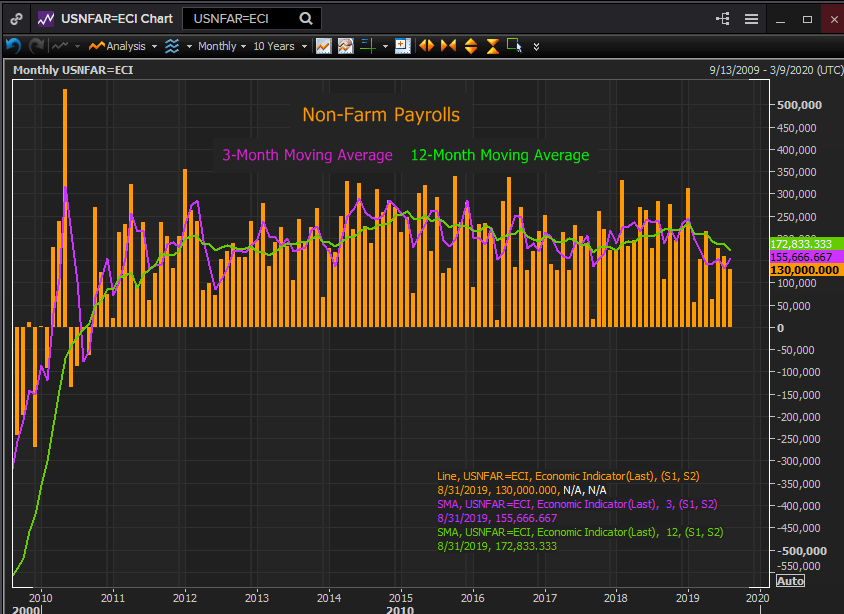
Job creation has slowed along with the economy. The 3-month and 12-month moving averages for non-farm payrolls peaked in January at 245,000 and 235,000 respectively. In August they were 155,700 and 172,800.
Reuters
Nevertheless, the continuing new employment combined with the large backlog of unfilled positions from the two year surge in hiring have resulted in widespread labor shortages and maintained the upward pressure on wages.
Employment has also spread to farther reaches of the population with record low unemployment for Blacks and Hispanics. The labor force participation rate rose to 63.2 in July matching the best rate in six years.
Consumer Sentiment
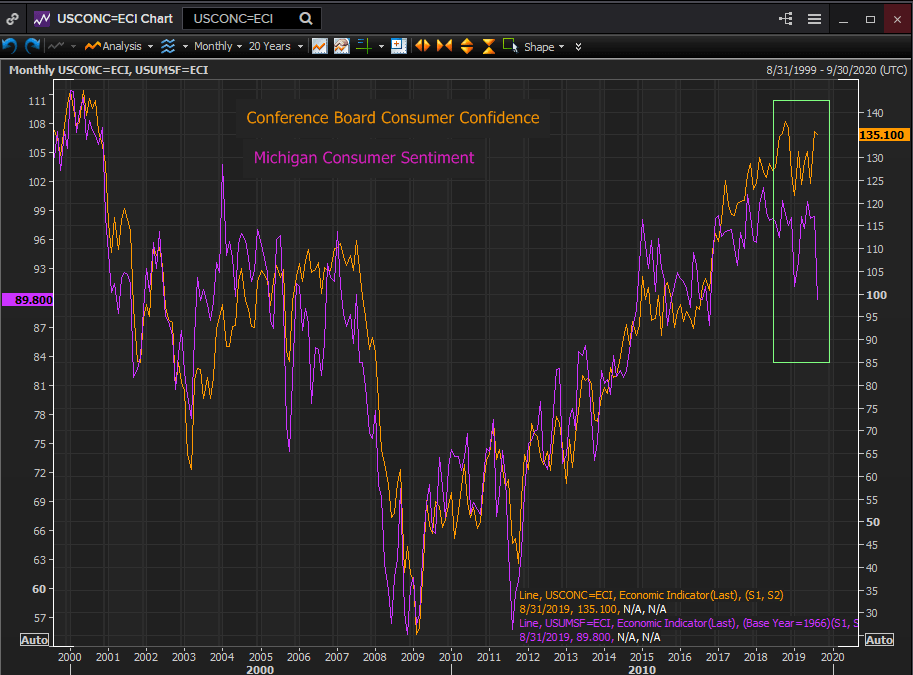
The two main surveys which chart the attitude of the American consumers have an unusual split in August.
The Michigan Consumer Sentiment Survey shows a sharp drop in outlook to 89.9, a three year low while the Conference Board Consumer Confidence poll has attitudes at 135.1, not far from last October’s almost two decade high of 137.9. Given the still exemplary labor market and the robust spending over the past five months it seem unlikely that consumer sentiment suddenly collapsed in August.
Reuters
Conclusion
The basics of the consumer economy are still excellent. Jobs, wages and inflation are aligned as they have rarely been in a generation.
This does not mean that issues from the China trade war to the partisan political bickering in Washington are unimportant to consumers. It is that when household spending decision are made it is the bottom line that matters most. Retail sales may slip in August after five strong months, but, like consumer sentiment, it is unlikely they retreated very far.
Author

Joseph Trevisani
FXStreet
Joseph Trevisani began his thirty-year career in the financial markets at Credit Suisse in New York and Singapore where he worked for 12 years as an interbank currency trader and trading desk manager.















