US Initial Jobless Claims Preview: Losing the prediction panache
- Jobless claims predicted to slip to 860,000 from 898,000.
- Continuing claims expected to dip to 9.5 million from 10.018 million.
- Markets unlikely to heed economic developments awaiting Thursday's presidential debate.

The achingly slow decline in unemployment requests is forecast to resume after unexpectedly rising to their highest level in seven weeks. Continuing claims are expected to drop below 10 million for the first time since the first week of April.
Initial jobless claims are predicted to drop to 860,000 in the week of October 16 following a jump to 898,000 in the prior week. Continuing claims are projected to fall to 9.5 million in the week of October 9 from 10.018 million, which would be the lowest total since the claims began their historic rise in late March.
Initial Jobless Claims
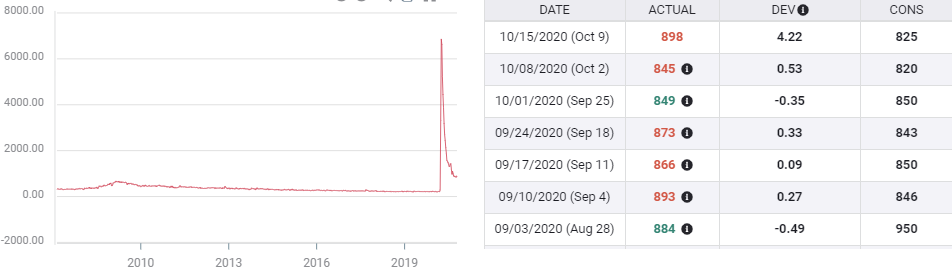
Initial claims and the economy
Unemployment claims have lost their pandemic prediction panache. Gone are the weeks of April and May when markets would wait breathlessly on the 8:30 am release for the latest on the sinking depths of the US economy.
Even though the exceedingly slow improvement and occasional reversals in claims have been the major disappointment of the recovery, they have not altered the general view that the economy is getting better. Nor have they lit the crisis beacons for a new stimulus package from Congress where discussion remains mired in election politics.
The recovery has been running since May's surprise return of job growth and a bit more than half the furloughed workers from March and April have returned to work. The unemployment rate has continued its precipitous decline, from 13.3% in May to 7.9% in September, beating forecasts for five straight months.
Retail Sales and Consumer Sentiment
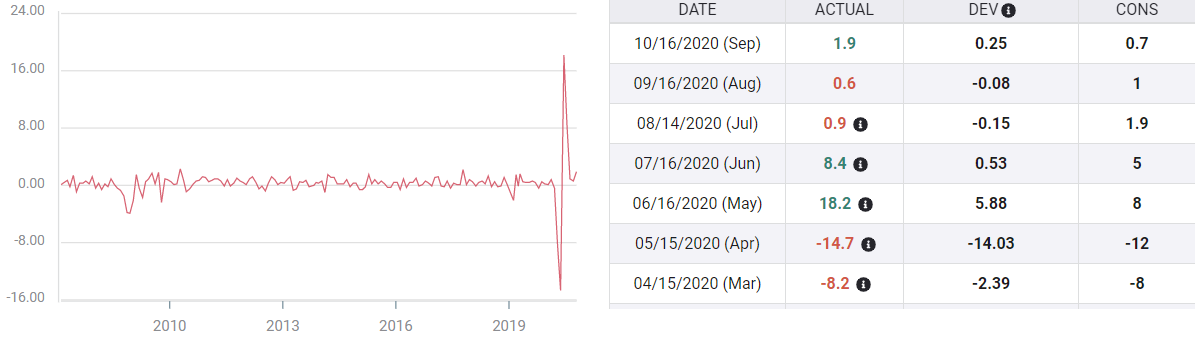
September's sales figures were much stronger than forecasts in all three categories. Overall sales rose 1.9%, nearly triple the 0.7% forecast and exactly so the August 0.6% gain. The GDP component Control Group jumped 1.4%, far more than the 0.2% consensus forecast and the revised -0.3% August result. Finally, Sales ex-Autos rose1.5%, thrice the 0.5% prediction and the identical August score.
Retail Sales
As is not surprising considering such such positive retail numbers, US consumers were happier than anticipated in October. The preliminary reading from the Michigan Survey reached 81.2 from 80.4 in September . The forecast from the Reuters Survey was 80.5
Conclusion and markets
Claims are important numbers for gauging the quality of the US economic economic recovery. With nearly one million people still being laid off each week more than seven months after the initial employment shock, the labor market remains a source of deep concern.
For markets however, the slow decrease and fitful jumps in claims are background, they have lost the ability to surprise or to convey pertinent information. There will be no market response.
All eyes will be on Thursday evening's election confrontation in Nashville, Tennessee.
Author

Joseph Trevisani
FXStreet
Joseph Trevisani began his thirty-year career in the financial markets at Credit Suisse in New York and Singapore where he worked for 12 years as an interbank currency trader and trading desk manager.