US ADP Employment Change December Preview: Labor market expansion is steady
- Private payrolls expected to revert to trend in December.
- Two weak months, September and November have not carried through to NFP.
- Labor market growth remains a bulwark of the US economy.

Automatic Data Processing (ADP) the US private payroll processing company will release its National Employment Report for December on Wednesday January 8th at 13:15 GMT, 8:15 EDT
Forecast
Payrolls for ADP’s clients are predicted to have added 160,000 new workers in December after November’s gain of 67,000 and October’s rise of 121,000.
ADP and NFP: Indicator and source
The ADP payroll is most important precursor to the Employment Situation Report from the Bureau of Labor Statistics (BLS) the best known and most followed US economic statistic, commonly called non-farm payrolls or NFP for its central job figures.
The BLS report tabulates monthly figures on job creation, unemployment, wages, average work week, labor participation rates and other topics.
The ADP lists payroll changes for its corporate clients and is issued on the Wednesday before the BLS report which is usually on the first Friday of the month.
Labor Market Trends: NFP and ADP
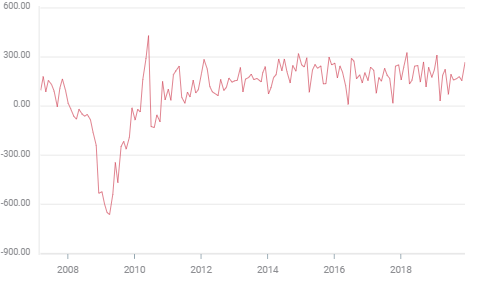
The pace of US job creation slackened last year. Non-farm payrolls dropped 22%, from 235,000 in the 12-month moving average in January to 184,000 in November. Figures from ADP fell 28% from 222,000 in April to 160,000 in November and were dragged down by three months that were well below trend, May at 46,000, June at 107,000 and November at 67,000. Only in May was there corresponding weakness in NFP at 62,000, June recorded 178,000 and November saw 266,000.
ADP Payrolls
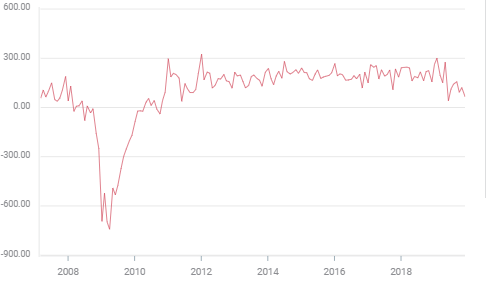
Poor ADP numbers in May and June which averaged 77,000 coupled with the NFP average for those months of 120,000 along with the declining trend probably helped to convince the Federal Reserve that the US economy needed support from the then very active threats of the China trade dispute and Brexit. The FOMC began their three 0.75% insurance policy one month later in July.
The US labor market needs between 125,000 and 150,000 new positions each month to provide work for entrants to the work force from population growth and immigration.
NFP
Labor Market Factors: Purchasing managers’ indexes
Purchasing mangers’ indexes (PMI) in manufacturing and services have been falling since late 2018. The recurring reason given by the executives surveyed by the Institute for Supply Management was the actual and feared impact of the US-China trade war.
Overall PMI in services has fallen from 60.8 in September 2018 and 59.7 last February to 52.6 in September. It has since rebounded to 55.0 in December. The employment index dropped from 60.4 in September 2018 and 58.1 this past May to 50.4 in September and has recovered to 55.2 in December.
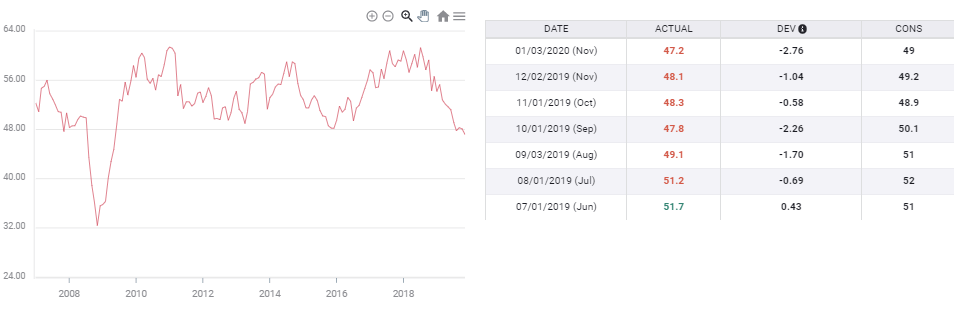
Manufacturing sentiment has declined from 60.8 in August 2018 and 56.6 in January last year to 47.2 in December. It has been below the 50 contraction mark for five straight months. December’s expected bounce from 48.1 to 49.0 did not materialize. The employment index crested last year at 57.5 in March dropped below 50 in August at 47.4 and has continued lower to 45.1 in December which is the lowest since January 2016.
Manufacturing PMI
FXStreet
Three factors are notable about the decline in business sentiment and the performance of the labor market. The first is that even though business executives have said that they are increasingly concerned about the future, their hiring decision have reflected US economic growth of 2.4% and a tight labor market. They are responding to actual demand and not their own concerns.
Second is if job creation of 150,000 a month is necessary for work force expansion, the US economy has throughout the past year found more jobs than workers. The five decade low unemployment rate of 3.5% is evidence.
Finally the US-China trade dispute has been mitigated with the deal set for signature in Washington on January 15, but positive effects are likely still a few months away.
Conclusion
Job creation in the US economy has fallen from its exceptionally high levels of 2018 but gives no indication of having run its course.
Even the manufacturing sector, whose overall and employment indexes have been in contraction for five months through December has created jobs throughout 2019. The 12-month moving average dropped from 22,000 in January to 11,000 in September, 4,100 in October and 6,000 in November. Factories are forecast to add 5,000 job in December.
Private sector payrolls from the NFP report have a similar profile. The 12-month the average peaked at 224,000 in January, had fallen to 166,000 by October and bounced to 170,000 after November’s 254,000 figure.
Coincident labor markets statistics also give no indication labor market stresses.
The 4-week moving average for initial jobless claims has risen about 20,000 since the end of the third quarter, from 213,000 in late September to 233,000 in the final week of the year. This gain however comes from lows not seen in 50 years and at the current level, which is the highest for the average since early 2018, the average remains below all rates from January 2018 to April 1973. Over the past five years the rate has moved higher in like fashion five times without signaling a shift in the job market.
Wages and compensation are near the best levels in a decade, notice that employers must offer good wages to secure scarce employees.
Federal Reserve Chairman Jerome Powell cited the desire to keep the labor market healthy as one of the motivations for the bank’s three summer and fall rate cuts. November’s excellent NFP may be proof that the Fed’s fears were misplaced or that its rate policy provided extra juice for the economy. Either way the governors will watch the ADP and NFP results carefully.
Likewise for currency traders the two jobs numbers are often a signal for immediate dollar direction
Author

Joseph Trevisani
FXStreet
Joseph Trevisani began his thirty-year career in the financial markets at Credit Suisse in New York and Singapore where he worked for 12 years as an interbank currency trader and trading desk manager.
















