Trump embarrasses himself every day
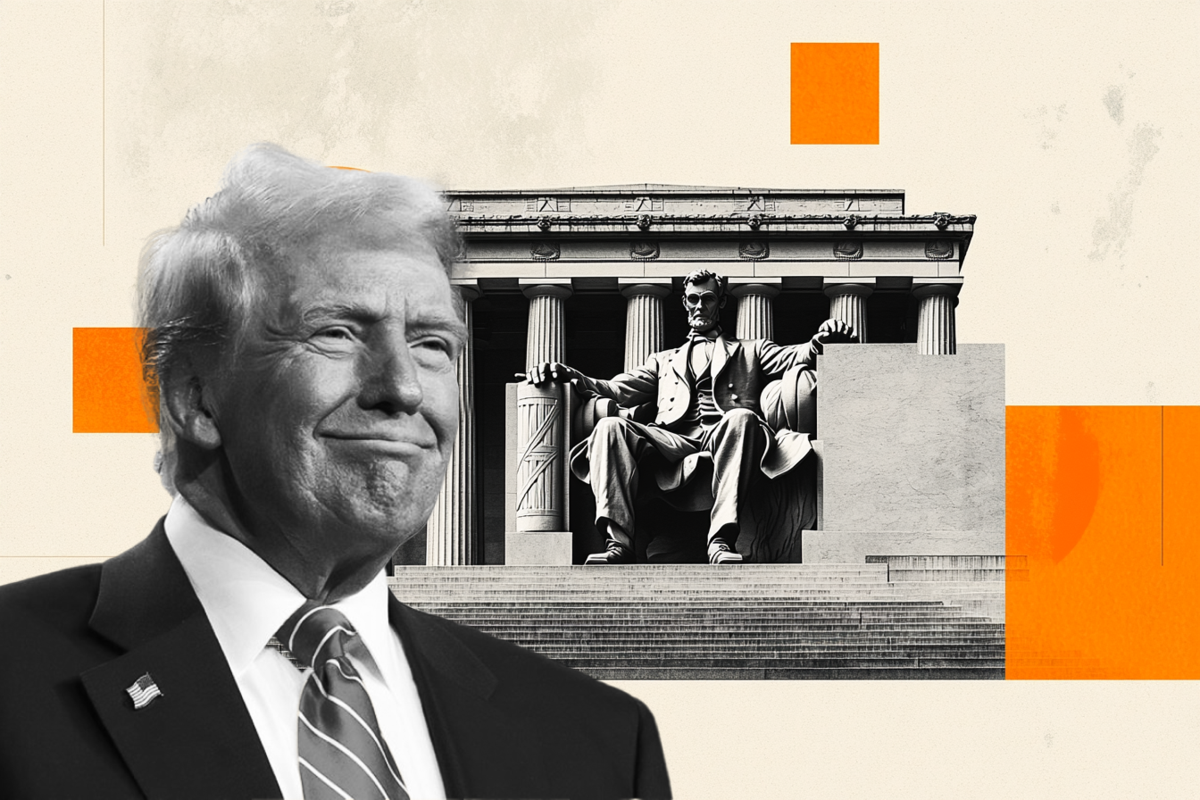

As the first 100 days of Trump in office comes closer (next Wednesday), the pundits are starting to deliver the verdict—total fail. The number of blunders is astonishing—one cut after another having to be pulled back because it was an “error.” One court case after another going against the Trump quest for autocracy. Street protests not withering away but increasing, and in all 50 states. Musk being driven out of government. Every poll showing the public does not favor anything Trump thinks he is doing (except stopping border crossings, if with cruelty).
The verdict: incompetence. This has long been our word but now it has reached the general public. Those six bankruptcies were not a tax gimmick.
Financial analysis should not contain a lot of political stuff and in decades past, analysts could safely ignore nearly everything political. Even the Republicans shutting down the government periodically got brushed off. This time it’s different. Data matters very little and the top factor is a single guy, forming a pseudo-macro factor.
Trump embarrasses himself every day. He embarrassed himself by backing down from the threat to fire Powell. He embarrassed himself by hinting he was in talks with China when he’s not and China called him out on the lie. The sheer size of the tariffs on China is itself an embarrassment. Even more embarrassing is China refusing to talk until he gets rid of them all—a full repeal--and starts over. Most reports, even the WSJ, say out loud that China is betting Trump will back down. After all, it’s his modus operandi.
Two things: China is right. He will back down. But before then, he hates being embarrassed more than normal people because he is a narcissist. He is going to lash out again.
The chances of the lash-out being dollar-friendly are very, very low.
Now that Trump has lost Round One of the trade war with China, attention can turn back to the fiscal mess. Remember that Trump I increased the deficit more than any other president (and Clinton was the only one to reduce it). Take that, Tea Party. The fiscal situation is really bad and could get so much worse that it takes the place of the tariff war and Powell fumble as the factor that drives away foreign investors from the US, a capital flight process that has already begun.
In the past we have dismissed this idea because the alternatives are so few, the US economy has amazing resilience, and the US has the “extraordinary privilege” of being the issuer of the top reserve currency. These factors remain but are being watered down by Trump and he has been in office less than 100 days. The cumulative damage after a full four years could be horrendous.
Happily, Goldman’s Hatzius writes (see FT reference below) that “Dollar depreciation should not be confused with loss of the dollar’s status as the world’s dominant currency. Barring extreme shocks, we think the dollar’s advantages as a global medium of exchange and store of value are too entrenched for other currencies to overcome. We have had large exchange rate moves without loss of the dollar’s dominant status in the past, and our baseline expectation is that the current move will be no different.”
And let’s not blame the dollar for the nearly certain recession: “In any case, the most important determinant of whether the US enters a recession is not the dollar. A decision to implement additional ‘reciprocal’ tariffs following the current 90-day pause, an ongoing US-China trade war, or aggressive further goods-specific tariffs could make recession inevitable, no matter where the dollar goes.”
Plenty of essayists are travelling this road and we neglect them at our peril. But traders have a hard time being aggrieved and stressed about the long-term when their job and mindset is far more short-term. Accordingly, it could be a while before the destruction of American exceptionalism becomes all too clear.
Forecast
The very, very good Jan Hatzius says in the FT the dollar has further to fall. He is now the chief economist at Goldman and not to be dismissed. He admits that he, like most big bank economists, usually dodge commenting on the dollar. But this time is argument is compelling: “demand for US assets cannot keep up with supply without a weaker currency.”
Hatzius has logic on his side. It’s not only outright capital flight away from US assets, it’s the absence of inflow countervailing the rise in the fiscal deficit.
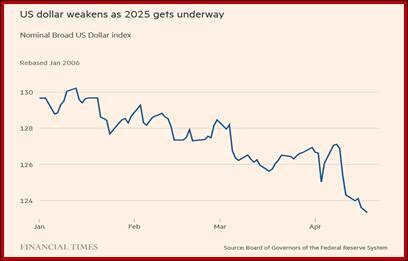
The likelihood of a Trump temper-tantrum is always with us. Because he is incompetent and reckless, the outcome cannot be dollar-friendly.
Tidbit: Stagflation is at the door and knocking. Remember those stories about the Port of Los Angeles during the pandemic? They’re back. Krugman posted this chart today. No source named but Krugman is to be trusted.
Krugman also notes the Beige Book is one story after another of production and planning in a nosedive due to uncertainty. The Beige Book is anecdotal but to be trusted.
-638810956561543816.jpg)
This is an excerpt from “The Rockefeller Morning Briefing,” which is far larger (about 10 pages). The Briefing has been published every day for over 25 years and represents experienced analysis and insight. The report offers deep background and is not intended to guide FX trading. Rockefeller produces other reports (in spot and futures) for trading purposes.
To get a two-week trial of the full reports plus traders advice for only $3.95. Click here!
This is an excerpt from “The Rockefeller Morning Briefing,” which is far larger (about 10 pages). The Briefing has been published every day for over 25 years and represents experienced analysis and insight. The report offers deep background and is not intended to guide FX trading. Rockefeller produces other reports (in spot and futures) for trading purposes.
To get a two-week trial of the full reports plus traders advice for only $3.95. Click here!
Author
Barbara Rockefeller
Rockefeller Treasury Services, Inc.
Experience Before founding Rockefeller Treasury, Barbara worked at Citibank and other banks as a risk manager, new product developer (Cititrend), FX trader, advisor and loan officer. Miss Rockefeller is engaged to perform FX-relat