S&P 500 - Nasdaq 100 – 1st Wave Of Ending-Diagonal!


Two Different Corrective Patterns – Same Message!
The April 2nd/April 4th lows ended expanding flat corrective patterns that began from the February 27th highs – these lows formed at 2552.00 for the S&P 500 futures contract and at 6306.75 for the Nasdaq 100 futures and labelled as ending sub-minuette wave (b) within February’s larger degree zig zag upswing – see fig #1. Following advances begin wave (c) which itself must develop higher whilst unfolding into a five wave impulse pattern, extending above the Feb. 27th highs of 2789.75 and 7009.00 respectively. So far, so good!
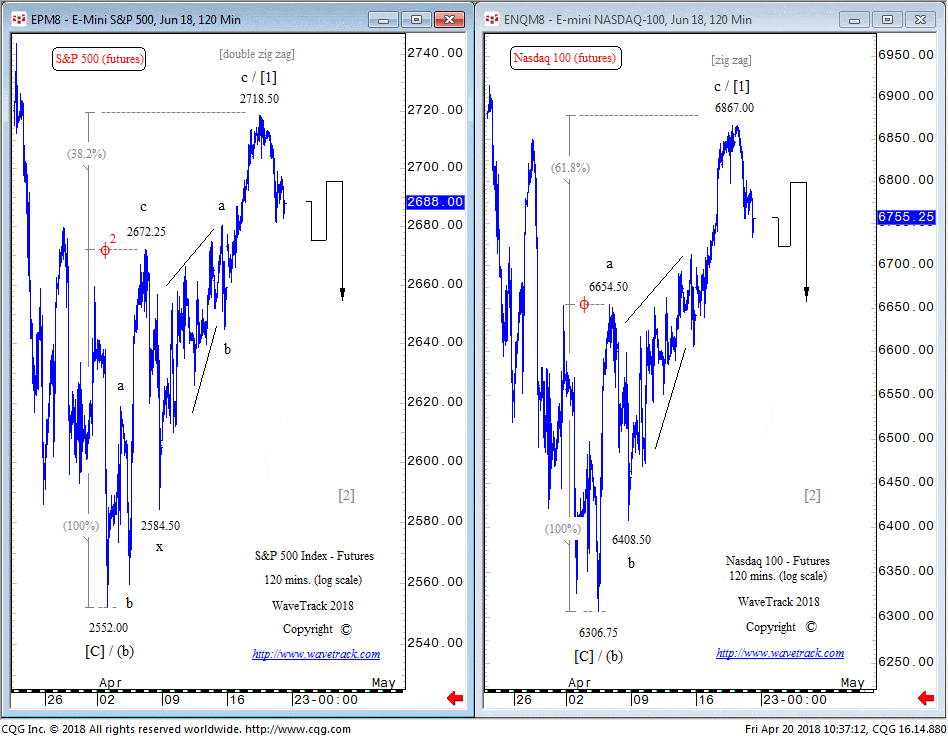
But taking a closer look at wave (c)’s upside progress from those April 2nd lows reveals two different corrective patterns ending into last Wednesday’s highs, a double zig zag for the S&P 500 (see left) and a single zig zag for the Nasdaq 100 (see right) – how can that be? Surely, the advance must unfold as a developing five wave impulse pattern, i.e. 1-2-3-4-5? Perhaps this is a series of 1-2’s, you know, a five wave ‘expanding-impulse’ pattern which begins 1-2-1-2 etc. then expands the price action with a 3rd-of-3rd wave surge to the upside. That could still happen. But if so, why have these indices dropped away from Wednesday’s highs? A 3rd-of-3rd wave should be propelling price action higher, not lower.
Furthermore, look at how these overlapping price-swings have adhered to fib-price-ratios that depict corrective sequences. For example, if the S&P has developed into a double zig zag, then extending the first from 2552.00 to 2672.25 by a fib. 38.2% ratio projects a terminal high for the secondary zig zag exactly into Wednesday’s high at 2718.50. Extending wave ‘a’ of the Nasdaq 100’s initial upswing from 6306.75 to 6654.50 by a fib. 61.8% ratio projects a terminal high for wave ‘c’ to 6878.75 – the actual high was 6867.00.
The Puzzle Solved
The only obvious answer to this rather intricate puzzle is that wave (c) is unfolding higher, not as an expanding-impulse pattern, but as a diagonal-impulse pattern, specifically, and ‘ending’ type diagonal. The wave labelling of the two impulse patterns remain the same, [1]-[2]-[3]-[4]-[5], but in an ending-diagonal, waves [1]-[3]-[5] have a tendency to subdivide into ‘threes’, zig zags or multiples, i.e. double zig zags or even triples. This explains why the advances have unfolded into a double zig zag and single zig zag for these two indices.
What Next?
Firstly, with wave [1] ending into last Wednesday’s highs, wave [2] is now underway as a corrective decline. Second wave retracements are usually sharp and steep affairs, so watch for a sudden sell-off over the next few trading days. But ultimately, wave [2] will end above the April 2nd / April 4th lows, then resume higher afterwards to begin wave [3].
Conclusion
We already know that market watchers are mystified over recent price-swings and can only stand aside with expectations of more volatility. But from an Elliott Wave perspective, we gain an intimate view of price-progression in a way no other financial system can operate – that’s because it is completely suited to non-linear dynamics, the DNA and the heartbeat of the markets’ character.
Subscribe and get the latest forecasts on Stocks, FX & Commodities – NOW!
Author
Peter Goodburn
WaveTrack International GmbH
WTI HISTORY