Gold Weekly Forecast: Focus shifts to US Payrolls and data
- Gold clinched its fourth consecutive week of gains, hitting record highs.
- Further upside impulse could spark bets on a test of $6,000 at any time soon.
- Fed rate cut bets and geopolitical tensions continued to support the uptrend.
Gold (XAU/USD) kept winning this week, and on Thursday it briefly reached new all-time highs just beyond the $5,600 mark per troy ounce. Since then, the yellow metal has entered a correction phase, as some traders took profits at the right time and the US Dollar (USD) rose sharply.
That said, two main factors have supported the larger rise in Gold. On a larger scale, markets have been pricing in the chance that the Federal Reserve (Fed) may slash interest rates again in the next several months.
At the same time, new geopolitical worries, this time focusing on the possibility of a US-Iran military conflict, have helped maintain demand for safe-haven Gold strong.
A test of the $6,000 mark appears on the horizon
It’s also worth remembering just how powerful this rally has been. Since 2024, Gold has only posted monthly declines in five instances, after almost four years of sideways movement. The metal is already up more than 16% this year and was closer to a near-30% gain when prices briefly hovered around record highs near $5,600 earlier this week.
Looking ahead, Gold’s constructive outlook continues to draw support from expectations that the Federal Reserve will deliver further interest rate cuts in the months ahead. US President Donald Trump's appointment of former Fed Chair Kevin Warsh to succeed Jerome Powell in May has reinforced this view.
However, a more dovish Fed chair does not guarantee aggressive rate cuts. Even so, the shift in leadership could nudge market expectations toward lower rates further down the road, a scenario that would likely pressure the US Dollar and keep the broader tone around Gold supportive.
What about sentiment?
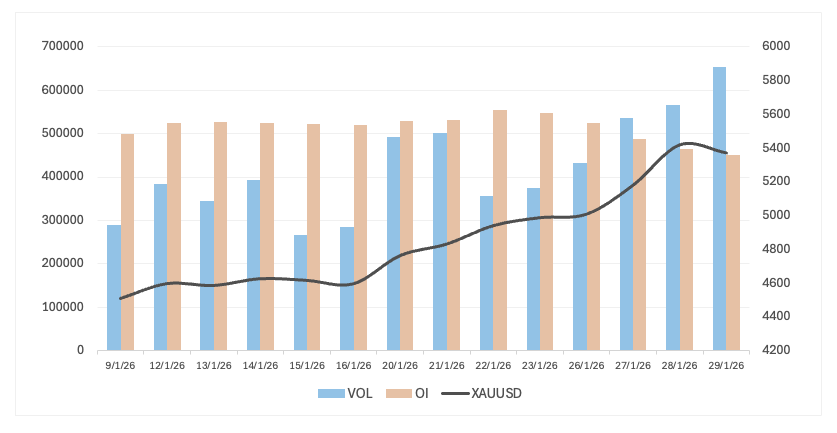
Gold prices have gone up a lot in the second half of January. Indeed, the yellow metal sped up near the mid-$5,400s before showing signs of being tired. The surge was accompanied by a notable rise in trading volume, which shows that many people were buying and selling as prices went up.
Open interest, on the other hand, has begun to roll over in the last sessions, even though prices are still high. This contrast shows that the current price rise is driven primarily by traders closing their positions and taking profits, not by new buyers coming in. If price momentum slows down, this might lead to a greater decline.
Gold technical outlook
A continuation of the rally could prompt Gold to challenge its all-time high at $5,598 (January 29), prior to the Fibonacci extension of the October 2025-January 2026 uptrend at $6,068.
On the downside, interim support emerges at the 55-day and 100-day SMAs at $4,438 and $4,218, respectively, prior to the December floor at $4,163 (December 2).
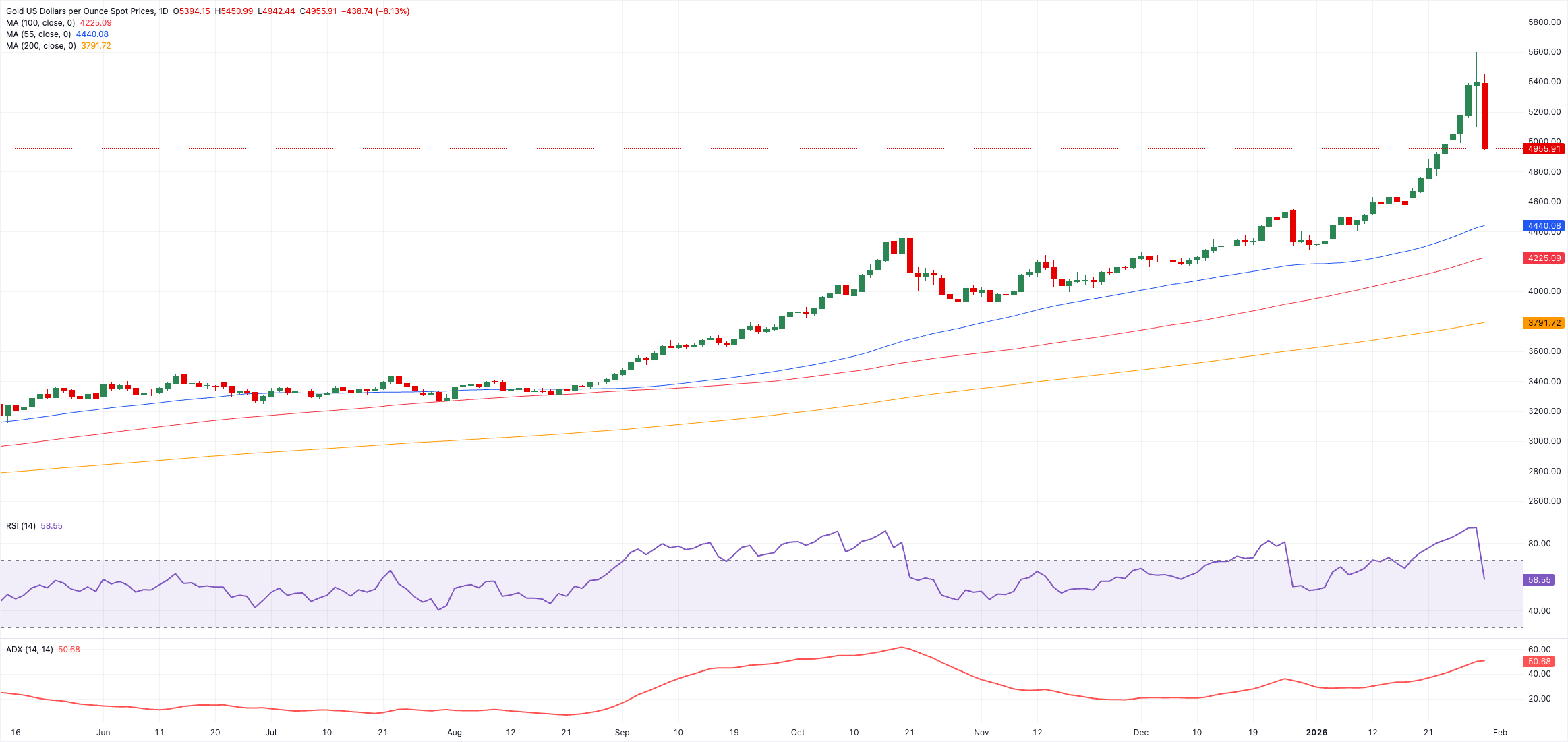
The precious metal’s bullish outlook remains well in place as long as it remains underpinned by its 200-day SMA at $3,787.
Additionally, momentum indicators suggest further gains in the near term, with the Relative Strength Index (RSI) easing below the 60 mark and the Average Directional Index (ADX) above 47, indicating a strong trend.
Gold FAQs
Gold has played a key role in human’s history as it has been widely used as a store of value and medium of exchange. Currently, apart from its shine and usage for jewelry, the precious metal is widely seen as a safe-haven asset, meaning that it is considered a good investment during turbulent times. Gold is also widely seen as a hedge against inflation and against depreciating currencies as it doesn’t rely on any specific issuer or government.
Central banks are the biggest Gold holders. In their aim to support their currencies in turbulent times, central banks tend to diversify their reserves and buy Gold to improve the perceived strength of the economy and the currency. High Gold reserves can be a source of trust for a country’s solvency. Central banks added 1,136 tonnes of Gold worth around $70 billion to their reserves in 2022, according to data from the World Gold Council. This is the highest yearly purchase since records began. Central banks from emerging economies such as China, India and Turkey are quickly increasing their Gold reserves.
Gold has an inverse correlation with the US Dollar and US Treasuries, which are both major reserve and safe-haven assets. When the Dollar depreciates, Gold tends to rise, enabling investors and central banks to diversify their assets in turbulent times. Gold is also inversely correlated with risk assets. A rally in the stock market tends to weaken Gold price, while sell-offs in riskier markets tend to favor the precious metal.
The price can move due to a wide range of factors. Geopolitical instability or fears of a deep recession can quickly make Gold price escalate due to its safe-haven status. As a yield-less asset, Gold tends to rise with lower interest rates, while higher cost of money usually weighs down on the yellow metal. Still, most moves depend on how the US Dollar (USD) behaves as the asset is priced in dollars (XAU/USD). A strong Dollar tends to keep the price of Gold controlled, whereas a weaker Dollar is likely to push Gold prices up.
Author

Pablo Piovano
FXStreet
Born and bred in Argentina, Pablo has been carrying on with his passion for FX markets and trading since his first college years.