Q2 Outlook - Gold: Set to glimmer as investors seek refuge in safe-havens

Gold is positioned to becomea likely prime destination for safety inthe second quarter of 2019 amid deteriorating global macroeconomic conditions and rising geopolitical risks.
The yellow metal swerved back and forth in Q1, gaining roughly 0.86% due to conflicting fundamental themes. But with the narrative around slowing global growth dampening appetite for risk and the Federal Reserve solidifying its dovish policy U-turn, the outlook for Gold is looking increasingly bright.
Gold to remain heavily influenced by Dollar in the near-term
There is an expectation that the metal’s near-term performance will be heavily influenced by risk sentiment and the Dollar’s valuation. Investor risk sentiment remains strained by ongoing US-China trade developments and Brexit drama, while Dollar bulls appear to be running out of steam. Although the Greenback held up remarkably well during the first quarter of 2019 despite a dovish Fed, there is a strong suspicion that the currency is running on borrowed time. With speculation over the Fed potentially cutting rates in the future seen to be threatening the Dollar’s competitive advantage, Gold may have another valid reason to push higher.
Global growth fears poised to accelerate the flight to safety
Heightened concerns surrounding the health of the US economy have not only pressured the Dollar but rattled its status as a safe-haven asset. Warning lights are flashing amber over the largest economy in the world entering a possible recession after the US Treasury Yield curve inverted for the first time since 2007. Naturally, this is a welcome development for Gold, which has the opportunity to snatch back safe-haven flows from king Dollar.
It is not only the United States that is facing headwinds; growth in Europeis showing risks of crumbling, China is resuming a gradual slowdown while the pace of UK economic expansion remains lacklustre. The fact that global macroeocnomic conditions are painting a gloomy picture will likely encourage the flight to safety – presenting a compelling argument for investors to monitor the Gold price.
Will rising equity markets weaken Gold’s allure?
A valid argument for the precious metal to depreciate in the coming months is likely based around the fact that global equity markets have performed relatively well year-to-date, despite ongoing growth concerns. However, the stock market rally seemsto be running out of steam with uncertainty over US-China trade talks, Brexit and even developments in Europe potentially sparking a heavy selloff.
Longer term outlook influenced by yields and EM
In the longer term, Gold is likely to remain supported by lower yields as growth fears result in falling interest rates across the globe. Demand in emerging markets is another factor that will impact the metal’s trajectory. If emerging markets are able to exploit the likely period of Dollar weakness to rise higher, physical demand for Gold could jump which will support upside gains.
While Gold bulls remain in a position of power fundamentally, control can still be easily wrestled away if global risk sentiment is boosted by a breakthrough in US-China trade talks or signs of global growth recovering.
Gold bulls wait for perfect moment to attack
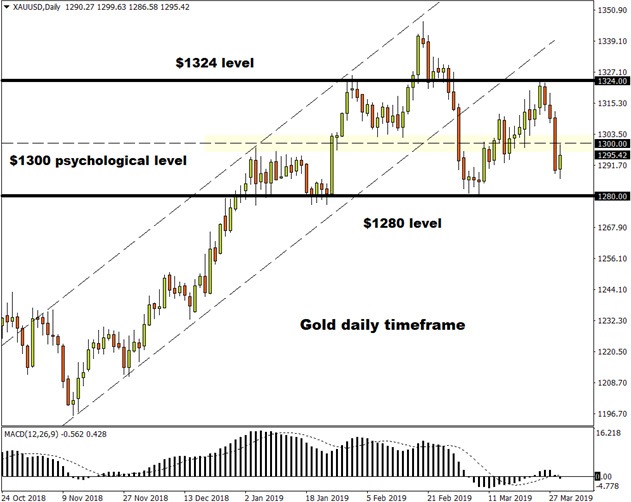
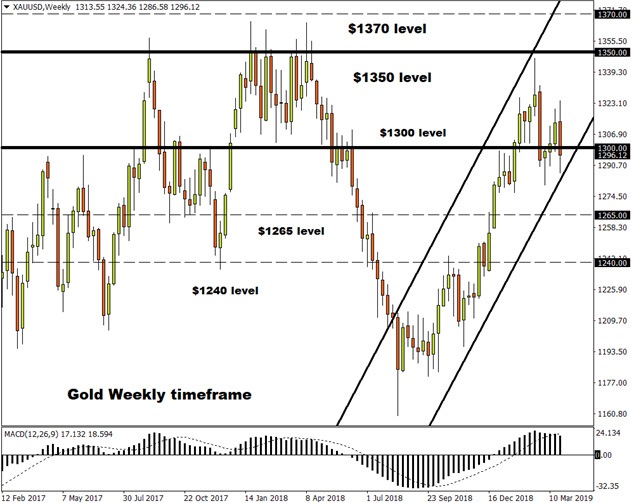
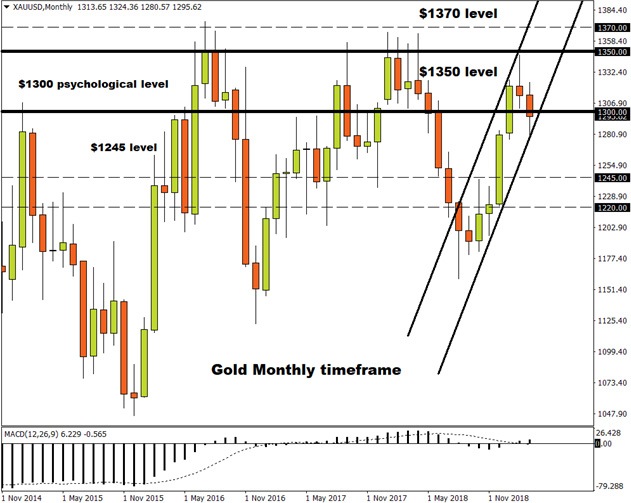
Focusing on the technical picture, Gold is experiencing a technical correction on the monthly charts. Although prices are trading below the $1300 phychological level, the trend still remains above the 20 Simple Moving Average. A technical rebound around the $1280-70 regions is on the cards which should push prices back towards $1300. A monthly close above this level should inspire bulls with enough inspiration to challenge $1324, $1350, $1370respectively. Alternatively, sustained weakness below $1265 threatens the bullish setup with prices likely to sink further towards $1245 and $1220.
Author

Lukman Otunuga
ForexTime (FXTM)
Lukman Otunuga has been a Research Analyst at FXTM since 2015. A keen follower of macroeconomic events, with a strong professional and academic background in finance, Lukman is well versed in fundamental and technical analysis.

















