Gold Price Forecast: XAU/USD regains footing on pre-US election/ Fed market caution
- Gold price bounces toward $2,750 early Monday, as a crucial week kicks off.
- The US Dollar slumps with US Treasury bond yields on odds of a Harris win in the US election.
- Recapturing $2,750 is critical for Gold price amid favorable technical indicators.

Gold price is attempting a tepid bounce toward $2,750 early Monday, as sellers take a breather amid a general market cautiousness ahead of the US election and the Federal Reserve (Fed) policy announcements due later this week.
Gold price gears up for US election, Fed verdict
Gold price stalls its correction from all-time highs of $2,790 set on Friday, as the US Dollar (USD) comes under heavy selling pressure, witnessing a bearish opening gap, following the latest opinion poll on the US election released on Saturday.
The Des Moines Register/Mediacom Iowa Poll released on Saturday showed that US Democratic presidential candidate Kamala Harris surpassed Republican Donald Trump in a new poll in Iowa, marking a notable turnaround.
Meanwhile, Harris and Trump are seen locked in a tight race for the White House, as Americans head to polls on Tuesday.
Additionally, the US Treasury bond yields are also wilting on cautious market sentiment and expectations of a 25 basis points (bps) interest rate cut by the Fed on Thursday, underpinning non-yielding Gold price.
On Friday, Gold price extended its two day retreat, as a disappointing headline US Nonfarm Payrolls (NFP) figure was offset by hot wage inflation data. The US labor market report failed to deter USD buyers, as it had limited impact on the market’s pricing of the Fed rate cut expectations.
Data published by the US Bureau of Labor Statistics (BLS) showed Friday that NFP increased by 12,000 last month, following a downward revision to the prior two months. The Unemployment Rate held at 4.1% in October.
Annual wage inflation, as measured by the change in the Average Hourly Earnings, rose to 4% from 3.9%. Markets shrugged off the weak NFP print, as it was largely expected to be distorted by severe hurricanes and a major strike at Boeing.
All eyes now remain on the US presidential election due on Tuesday and the Fed outcome on Thursday, representing a pivotal week that will determine the value of the US Dollar and the Gold price in the months ahead.
Markets believe Trump's policies on immigration, tax cuts and tariffs would put upward pressure on inflation, bond yields and the Greenback while a policy continuity is seen on a Harrish win.
Also read: US presidential election outcome: What could it mean for the US Dollar?
Gold price technical analysis: Daily chart
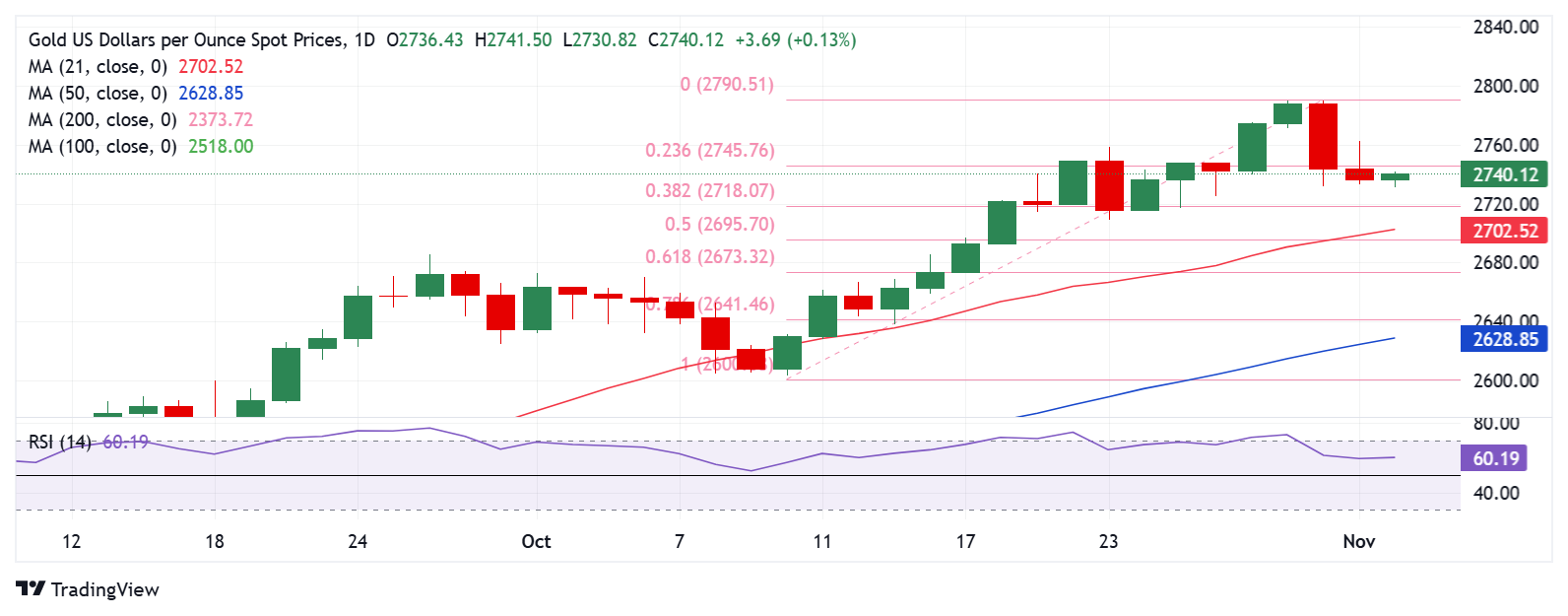
As observed on the daily chart, Gold price has found some support near the $2,730 demand area.
The 14-day Relative Strength Index (RSI) has seen a modest uptick to near 60, reviving the buying interest around the bright metal.
Gold buyers need to reclaim the $2,746 resistance on a daily closing basis to resume its uptrend. That level is the 23.6% Fibonacci Retracement (Fibo) level of the latest record rally from the October 10 low of $2,604 to the new all-time high of $2,790.
The next bullish target is seen at the record high of $2,790.
On the downside, a sustained move below $2,730 will expose the 38.2% Fibo support at $2,718.
Acceptance below that level on a daily candlestick closing basis could challenge the $2,700 confluence zone, where the 50% Fibo level of the same ascent and the 21-day Simple Moving Average (SMA) close in.
Additional declines will call for a test of the 61.8% Fibo support at $2,673.
Gold FAQs
Gold has played a key role in human’s history as it has been widely used as a store of value and medium of exchange. Currently, apart from its shine and usage for jewelry, the precious metal is widely seen as a safe-haven asset, meaning that it is considered a good investment during turbulent times. Gold is also widely seen as a hedge against inflation and against depreciating currencies as it doesn’t rely on any specific issuer or government.
Central banks are the biggest Gold holders. In their aim to support their currencies in turbulent times, central banks tend to diversify their reserves and buy Gold to improve the perceived strength of the economy and the currency. High Gold reserves can be a source of trust for a country’s solvency. Central banks added 1,136 tonnes of Gold worth around $70 billion to their reserves in 2022, according to data from the World Gold Council. This is the highest yearly purchase since records began. Central banks from emerging economies such as China, India and Turkey are quickly increasing their Gold reserves.
Gold has an inverse correlation with the US Dollar and US Treasuries, which are both major reserve and safe-haven assets. When the Dollar depreciates, Gold tends to rise, enabling investors and central banks to diversify their assets in turbulent times. Gold is also inversely correlated with risk assets. A rally in the stock market tends to weaken Gold price, while sell-offs in riskier markets tend to favor the precious metal.
The price can move due to a wide range of factors. Geopolitical instability or fears of a deep recession can quickly make Gold price escalate due to its safe-haven status. As a yield-less asset, Gold tends to rise with lower interest rates, while higher cost of money usually weighs down on the yellow metal. Still, most moves depend on how the US Dollar (USD) behaves as the asset is priced in dollars (XAU/USD). A strong Dollar tends to keep the price of Gold controlled, whereas a weaker Dollar is likely to push Gold prices up.
Author

Dhwani Mehta
FXStreet
Residing in Mumbai (India), Dhwani is a Senior Analyst and Manager of the Asian session at FXStreet. She has over 10 years of experience in analyzing and covering the global financial markets, with specialization in Forex and commodities markets.