|

Gold Price Forecast: XAU/USD bears eye daily closing below November 30 lows

  • Gold off multi-month lows but downside bias still intact.
  • US Treasury yields hold higher amid hopes of US stimulus.  
  • Markets focus on Friday’s close amid EZ/US PMIs. 

Gold (XAU/USD) is attempting a bounce from seven-month lows of $1761 but the bears are likely to regain control if the US Treasury yields extend their advance on expectations of a bigger US fiscal stimulus. The benchmark 10-year US yields sit at yearly highs amid hopes that the US stimulus would help boost the economic recovery. Meanwhile, a broad-based US dollar rebound, amid fears over the new covid strains and nervousness ahead of the preliminary Markit PMIs on both sides of the Atlantic, also weighed on gold.

Markets also rethink the implications of the rising US rates on the equities and its eventual impact on the recovery prospects. Meanwhile, US Treasury Secretary Janet Yellen’s appeal to back the $1.9 trillion stimulus package could bode well for the Treasury yields. Focus remains on the Eurozone/ US PMIs, virus and stimulus updates for fresh trading incentives.  

Gold Price Chart - Technical outlook

Gold: Daily chart
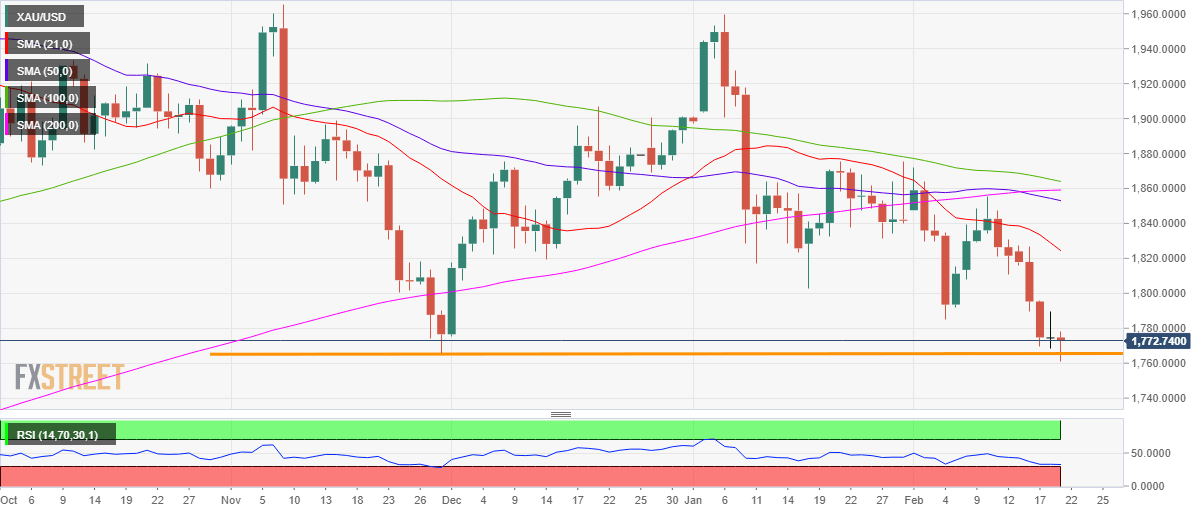
As observed in the daily chart, the gold price is at the brink of announcing a massive sell-off should sellers find acceptance below the November 30 low of $1765 on a daily closing basis.

Stops could be triggered on a sustained move below the latter, exposing the June 2020 lows around $1720. 

The 14-day Relative Strength Index (RSI) lies just above the oversold territory, suggesting that there is room for further downside. Therefore, the bears could extend the sell-off fuelled by the confirmation of the death cross formation on Tuesday.

However, if the bulls manage to defend the crucial support, allowing the price to settle above that level, a corrective pullback towards the January low of $1803 cannot be ruled out.

Author

Dhwani Mehta

Dhwani Mehta

FXStreet

Residing in Mumbai (India), Dhwani is a Senior Analyst and Manager of the Asian session at FXStreet. She has over 10 years of experience in analyzing and covering the global financial markets, with specialization in Forex and commodities markets.


More from Dhwani Mehta
Share:

Editor's Picks

AUD/USD flirts with 0.7000, lowest since early August amid bullish USD

AUD/USD hits a fresh low since early August during the Asian session on Friday and looks vulnerable near 0.7000 after breaking below the 200-day SMA overnight. Against the backdrop of the hawkish Fed, a two-day rally in oil prices revives inflation fears and continues to push US bond yields to multi-year highs. Adding to this, geopolitical risks lift the US Dollar to a two-month high, overshadowing RBA rate hike bets and weighing on the pair.

USD/JPY pulls back from three-week high after failing near 159.00

USD/JPY edges lower during the Asian session on Friday, stalling its recent strong move to a three-week high of 159.00 as Japanese Yen bears turn cautious amid intervention fears. Meanwhile, the US Dollar retains a strong bullish undertone as the Fed's hawkish outlook and oil-driven inflation fears continue to push US bond yields to multi-year peaks. Furthermore, the BoJ's dovish rate hike last week might cap JPY and support spot prices.

Gold treads water below $4,300

Gold grabs some buying attention and advances marginally at the end of the week, partially retracing the weekly decline, although it is still navigating below the key $4,300 mark per troy ounce. The fresh selling bias on the Greenback and the modest decline in US Treasury yields appear to support the humble advance in the precious metal.

Crypto Today: Bitcoin and Ethereum edge lower, XRP extends recovery as macro headwinds weigh

The broader cryptocurrency market is consolidating on Friday, with Bitcoin paring losses slightly above $84,000. Ethereum declines in tandem with BTC. Ripple (XRP), meanwhile, paints a different picture.


Fed vs BoJ: Both hiked. The market only believes one of them – and the chart shows which
The Federal Reserve (Fed) and the Bank of Japan (BoJ) have just done something remarkably similar. Both central banks raised interest rates by 25 basis points (bps) last week, both are confronting inflation risks, and both signal that future decisions will depend on incoming economic data.
Fed vs BoJ: Both hiked. The market only believes one of them – and the chart shows which

The Fed and the BoJ have just done something remarkably similar. Both central banks raised interest rates by 25 bps last week, both are confronting inflation risks, and both signal that future decisions will depend on incoming economic data.













