Gold consolidates after Fed cut amid margin hikes and war risk

Gold (XAUUSD) has pulled back from recent highs despite a supportive macro backdrop. The US Federal Reserve cut interest rates by 25 basis points, fueling initial gains in the metal. However, renewed market volatility and regulatory shifts triggered a correction. Margin requirement hikes and thin holiday liquidity added short-term pressure. At the same time, geopolitical tensions continue to support safe-haven demand. While prices are consolidating, gold’s broader uptrend remains intact, backed by expectations for further policy easing in 2026.
Gold retreats despite dovish Fed and elevated geopolitical risk
Gold initially rallied after the US Federal Reserve reduced interest rates by 25 basis points, lowering the federal funds rate to a range of 3.50%–3.75%. However, prices have since pulled back amid renewed volatility. The decision reflects growing concerns about a potential economic slowdown and easing inflationary pressure. Fed members appeared divided, with some pushing for a larger cut and others favoring a pause. However, the broader consensus leans toward continued policy easing into 2026. Lower interest rates reduce the opportunity cost of holding gold, which has no yield, and this macro backdrop continues to strengthen its appeal.
The December FOMC minutes revealed that most Fed officials view further rate cuts as appropriate, assuming inflation continues to decline. However, the exact timing and pace remain uncertain. The probability of a January rate cut dropped slightly to around 15%, suggesting that markets expect the Fed to remain cautious in the near term. Despite this, expectations for further cuts later in 2026 are already priced in, adding support to gold’s long-term outlook.
On the regulatory side, the CME raised margin requirements for gold and other metals, adding pressure during thin year-end trading conditions. These adjustments are designed to protect market integrity by requiring additional collateral to be posted for metal positions. While this led to short-term volatility, the underlying demand for gold remains firm. Additionally, global geopolitical tensions, including conflicts in the Middle East and rising friction between the US and Venezuela, continue to drive demand for safe-haven assets. In this environment, gold continues to stand out as a reliable store of value.
Gold holds bullish channel structure after sharp correction
The gold chart below shows a well-defined ascending channel guiding price action over the past two months. The lower trendline has acted as a consistent support, while price action has stayed mostly below the channel’s upper region. The latest leg higher pushed gold toward the mid-region of the channel before encountering resistance and pulling back. Despite the retracement, gold remains firmly within its bullish structure, signaling a strong and intact technical setup.
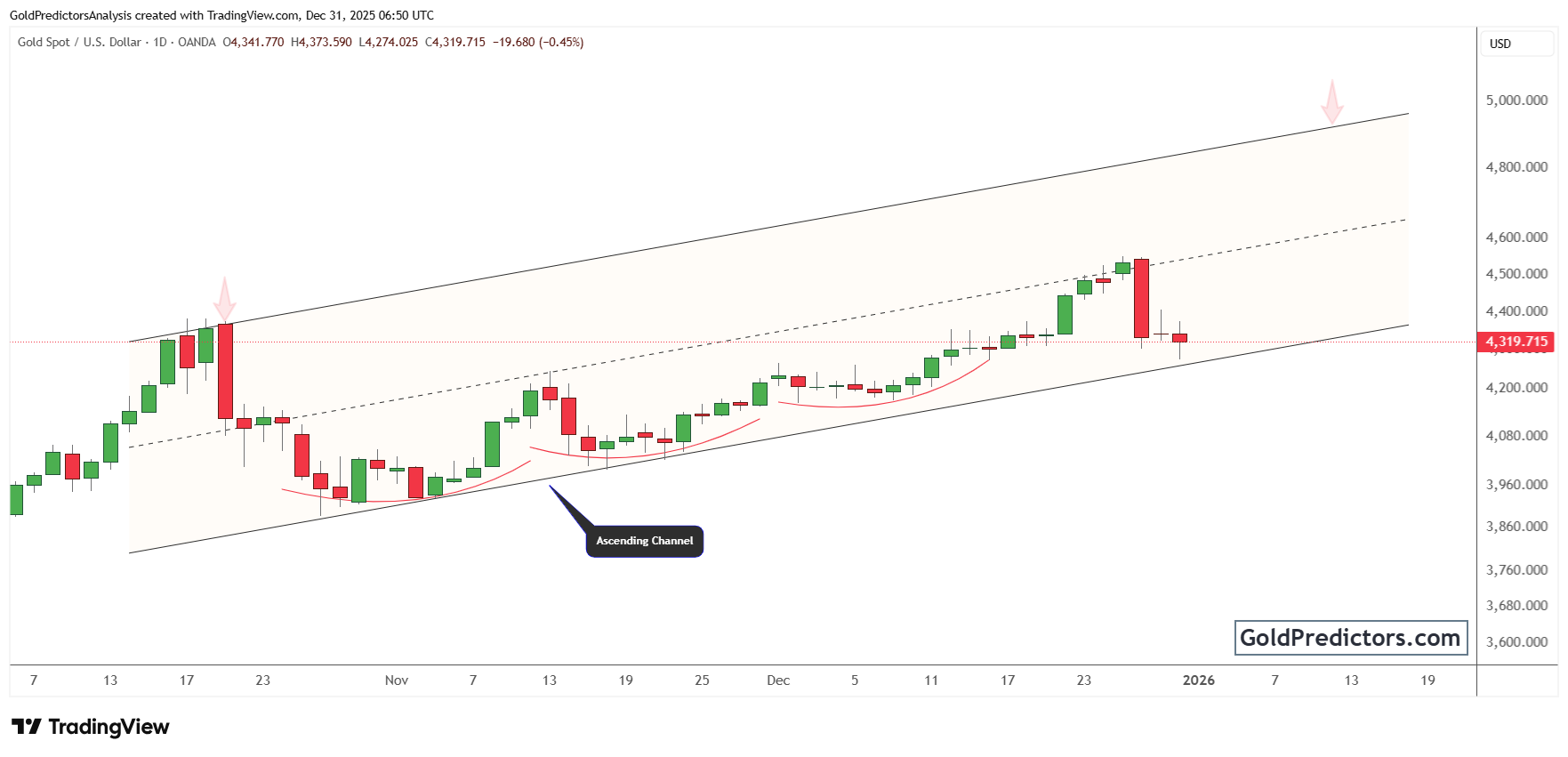
Notably, multiple cup-like formations have developed along the lower end of the channel. These rounded bases represent periods of accumulation, reflecting steady demand and consolidation within the broader trend. Each recovery from the lower boundary has shown stronger momentum, confirming underlying demand and validating the bullish trend. The most recent cup formation led to a breakout above $4,400, followed by a sharp profit-taking drop that has pushed price back toward the lower boundary of the channel.
Additionally, the $5,000 region, marking the upper boundary of the channel, could come into view if upward pressure strengthens. So far, pullbacks have been limited and contained within the channel, suggesting that buyers are stepping in at higher lows. With price now consolidating above $4,200, any renewed upside could retest the upper boundary in the coming weeks, particularly if macro drivers stay supportive.
Gold outlook: Macro drivers and technical support remain intact
Gold remains in a broader uptrend despite the recent pullback. The correction was driven by margin hikes, thin liquidity, and renewed volatility, but the underlying fundamentals continue to favor higher prices. The Federal Reserve’s rate cut and signals of continued easing into 2026 reduce the opportunity cost of holding gold, while persistent geopolitical tensions keep safe-haven demand elevated. Technically, gold continues to hold within its ascending channel, with each pullback finding support and forming accumulation zones. As long as the macro backdrop stays supportive, the current consolidation sets the stage for another move toward higher resistance levels.
Unlock exclusive gold and silver trading signals and updates that most investors don’t see. Join our free newsletter now!
Author

Muhammad Umair, PhD
Gold Predictors
Muhammad Umair is a financial markets analyst and investor who focuses on the forex and precious metals markets.