GBP/USD Forecast: Pound Sterling sellers return as markets remain risk-averse
- GBP/USD declines below 1.3000 following Thursday's impressive upsurge.
- Safe-haven flows continue to dominate the market action on Friday.
- US Nonfarm Payrolls data and Fed Chairman Powell's remarks on the economic outlook awaited.

GBP/USD climbed above 1.3200 for the first time since early October on Thursday but erased a portion of its daily gains later in the American session. The pair stays under bearish pressure in the European session on Friday and trades below 1.3000.
British Pound PRICE This week
The table below shows the percentage change of British Pound (GBP) against listed major currencies this week. British Pound was the strongest against the Australian Dollar.
| USD | EUR | GBP | JPY | CAD | AUD | NZD | CHF | |
|---|---|---|---|---|---|---|---|---|
| USD | -1.52% | -0.35% | -2.30% | -1.23% | 1.32% | 0.51% | -2.84% | |
| EUR | 1.52% | 1.30% | -0.76% | 0.34% | 2.97% | 2.11% | -1.29% | |
| GBP | 0.35% | -1.30% | -2.05% | -0.90% | 1.65% | 0.83% | -2.50% | |
| JPY | 2.30% | 0.76% | 2.05% | 1.09% | 3.75% | 2.92% | -0.63% | |
| CAD | 1.23% | -0.34% | 0.90% | -1.09% | 2.61% | 1.77% | -1.62% | |
| AUD | -1.32% | -2.97% | -1.65% | -3.75% | -2.61% | -0.81% | -4.12% | |
| NZD | -0.51% | -2.11% | -0.83% | -2.92% | -1.77% | 0.81% | -3.33% | |
| CHF | 2.84% | 1.29% | 2.50% | 0.63% | 1.62% | 4.12% | 3.33% |
The heat map shows percentage changes of major currencies against each other. The base currency is picked from the left column, while the quote currency is picked from the top row. For example, if you pick the British Pound from the left column and move along the horizontal line to the US Dollar, the percentage change displayed in the box will represent GBP (base)/USD (quote).
The broad-based selling pressure surrounding the US Dollar (USD) fuelled GBP/USD rally on Thursday. US President Donald Trump's aggressive tariffs fed into fears of an economic downturn in the US, forcing the USD to weaken against its peers.
As markets remain risk-averse on Friday, GBP/USD finds it difficult to hold its ground. At the time of press, the UK's FTSE 100 Index was down nearly 1.5% on the day and US stock index futures were losing between 0.3% and 0.9%.
Later in the day, the US economic calendar will feature the March employment report, which will feature Nonfarm Payrolls (NFP), Unemployment Rate and wage inflation figures.
Markets forecast an increase of 135,000 in NFP in March. A significant negative surprise, with an NFP reading at or below 100,000, could weigh on the USD and help GBP/USD find support. Conversely, an NFP print of 160,000 or higher could have the opposite impact on the pair's action with the immediate reaction.
Ahead of the weekend, Federal Reserve (Fed) Chairman Jerome Powell will speak on the US economic outlook at the annual conference for the Society for Advancing Business Editing and Writing. Powell will also attend a moderated panel discussion afterward.
In case Powell voices his concerns over the growth outlook, citing the new tariff regime, the USD could come under renewed selling pressure. On the other hand, the USD could end the week on a bullish note if Powell puts more emphasis on the upside risks to inflation outlook and reiterates their willingness to remain patient with regard to further policy easing.
According to the CME FedWatch Tool, investors are currently pricing in about a 32% probability of a 25 basis points Fed rate cut in May. The market positioning suggests that the USD has room on the upside if Powell's remarks revive expectations for a policy hold at the next meeting.
GBP/USD Technical Analysis
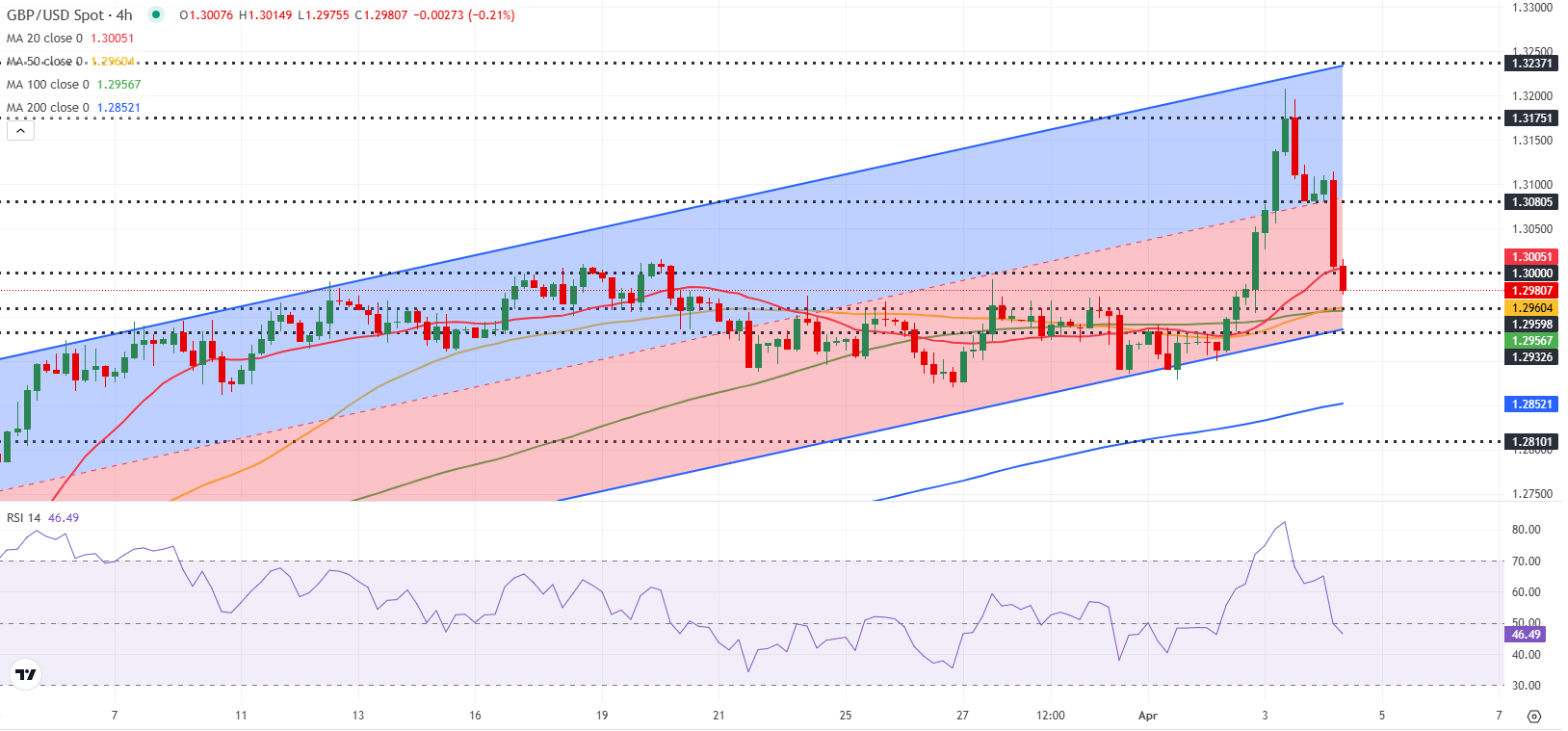
The Relative Strength Index (RSI) indicator on the 4-hour chart dropped below 50, reflecting a bearish tilt in the short-term outlook.
On the downside, 1.2960 (100-period Simple Moving Average (SMA), 50-period SMA) aligns as first support before 1.2935 (lower limit of the ascending channel) and 1.2900 (static level, round level).
In case GBP/USD reclaims 1.3000 (round level, static level), technical buyers could take action. In this scenario, 1.3080 (mid-point of the ascending channel) and 1.3100 (round level, static level) could be seen as next resistance levels.
Tariffs FAQs
Tariffs are customs duties levied on certain merchandise imports or a category of products. Tariffs are designed to help local producers and manufacturers be more competitive in the market by providing a price advantage over similar goods that can be imported. Tariffs are widely used as tools of protectionism, along with trade barriers and import quotas.
Although tariffs and taxes both generate government revenue to fund public goods and services, they have several distinctions. Tariffs are prepaid at the port of entry, while taxes are paid at the time of purchase. Taxes are imposed on individual taxpayers and businesses, while tariffs are paid by importers.
There are two schools of thought among economists regarding the usage of tariffs. While some argue that tariffs are necessary to protect domestic industries and address trade imbalances, others see them as a harmful tool that could potentially drive prices higher over the long term and lead to a damaging trade war by encouraging tit-for-tat tariffs.
During the run-up to the presidential election in November 2024, Donald Trump made it clear that he intends to use tariffs to support the US economy and American producers. In 2024, Mexico, China and Canada accounted for 42% of total US imports. In this period, Mexico stood out as the top exporter with $466.6 billion, according to the US Census Bureau. Hence, Trump wants to focus on these three nations when imposing tariffs. He also plans to use the revenue generated through tariffs to lower personal income taxes.
Author

Eren Sengezer
FXStreet
As an economist at heart, Eren Sengezer specializes in the assessment of the short-term and long-term impacts of macroeconomic data, central bank policies and political developments on financial assets.