EUR/USD Weekly Forecast: Surprise, surprise! Hawkish Powell neutralized by mixed NFP
- The US monthly employment report showed a higher unemployment rate in a still-tight labor market.
- The European Central Bank decision and the US Consumer Price Index to shake foundations next week.
- EUR/USD bullish potential remains limited, 1.0745 stands in the way for bulls.

The US Dollar returned with a vengeance this week, soaring across the FX board after Federal Reserve Chair Jerome Powell testified about monetary policy before United States Congress. The EUR/USD pair plummeted to a low of 1.0523 but heads into the weekly close trading well above the 1.0600 mark, up for a second week in a row.
Powell rocks financial markets
Fed’s Powell hawkish words shocked financial markets and spurred risk aversion, as he noted that the central bank is prepared to increase the pace of interest rate hikes to bring inflation to the 2% target. He agreed that inflation is coming down but added that it’s very high and that the cost of not getting it down “would be much higher than costs of controlling it.” Furthermore, he said he sees little signs of disinflation in core services.
He then added that policymakers had not made any decision about the upcoming March meeting, as the decision will be data-dependant. On employment, Powell noted that “extraordinarily strong jobs report and inflation reports pointed in the same direction.”
Stock markets plummeted, while the yield on the 2-year Treasury note soared to 5%, boosting the Greenback across the FX board. EUR/USD grind higher from the weekly low as investors digested Fed’s hawkishness on Thursday, but then came the United States Nonfarm Payrolls (NFP) report. According to the Bureau of Labor Statistics, the country added 311K new job positions in February, much better than the 205K expected. Also, the Labor Force Participation Rate improved to 62.5% from 62.4% in January, while the Unemployment Rate unexpectedly rose to 3.6%, and the annual wage inflation, as measured by the Average Hourly Earnings, increased to 4.6% from 4.4%, below the 4.7% anticipated by market participants.
The employment news put pressure on the Greenback, as the mixed figures could be translated into an upcoming 25 basis points (bps) by the Federal Reserve. Market participants seem to have already digested the fact that price pressures are easing at a slower-than-anticipated pace and read the higher Unemployment Rate as a potential game-changer for the central bank. The CME Group FedWatch Tool now shows that the chances of a 50 bps hike at the next policy meeting declined to 40% following the NFP report.
Data published these last few days hurt the Euro. Most figures indicated that the Eurozone economy has yet to see its bottom. Retail Sales rose a measly 0.3% in February, declining 2.3% from a year earlier. German sales were also sharply down, losing 6.9% in January, according to the official release. Also, the final estimate of the EU Q4 Gross Domestic Product indicated the economy grew at an annualized pace of 1.8%, downwardly revised from the previous 1.9%. Finally, Germany confirmed the February Harmonized Index of Consumer Prices at 9.3% YoY.
Definitions in the docket
Next Tuesday, March 14, the United States will publish the February Consumer Price Index (CPI) expected to post a 6.2% annualized increase. The core annual reading is foreseen rising by 5.5%, barely easing from the previous 5.6%. Such a figure will indicate that, while inflation is still moving in the right direction, the Fed’s decision to accelerate the pace of tightening makes sense. The release is expected to have quite an impact in financial markets, which may well stay on hold ahead of it.
The next first-tier event will be the European Central Bank (ECB) monetary policy decision on Thursday. President Christine Lagarde has long ago clarified this meeting will bring a 50 basis points (bps) rates hike, which is fully priced in. However, in the last monetary policy meeting, she noted that there are no particular plans from now on and that upcoming decisions will depend on data and would be made meeting-by-meeting.
European policymakers these last weeks repeated ad-exhaustion their concerns about slow growth and high inflation, nullifying another potential surprise factor within the announcement. A change in Lagarde’s hawkish wording or an anticipated decision on what they plan for the near future could shock the Euro.
Throughout the week, there are other relevant macroeconomic figures scheduled, including US February Retail Sales, the final estimate of the EU HICP for February, and the preliminary estimate of the US March Michigan Consumer Sentiment Index.

EUR/USD technical outlook
The EUR/USD pair developed for a third consecutive week between Fibonacci levels. The weekly low was set just ahead of the 50% retracement of the 2022 yearly slide at 1.0515, while advances were short of 1.0745, the 61.8% retracement of the same decline. The pair currently trades mid-way between such levels, and one would need to give up for a clearer directional movement.
Technical readings in the weekly chart suggest that not everything is lost for bulls. The 20 Simple Moving Average (SMA) keeps heading firmly higher and currently stands a handful of pips above the aforementioned Fibonacci support. On the other hand, the 100 SMA extended its decline well above the current level, now hovering around the 1.1000 psychological threshold. Finally, the Momentum indicator extended its decline with a firm downward slope and is about to challenge its midline, while the Relative Strength Index (RSI) indicator consolidates around 52.
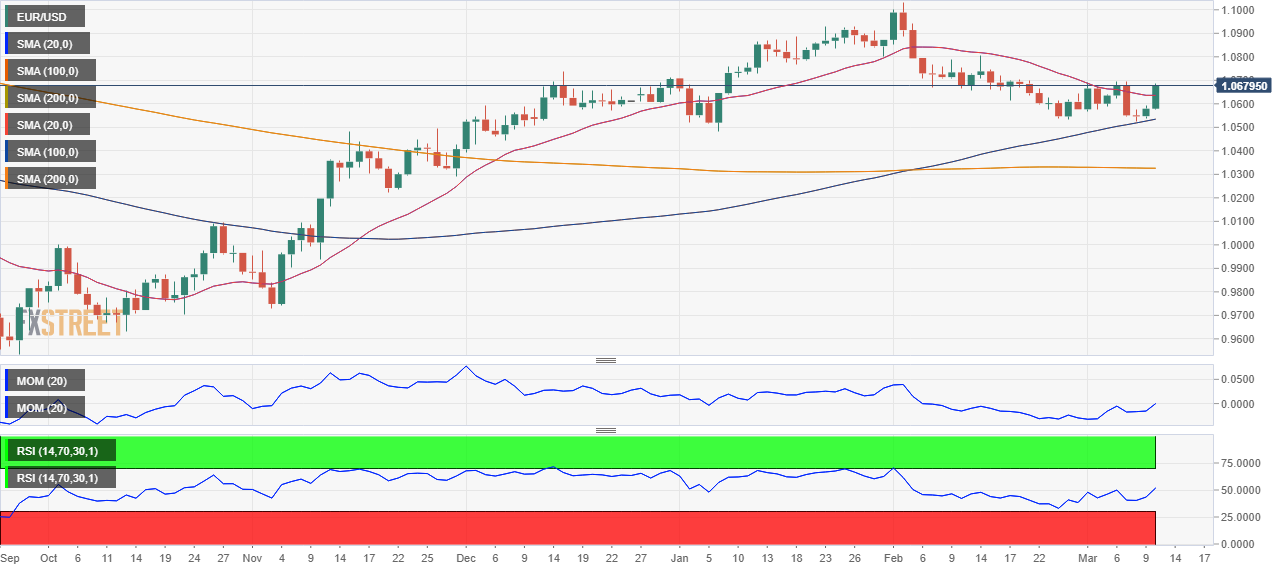
On a daily basis, the bullish potential seems limited. The pair is currently battling with a flat 20 SMA, aiming to break above it. The 100 SMA advances below the current level and currently stands at around 1.0520, reinforcing the static support area. Finally, technical indicators gyrated north but remain just below their midlines, falling short of anticipating a steeper advance.
The pair now has support at 1.0600, with the next relevant one at 1.0515. It needs to clear the latter to have room to extend its decline towards the 1.0400 price zone. On the upside, the key is 1.0745, as sellers are likely to reject advances around it. Once beyond it, the rally could continue towards 1.0820.
 EUR/USD sentiment poll
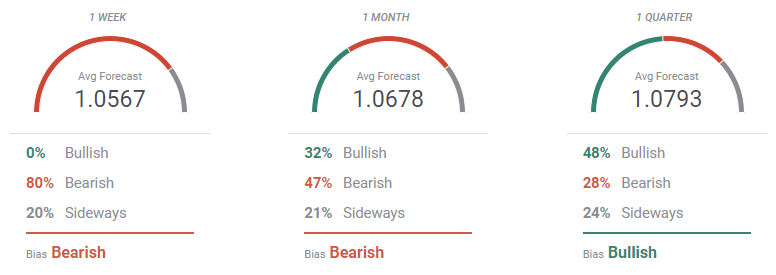
The FXStreet Forecast Poll suggests that the EUR/USD pair could maintain the bullish course. Most market players are looking for targets below the current one, as the Nonfarm Payrolls report caught them off-guard. However, the Overview chart shows that moving averages maintain their recent upward strength. The near-term one is flat, but the longer ones continue to grind north. As time goes by, bulls gain ground increasing from 0% in the weekly view to 48% in the quarterly one.
Finally, the Overview chart also shows that most targets accumulate above 1.0800, suggesting market players have completely digested Powell’s hawkishness.
Author

Valeria Bednarik
FXStreet
Valeria Bednarik was born and lives in Buenos Aires, Argentina. Her passion for math and numbers pushed her into studying economics in her younger years.

















