EUR/USD Weekly Forecast: Next bounce could be a trap
- EUR/USD has closed the week practically unchanged around 1.1200.
- The pair’s inconclusive price action came on the back of a weaker USD.
- Germany and Eurozone inflation, along with the Fed, will be in the spotlight.

The single currency alternated gains and losses against the US Dollar (USD) this week, prompting EUR/USD to stabilise around the 1.1200 neighbourhood on Friday, while remaining unable to sustain its earlier bull run toward the 1.1260 zone. On the monthly chart, the second drop in a row appears almost unavoidable.
Furthermore, spot has given away around six big figures since its peak past 1.1700 in the summer, coming under increasing selling pressure since then in tandem with the strong bounce in the Greenback.
On the latter, the US Dollar has traded on the back foot this week, as the ongoing bullish move appears to have taken a breather alongside alternating moods regarding developments from the Middle East crisis.
Next week could be critical for the pair in light of both the European Central Bank (ECB) and Federal Reserve (Fed) meetings, where both central banks are expected to keep a steady hand this month.
No news is hardly good news
Geopolitical tensions remain stubbornly elevated. The familiar US-Iran standoff over the Strait of Hormuz shows little sign of resolution, while the ongoing Russia-Ukraine conflict adds another layer of uncertainty, keeping risk aversion alive and safe-haven demand supported.
Energy prices put the ECB back on the defensive
The geopolitical fallout is increasingly visible in energy markets. Crude Oil prices continue to climb, European fuel costs are rising, and gas price forecasts face repeated upward revisions. For the energy-dependent Eurozone, this represents more than another squeeze on household budgets: it threatens to turn an external price shock into a more persistent inflation problem.
That is precisely where the European Central Bank faces its biggest challenge. Policymakers can look through a temporary jump in energy prices, but not if higher costs spread into wages, services and inflation expectations. With growth already vulnerable to expensive energy imports, the ECB risks having to tighten policy into a weakening economy simply to prevent inflation from becoming entrenched. The longer the energy shock persists, the stronger the case for additional tightening becomes. Markets are already pricing in around 18 basis points of further rate hikes by year-end.
Now, about inflation…
According to Friday’s ECB survey, Eurozone consumers’ inflation expectations rose slightly over the 12-month horizon in September, while longer-term expectations remained unchanged. The survey points to persistent upside risks for the ECB, although it does not yet suggest a fresh deterioration in medium-term expectations.
Inflation expectations for the next year increased to 3.1% from 3.0% in August. Expectations three years ahead held at 2.9%, while the five-year measure remained unchanged at 2.5%.
The latest survey is mildly hawkish for monetary policy.
Near-term expectations remain elevated and above the bank’s 2% target, but the stability of the three- and five-year measures suggests that longer-term expectations have not materially de-anchored. The ECB will nevertheless remain alert to the risk that persistent energy and supply pressures may begin to influence broader price-setting behaviour.
Crowded shorts meet a surprising options divergence
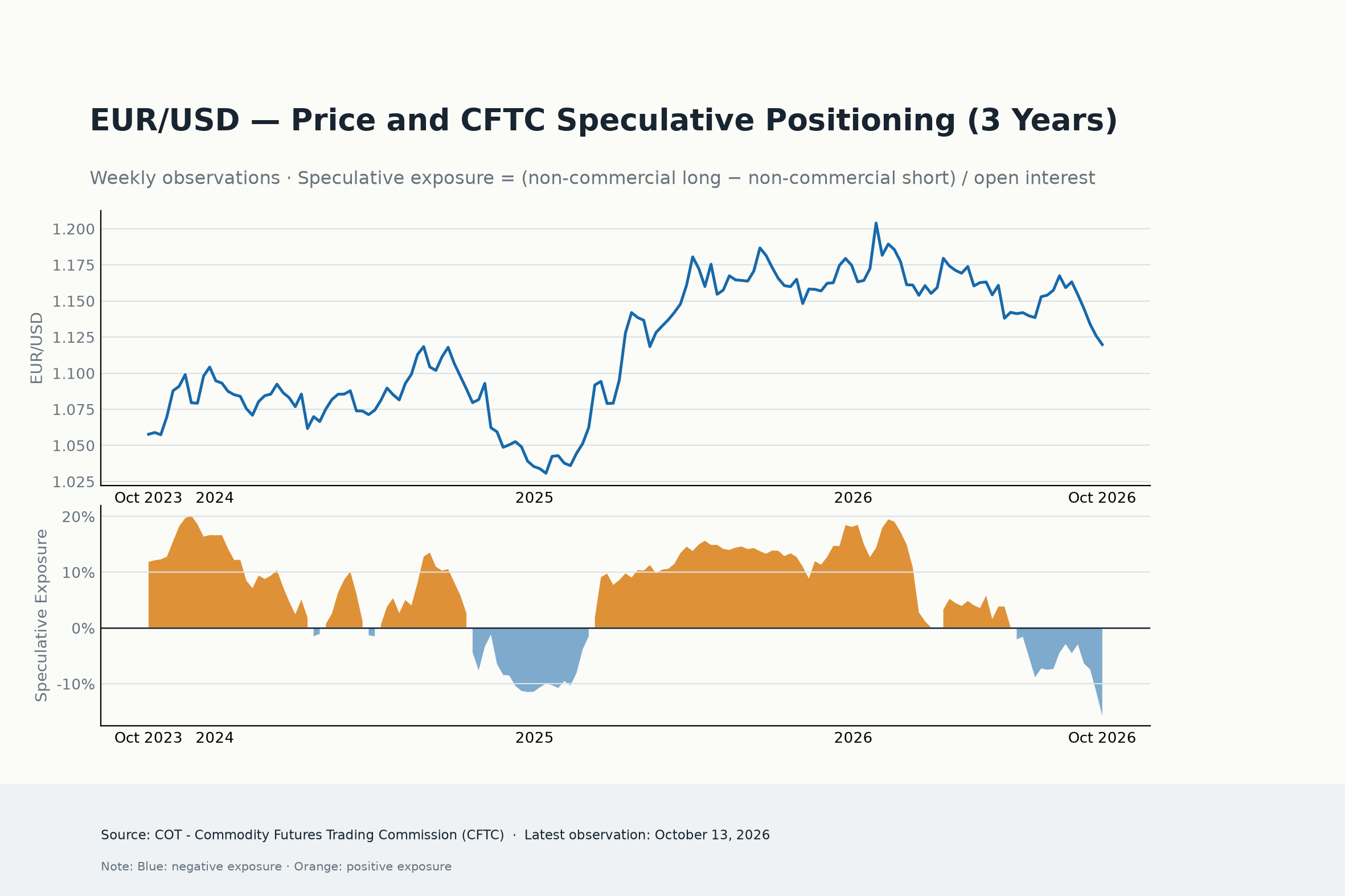
EUR bearish positioning intensified in the week ending October 13, according to Commodity Futures Trading Commission (CFTC) data.
That said, non-commercial net shorts increased to around 137.6K contracts, while the weekly change deteriorated to -38,241 contracts from -36,076. The four-week change tumbled to around -110.6K contracts, confirming that bearish speculative positioning continues to deepen.
Also, open interest rose to around 874.6K contracts. The deeper net shorts, combined with a slightly higher participation, suggest a continued bearish positioning, though the modest increase in open interest implies the latest move was not accompanied by a significant expansion in overall market activity.
The speculative exposure plummeted to -15.73% (previously -11.41%), and its percentile dropped to 0 (from 0.7). The Net Position Percentile also remained at 0. Both measures are now at the most bearish levels in the five-year reference period, showing that EUR positioning is historically extreme both in absolute terms and relative to open interest.
However, the options market presents a contrasting picture. The one-month 25-delta Risk Reversal was -0.531 volatility points on October 22, implying that EUR puts are still priced higher than equivalent calls. But the reading is at the 30.7th percentile of its five-year distribution, indicating that the downside skew is quite moderate compared with the extremely bearish positioning in futures markets.
More importantly, option pricing has now become decidedly less bearish compared to EUR/USD spot performance. The pair has dropped 1.45% over the last month, but Risk Reversals were higher by 0.114 volatility points. Historically, a decline of such magnitude would have implied a deterioration of about 0.223 volatility points based on their history.
Instead, the positive deviation of 0.337 volatility points is at the 89.5th percentile of the out-of-sample distribution. This implies that options have repriced the EUR much more positively than spot moves would imply in isolation, creating a large divergence between speculative futures positioning and options sentiment.
That said, the latest weekly Risk Reversal change of -0.082 volatility points suggests that some demand on the downside has returned, meaning the improvement in options sentiment is not yet firmly established across all time horizons.
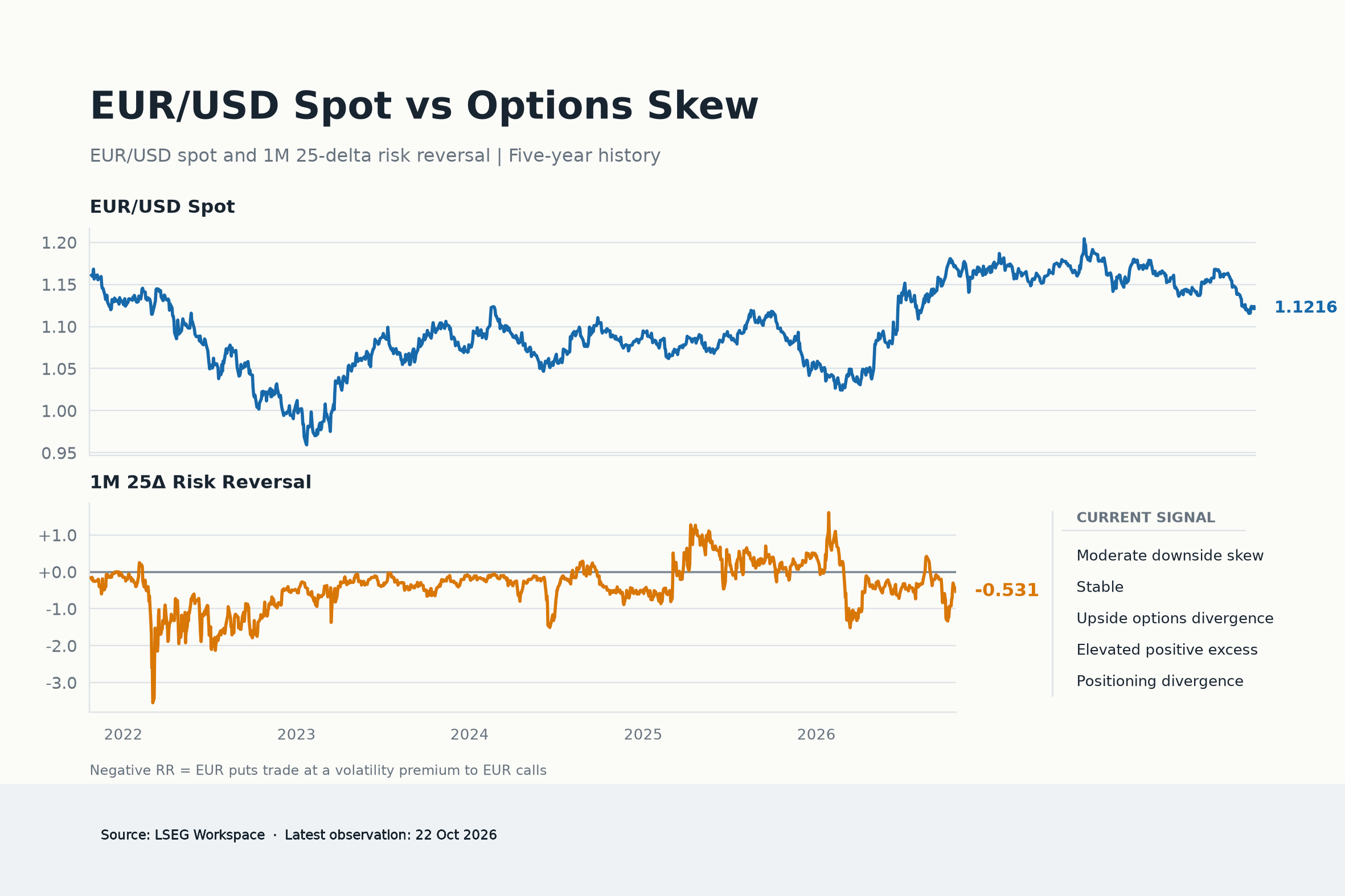
Overall, the positioning on the EUR remains decisively bearish, but the divergence between futures and options is something to watch. Speculative shorts are exceptionally extended, while options markets are displaying considerably less downside concern than the EUR’s recent weakness would normally suggest. This combination raises the risk of a short-covering rebound if bearish momentum begins to fade, although the continued deterioration in weekly futures positioning means that a sustained reversal remains unconfirmed.
What’s in store for EUR/USD?
The coming week may be key for EUR/USD: preliminary inflation figures from Germany and the Euroland will provide fresh clues on whether the recent energy-induced price pressures are beginning to feed through to inflation expectations.
In addition, the ECB is widely anticipated to leave its policy rates unchanged at its meeting on Thursday, while the usual press conference by President Christine Lagarde is expected to highlight persistent energy-driven inflation.
Across the Atlantic, the focus will be on the FOMC gathering on Wednesday, with the Federal Reserve (Fed) also seen leaving its Fed Funds Target Range (FFTR) at 3.75%-4.00%. Data-wise, investors are also expected to keep their focus on inflation measured by the Personal Consumption Expenditure (PCE) and another estimate of the Q3 GDP Growth Rate.
Too bearish to fall, too weak to rally?
While the Euro may be near a level where selling is becoming more difficult, that doesn’t necessarily mean the overall bearish trend is losing momentum. The pair stays close to 1.1200 after giving up some six big figures from summer highs. The short-term outlook is fragile, with the Greenback holding a bid amid relatively solid US fundamentals, higher Treasury yields and ongoing geopolitical uncertainty.
Still, positioning suggests the next move may not be entirely smooth. Speculative EUR shorts are at 5-year extremes, and options markets are showing much less conviction in the bearish theme than the recent decline in spot would imply. That divergence makes spot more and more susceptible to a short-covering rally if next week's Fed meeting turns out to be less hawkish than what investors are currently expecting.
However, a recovery driven primarily by position adjustment would hardly qualify as a genuine change in trend. The Eurozone remains particularly exposed to elevated energy prices, and while those pressures could keep the ECB leaning towards further tightening, they also threaten to undermine growth. That uncomfortable combination limits the extent to which a hawkish ECB can provide lasting support for the single currency.
Looking beyond next week's central bank meetings, the balance of risks therefore remains tilted to the downside. A sustained recovery would likely require a meaningful retreat in US yields, a broader improvement in risk appetite and convincing evidence that the Fed's tightening cycle is approaching its end. Without those catalysts, any rebound towards the 1.1260 area could struggle to attract sustained buying interest, leaving the 1.1000 psychological threshold as a plausible medium-term destination.
For now, the Euro may be due for a bounce, but the burden of proof remains firmly on the bulls.
Inflation FAQs
Inflation measures the rise in the price of a representative basket of goods and services. Headline inflation is usually expressed as a percentage change on a month-on-month (MoM) and year-on-year (YoY) basis. Core inflation excludes more volatile elements such as food and fuel which can fluctuate because of geopolitical and seasonal factors. Core inflation is the figure economists focus on and is the level targeted by central banks, which are mandated to keep inflation at a manageable level, usually around 2%.
The Consumer Price Index (CPI) measures the change in prices of a basket of goods and services over a period of time. It is usually expressed as a percentage change on a month-on-month (MoM) and year-on-year (YoY) basis. Core CPI is the figure targeted by central banks as it excludes volatile food and fuel inputs. When Core CPI rises above 2% it usually results in higher interest rates and vice versa when it falls below 2%. Since higher interest rates are positive for a currency, higher inflation usually results in a stronger currency. The opposite is true when inflation falls.
Although it may seem counter-intuitive, high inflation in a country pushes up the value of its currency and vice versa for lower inflation. This is because the central bank will normally raise interest rates to combat the higher inflation, which attract more global capital inflows from investors looking for a lucrative place to park their money.
Formerly, Gold was the asset investors turned to in times of high inflation because it preserved its value, and whilst investors will often still buy Gold for its safe-haven properties in times of extreme market turmoil, this is not the case most of the time. This is because when inflation is high, central banks will put up interest rates to combat it. Higher interest rates are negative for Gold because they increase the opportunity-cost of holding Gold vis-a-vis an interest-bearing asset or placing the money in a cash deposit account. On the flipside, lower inflation tends to be positive for Gold as it brings interest rates down, making the bright metal a more viable investment alternative.
Author

Pablo Piovano
FXStreet
Born and bred in Argentina, Pablo has been carrying on with his passion for FX markets and trading since his first college years.

















