The French bond panic is overdone. Here's what the market is misreading

France's 10-year government bond yield has climbed above 5%, reigniting fears of a sovereign debt crisis in the Eurozone. With public debt exceeding €3.5 trillion, persistent budget deficits and a fragmented political landscape, investors are increasingly questioning the French government's ability to stabilize its finances.
Yet deteriorating market sentiment does not necessarily mean France is heading toward a Greek-style debt crisis. Beneath the alarming headlines, several factors suggest that the situation remains manageable, provided policymakers can restore fiscal credibility before market pressure becomes self-reinforcing.
Bond markets are sending a warning, not necessarily predicting a default
French government bonds have come under intense selling pressure, pushing the 10-year yield above 5% and widening the spread over equivalent German bonds to approximately 175 basis points.
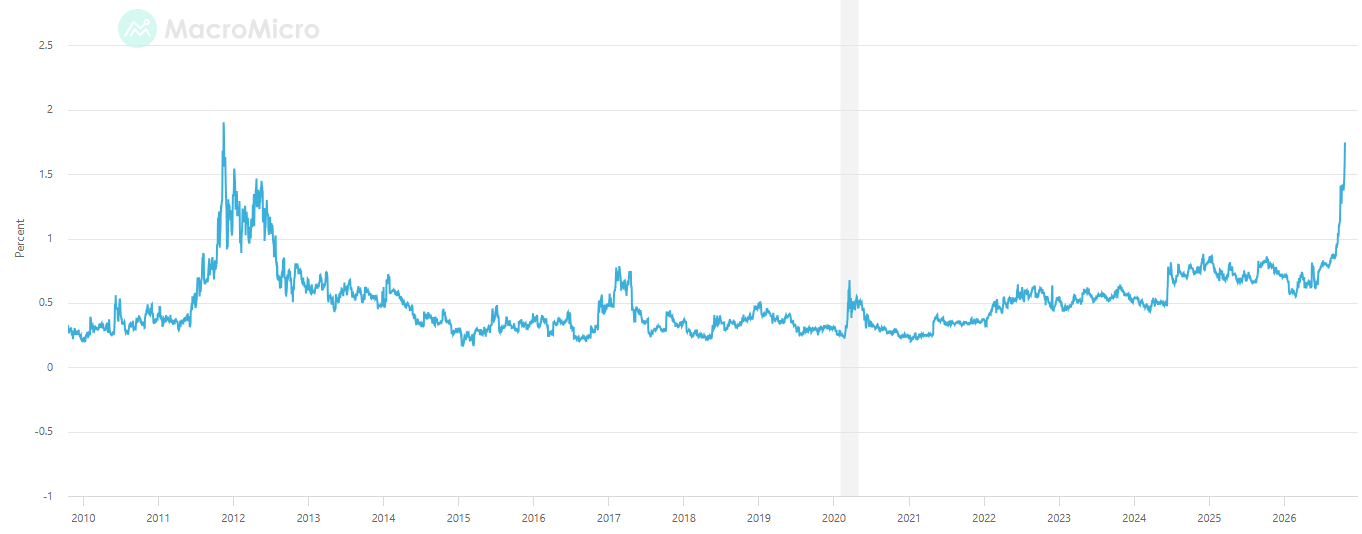
The sell-off reflects genuine concerns about France's fiscal trajectory. The budget deficit is estimated at around 5.4% of Gross Domestic Product (GDP) for the year, while public debt could reach 121.7% of GDP in 2027, according to Oddo BHF. Investors are also pricing in the difficulty of passing meaningful fiscal reforms ahead of the 2027 presidential election. With no stable parliamentary majority, even modest budget adjustments have become politically contentious.
However, rising yields do not automatically signal that a country is losing access to financial markets. France continues to issue government bonds, and recent debt auctions have proceeded without major disruption. This distinction matters: a market demanding higher compensation for risk is not the same as a market refusing to finance the government altogether.
Technical market dynamics may also have amplified the decline in bond prices. The unwinding of leveraged positions and forced selling by some investors can accelerate movements beyond what changes in economic fundamentals alone would justify.
That does not make the sell-off harmless, but it suggests current yields may reflect a combination of structural concerns, political uncertainty and temporary market dislocation.
The 5% yield does not apply to France's entire debt stock
One of the most important distinctions in assessing France's debt burden is the difference between the interest rate on newly issued bonds and the average financing cost of outstanding debt. Although the French government now faces borrowing costs above 5% on 10-year bonds, its existing debt was issued over many years, often at substantially lower rates.
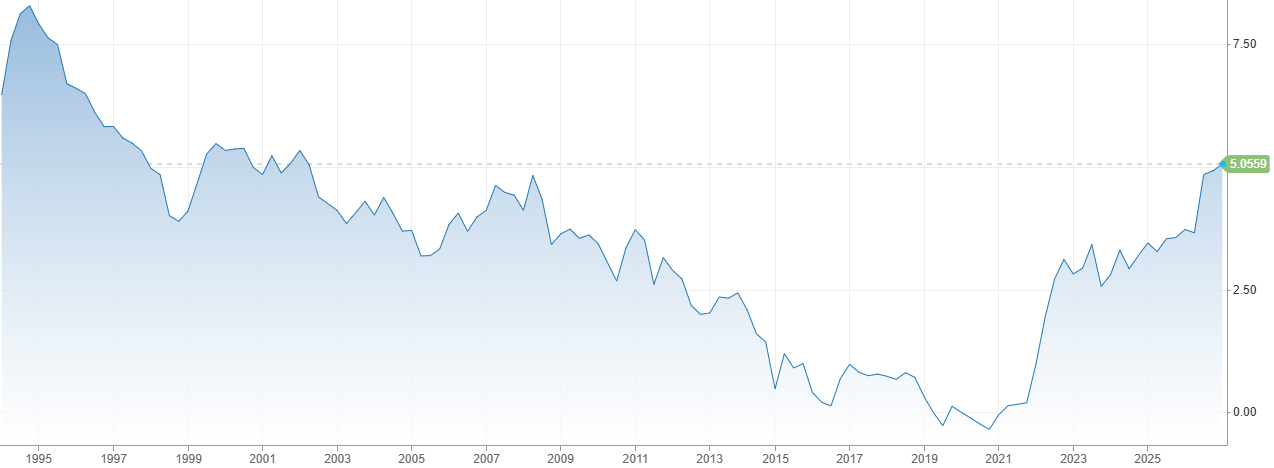
According to AXA Chief Economist Gilles Moëc, the average interest rate on France's outstanding public debt is approximately 2.2% in 2026. That compares with 6.5% in 1994 and 3.1% in 2011. Higher market yields therefore affect the public finances gradually, as maturing bonds are refinanced and new borrowing is issued. This provides policymakers time, although not unlimited time, to correct the fiscal trajectory.
Moëc also points to the importance of nominal economic growth, estimated annually at around 3%. Under these conditions, an improvement in the primary fiscal balance of approximately two percentage points of GDP could help stabilize the debt ratio.
Such an adjustment would be politically difficult, but it is not economically inconceivable. France has undertaken significant fiscal adjustments before, notably in the 1990s and after the global financial crisis.
The challenge is less about an immediate inability to service the debt than about demonstrating a credible path toward stabilizing it.
France is not Greece in 2010
Comparisons with the Eurozone sovereign debt crisis are understandable, but they overlook important differences. France has a large, diversified economy, a substantial domestic savings base and a broadly balanced external position. Its banking system operates in a stronger European regulatory environment than it did during the previous crisis.
Unlike Greece at the beginning of the 2010s, France is not confronting a simultaneous collapse in market access, a severe banking crisis and a major external financing imbalance.
The broader European economic backdrop is also different. Germany is pursuing a more expansionary fiscal stance, potentially providing support to regional economic activity rather than reinforcing a synchronized period of austerity.
The International Monetary Fund (IMF) has acknowledged these distinctions. Speaking to CNBC, IMF Managing Director Kristalina Georgieva emphasized that the European financial architecture is now better equipped to withstand sovereign debt stress: “And I think we need to remember that, [compared] to the previous time, we have a much more mature system in Europe. We have the strength of the European Central Bank. We have other instruments that Europe has developed to protect against financial stability risks.”
That assessment does not dismiss France's fiscal problems. Instead, it suggests that the Eurozone is better prepared to contain the consequences of a loss of investor confidence. As ING Chief Economist Carsten Brzeski put it: “Greece’s credibility was destroyed by false statistics; France’s is being eroded by false promises.”
The distinction is significant. France's fiscal credibility has weakened, but rebuilding confidence remains possible if political commitments translate into concrete measures.
The European Central Bank has tools to prevent a broader crisis
The European Central Bank (ECB) represents another important difference from previous sovereign debt crises. Since the Eurozone crisis, European institutions have developed mechanisms designed to prevent unjustified financial fragmentation and contain destabilizing movements in government bond markets.
The ECB could initially respond through communication, adjustments to its monetary policy stance or changes to the pace at which it reduces its bond holdings. More direct intervention could involve the Transmission Protection Instrument (TPI), which allows the central bank to purchase government bonds when market dynamics threaten the effective transmission of monetary policy.
The European Stability Mechanism (ESM), meanwhile, has approximately €433 billion in available lending capacity, offering another potential source of financial support under appropriate conditions.
These mechanisms do not provide France with an unconditional safety net. The TPI is subject to eligibility criteria, including compliance with the European Union's fiscal framework. A failure to adopt a credible budget could therefore complicate access to the very instruments that might reassure investors.There is also a fundamental distinction between market dysfunction and a justified reassessment of sovereign credit risk. The ECB may be reluctant to intervene if higher French yields primarily reflect concerns about the country's own fiscal and political choices. Nevertheless, the existence of these instruments can itself help stabilize expectations.
A credible budget could change the market narrative
Ultimately, the most sustainable solution must come from France itself. The government's draft 2027 budget includes approximately €43 billion in proposed fiscal savings, although alternative adjustment figures have also circulated in the political debate. Passing a credible budget would provide an immediate signal that French institutions remain capable of responding to market pressure.
But fiscal consolidation does not necessarily have to rely exclusively on abrupt spending cuts or higher taxation. Measures to improve employment rates, raise productivity, increase the efficiency of public expenditure and strengthen long-term economic growth could make debt stabilization more achievable.
Portugal offers a useful, although imperfect, European comparison. After years of fiscal adjustment and reforms, its debt ratio has moved onto a substantially more favorable trajectory, illustrating how market perceptions can improve when public finances and growth prospects strengthen.
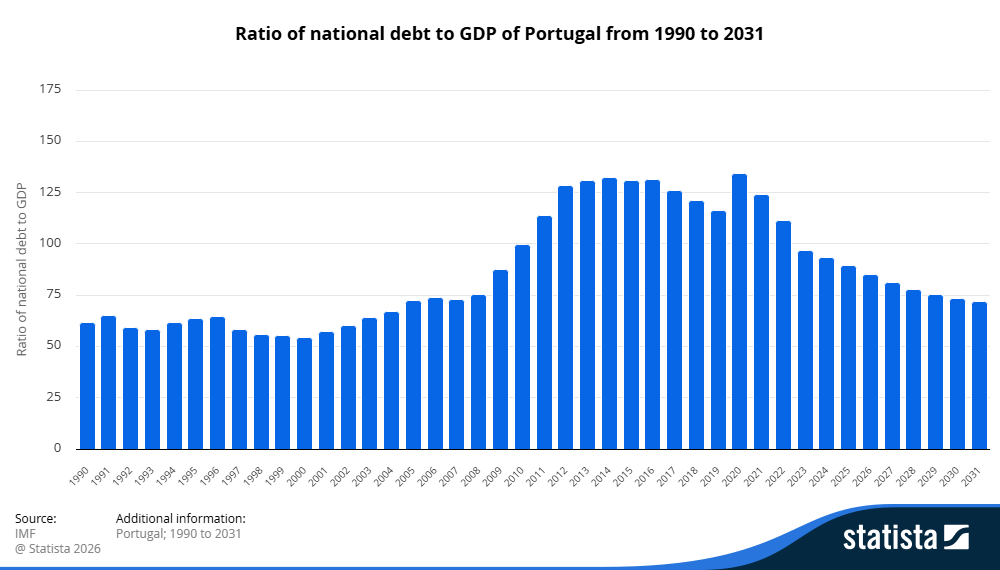
France's much larger economy, different political structure and higher financing requirements mean that the Portuguese experience cannot simply be replicated. Still, it shows that elevated public debt is not necessarily irreversible. A credible medium-term fiscal framework, supported by realistic assumptions and clear implementation milestones, could reduce the risk premium investors demand on French bonds.
As Goldman Sachs Economist Alexandre Stott wrote in a report: “Tackling the underlying problem requires a budgetary solution rather than the ECB.” European institutions may help contain a crisis, but they cannot substitute for a sustainable national fiscal strategy.
What could derail a recovery in confidence?
The strongest argument against excessive pessimism is that France still has the economic resources, institutional support and policy options needed to stabilize its debt. The strongest argument for caution is that these advantages are only useful if political leaders can act.
Parliamentary fragmentation could prevent the adoption of a credible budget. The approach of the 2027 presidential election may encourage parties to postpone difficult decisions rather than accept the political costs of fiscal adjustment.
A prolonged institutional deadlock could then reinforce the market pressures that make adjustment more difficult. Higher borrowing costs would gradually increase debt-servicing expenses, reducing the government's fiscal flexibility. Weaker confidence could weigh on investment and economic growth, while additional credit-rating downgrades might further discourage some investors.
A sharper deterioration in French bonds could also spill over into other Eurozone sovereign markets, complicating the ECB's response. And although European support mechanisms are considerably stronger than they were fifteen years ago, their conditions and political constraints mean that intervention cannot be taken for granted.
The central question, therefore, is not whether France has the capacity to stabilize its debt, but whether its political system can deliver the necessary decisions quickly enough.
France's debt crisis is serious, but it is not necessarily destined to become a financial catastrophe. The country still has time, economic strengths and European safeguards on its side. Whether those advantages are enough will depend less on the next bond-market headline than on the credibility of the fiscal choices made in Paris.
Author

Ghiles Guezout
FXStreet
Ghiles Guezout is a Market Analyst with a strong background in stock market investments, trading, and cryptocurrencies. He combines fundamental and technical analysis skills to identify market opportunities.
















