CFTC Report: WTI rally runs ahead of positioning

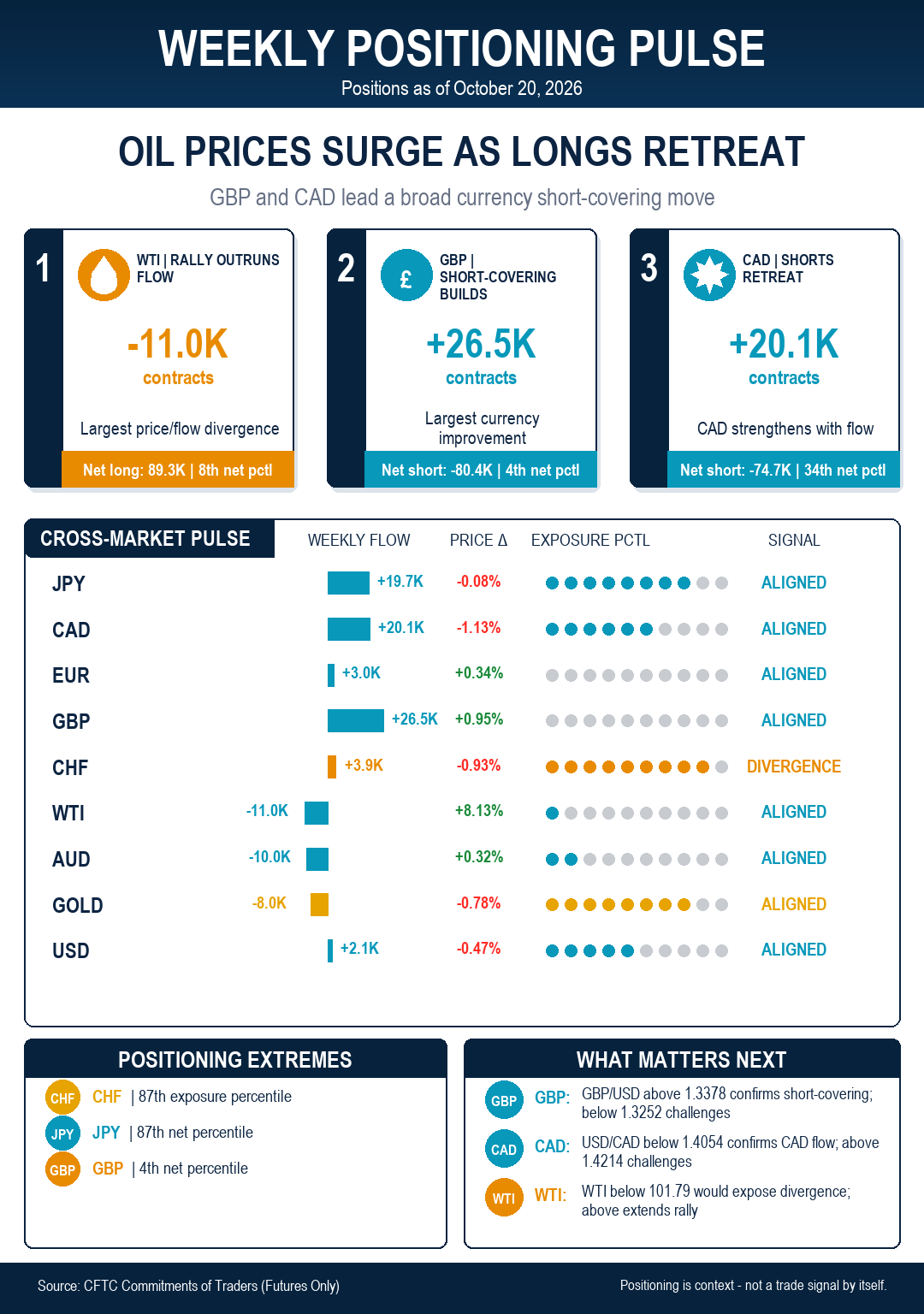
The week in one sentence: WTI prices surged while speculative longs were cut in the week to October 20, creating the clearest price/positioning divergence. Sterling and the Canadian Dollar led the constructive currency shift, while Yen longs also rebuilt.
WTI: Rally outruns speculative conviction
Speculators turned less constructive on the WTI, reducing their net exposure to around 89.3K contracts. Prices increased markedly during the period, approaching the $102.00 mark per barrel, so the market is not yet confirming the positioning signal. Exposure is at its 8th percentile, and net positioning is near the 8th. A move in the positioning direction would validate the signal; continued price action against it would deepen the divergence.
GBP: Short-covering powers the quid higher
Non-commercial players moved decisively towards the British Pound (GBP), reducing the net shorts to a five-week low around 80.4K contracts. GBP/USD’s move higher flirted with the 1.3380 zone, in line with the positioning signal. Speculative exposure is near the 3rd percentile and net positioning near the 4th. Further price confirmation would strengthen the move; a reversal would argue that the flow is fading.
Price and positioning are still at odds
WTI was the clearest mismatch after speculative net longs declined while the benchmark price rose with firm conviction. Price is therefore moving ahead of the flow rather than following it. For traders, a reversal down below 94.14 would reveal the rally's weakness, while additional advances would leave the divergence unresolved.
Where the flow has confirmation
Price action and positioning moved in tandem across the Japanese Yen (JPY), the Canadian Dollar (CAD) and the Euro (EUR), lending some credibility to the latest moves. Still, next week will be crucial to see whether that momentum holds. A quick reversal would cast doubt on the apparent confirmation and suggest the moves were little more than a false start.
The crowded trade
The Japanese Yen (JPY) stands out as the most vulnerable to a positioning unwind, with speculative exposure at the 84th percentile. That doesn't mean a reversal is imminent, but it does suggest that the trade is becoming increasingly crowded. Should bullish momentum fade or sentiment suddenly turn, investors rushing to unwind their long positions could accelerate the Yen's decline, turning an otherwise modest pullback into a much sharper sell-off.
Positioning map
The contrast could hardly be sharper. The Yen stands out as the most crowded long trade, with speculative exposure at the 84th percentile and outright net positioning at the 87th. The Australian Dollar (AUD), meanwhile, sits at the opposite extreme, with its net-positioning percentile hovering near zero as bearish bets dominate. These figures tell two different but complementary stories: speculative exposure measures crowding relative to open interest, while net positioning shows how extreme those bets have become historically. For markets, the implications are clear. JPY is increasingly vulnerable to a sharp sell-off if investors begin unwinding crowded longs, while AUD could stage a sizeable rebound if improving sentiment forces bearish traders to cover their shorts. Neither outcome is guaranteed, but positioning could amplify price moves in either direction once momentum begins to shift.
Author

Pablo Piovano
FXStreet
Born and bred in Argentina, Pablo has been carrying on with his passion for FX markets and trading since his first college years.

















