EUR/USD Price Forecast: The 1.1000 barrier looms closer
- EUR/USD made a U-turn and rebounded to the 1.1000 region on Tuesday.
- The US Dollar faced renewed downside pressure following potential tariff talks.
- Additional US tariffs on China (totalling 104%) will kick in on April 9.

The Euro (EUR) gathered balance and prompted EUR/USD to leave behind two daily drops in a row and refocus on the upside, briefly flirting with the psychological 1.1000 hurdle.
In fact, the US Dollar (USD) succumbed to the resurgence of the selling pressure on Tuesday as hopes of some negotiation surrounding US tariffs seem to have lifted spirits among market participants.
Tariffs remain in centre stage
President Trump’s latest tariff agenda is stirring global trade anxiety. A blanket 10% duty on all U.S. trade partners took effect on April 5, with additional levies—varying from 10% to 50%—rolling out for specific regions. Notable hits include a 20% rate for the European Union (EU).
Adding fuel to the fire, the White House said that 104% levies on US imports of Chinese goods will kick in on April 9, while its trade team are expected to negotiate taylor-made trade deals with every country.
Across the Atlantic, EU President Ursula von der Leyen stressed that although the EU would prefer to negotiate, it stands ready to retaliate. With the Eurozone potentially losing up to 0.5% in GDP if tit-for-tat measures escalate, markets remain on edge.
Central banks under pressure
The Federal Reserve (Fed) chose to keep rates unchanged, mindful that higher tariffs can propel inflation even as the broader economy shows signs of cooling. Chair Jerome Powell underscored the challenging road ahead, hinting that 50 basis points of easing could still be on the table if growth decelerates.
Speaking on Friday, Powell noted that new tariffs may be “significantly larger than expected” and warned of slower growth and higher inflation.
Across the Atlantic, the European Central Bank (ECB) cut its key rate by 25 basis points and signalled a readiness to act further if uncertainty remains elevated. While fresh forecasts point to a dip in growth and stubborn near-term inflation, policymakers expect price pressures to ease by 2026. ECB President Christine Lagarde cautioned that a trade spat with the US could erode Eurozone GDP by 0.5%. Although some officials, like Robert Holzmann, argue that further cuts aren’t vital, they concede that an escalating trade war could force the ECB’s hand.
Euro sentiment cools… but still bullish?
Speculative traders trimmed their net long Euro positions to three-week lows near 52K contracts in the week leading up to “Liberation Day.” Meanwhile, commercial traders cut shorts to about 83K contracts. While the net positioning still leans bullish, mounting uncertainty suggests EUR longs are waiting on the sidelines for clearer signals.
EUR/USD: Technical outlook
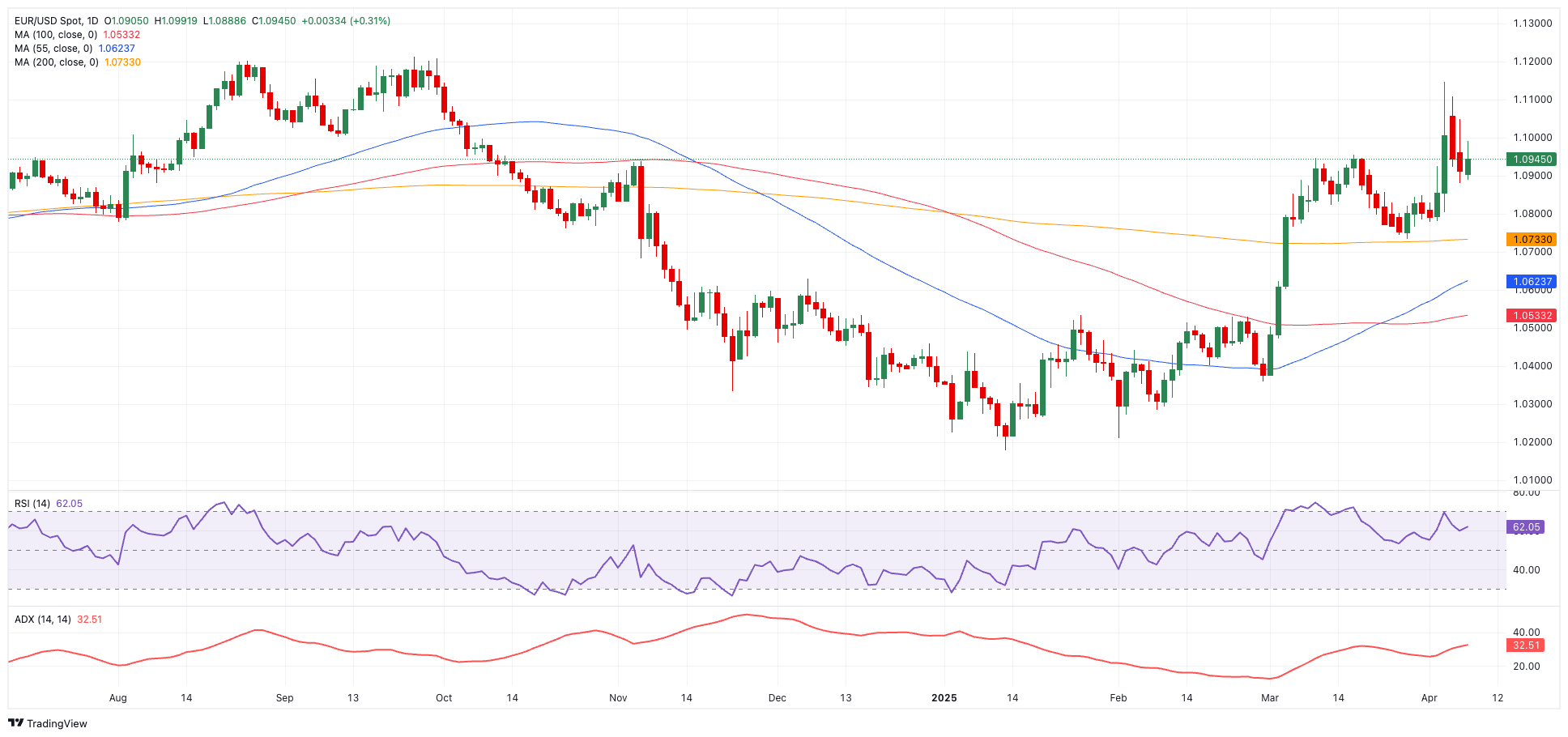
Initial resistance lies at 1.1145, the 2025 peak (April 3). Beyond that level, the 1.1200 threshold and the 2024 high at 1.1213 (September 25) emerge as the next hurdles.
On the downside, 1.0732 (March 27 weekly low) aligns with the 200-day SMA, acting as a crucial floor. A clear break below this region could open the way to the 55-day SMA at 1.0624.
From a technical perspective, the RSI has bounced toward 60, indicating some bullish bias. Meanwhile, the ADX above 32 signals a moderately strong trend.
EUR/USD daily chart
Looking ahead
All eyes are on how US trade policies evolve and whether tensions with China and the EU reach boiling point. Eastern Europe’s ceasefire deal may provide some short-lived calm, but additional rhetoric from both the Fed and ECB will set the tone for the EUR/USD pair going forward. This week’s FOMC Minutes and US inflation numbers stand out as the main catalysts, with markets seeking any hint of near-term monetary policy shifts.
Author

Pablo Piovano
FXStreet
Born and bred in Argentina, Pablo has been carrying on with his passion for FX markets and trading since his first college years.