EUR/USD Price Forecast: Sellers losing interest, 1.1400 still caps gains

EUR/USD Current price: 1.1375
- The German IFO Business Climate came in better than expected, supporting the Euro.
- United States data indicated economic resilience despite persistent uncertainty.
- EUR/USD trimmed part of its weekly losses, demand for the USD eases.
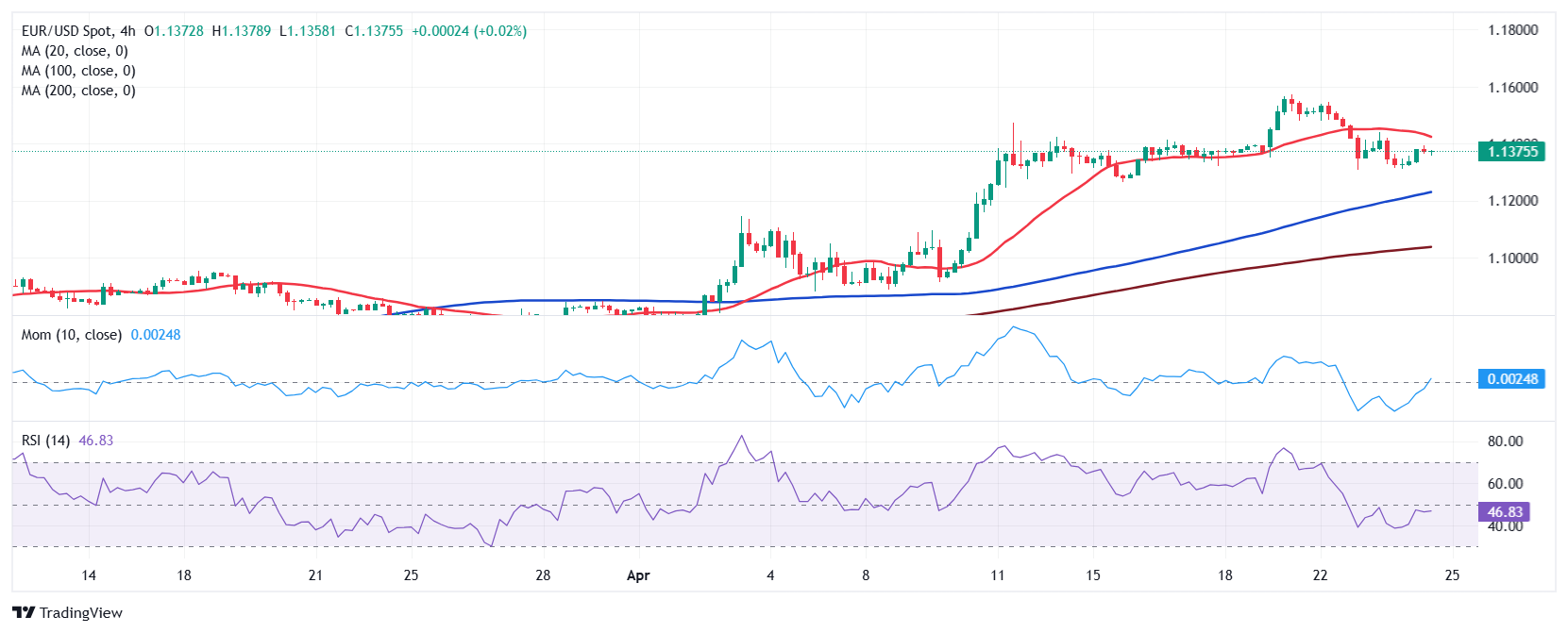
The EUR/USD pair is slowly grinding higher on Thursday, but trades below the 1.1400 threshold. The pair approached the 1.1300 mark for a second consecutive day before bounding, somehow suggesting sellers are losing interest.
Easing concerns related to the United States (US) policies lifted the market’s mood, keeping US Dollar (USD) demand in check. On the one hand, US President Donald Trump clarified that he does not plan to dismiss Federal Reserve (Fed) Chairman Jerome Powell, but that he would prefer the central bank to lower the interest rate at a faster pace. On the other hand, the sentiment improved on the back of encouraging headlines related to trade negotiations between Washington and Beijing.
The Euro (EUR) was helped by encouraging German data on its way up, as the country released the April IFO survey on Business Climate, which came in better than the 91 expected, printing at 92 as in March. The assessment of the current situation improved from 85.7 in the previous month to 86.4, while Expectations printed at 87.4, below the previous 87.7 but above the 85 anticipated by market participants.
Across the pond, the US released Durable Goods Orders, which impressed with a 9.2% increase in March, much better than the 2% forecast. Additionally, Initial Jobless Claims were slightly worse than anticipated, up to 222K vs the 21K expected. The US will later publish March Existing Home Sales and the April Kansas Fed Manufacturing Activity index. A couple of Fed speakers will participate in public events, and investors will be looking for comments on monetary policy.
EUR/USD short-term technical outlook
The daily chart for the EUR/USD pair shows that the risk is skewing to the upside. Technical indicators turned higher within positive levels after correcting extreme overbought conditions. At the same time, EUR/USD keeps developing above all its moving averages, with a bullish 20 Simple Moving Average (SMA) currently at around 1.1150.
The near-term picture, on the contrary, shows that another leg lower is still possible. Technical indicators in the 4-hour chart turned marginally lower below their midlines, reflecting the recent retracement from intraday highs. Yet at the same time, EUR/USD develops below its 20 SMA, which gains downward strength and provides dynamic resistance at around 1.1435. The 100 and 200 SMAs, in the meantime, maintain their upward slopes far below the current level, limiting the case for a steeper slide.
Support levels: 1.1345 1.1300 1.1260
Resistance levels: 1.1405 1.14350 1.1470
Author

Valeria Bednarik
FXStreet
Valeria Bednarik was born and lives in Buenos Aires, Argentina. Her passion for math and numbers pushed her into studying economics in her younger years.

















