EUR/USD Price Forecast: Extra advances look likely
- EUR/USD left behind recent peaks north of the 1.1500 hurdle on Tuesday.
- The US Dollar picked up renewed impulse on the back of US-China trade news.
- Investors’ attention now shifts to upcoming preliminary PMIs in the US and the bloc.

EUR/USD lost steam after a failing to push to the area of Monday’s yearly highs near 1.1570, allowing sellers to drive the pair lower as the US Dollar Index (DXY) staged a decent comeback, leaving behind recent three-year lows in the sub-98.00 area when measured by the US Dollar Index (DXY).
Tariff tensions persist
President Trump’s latest tariff announcement, a blanket 10 % duty on all trading partners plus surcharges up to 50 % in certain regions and a 145 % levy on select Chinese goods, has kept risk sentiment on tenterhooks.
A 90‑day reprieve for non‑retaliating nations and the late exclusion of smartphones and computers provided only brief respite, while EU officials warned Brussels stands ready to counter if necessary.
Tuesday’s marked recovery in the Greenback was exclusively sponsored by encouraging headlines from US Treasury Secretary Bessent, allowing some respite on the US-China trade conflict.
Central bank crossroads
The Federal Reserve (Fed) left its policy rate at 4.25 %–4.50 % this week, with Chair Jerome Powell reiterating that the fight against inflation remains paramount—even as tariffs threaten stagflation.
In recent comments, Powell stressed that any future rate cuts will depend on how inflation and growth trends evolve, warning that rising duties could force the Fed to juggle conflicting goals.
Meanwhile, the European Central Bank (ECB) delivered a widely expected 25 basis point cut to 2.25 %, removed “restrictive” from its statement, and signalled a data‑driven approach—prompting markets to price in another cut at the June meeting.
Trump-Powell: Another open front
The US Dollar managed to set aside the recent strong bearish note as President Trump escalated his criticism of Federal Reserve Chair Jerome Powell, calling him “a major loser” for not cutting interest rates. Indeed, in a social media post, Trump urged Powell to lower rates “pre-emptively” to support the economy, accusing him of being too slow to react to shifting conditions. The renewed attack came amid growing market turmoil tied to Trump’s own tariff policies, which have rattled investors and fuelled stagflation concerns.
Positioning pressures
Speculative net longs in the Euro climbed to approximately 69.3K contracts in the week to April 15, marking their highest level since September 2024. Commercial traders, in the meantime, ramped up their net shorts to nearly 118K contracts, also reaching multi-month highs. In addition, open interest surged past 708K contracts, a five-week peak.

Technical checkpoints
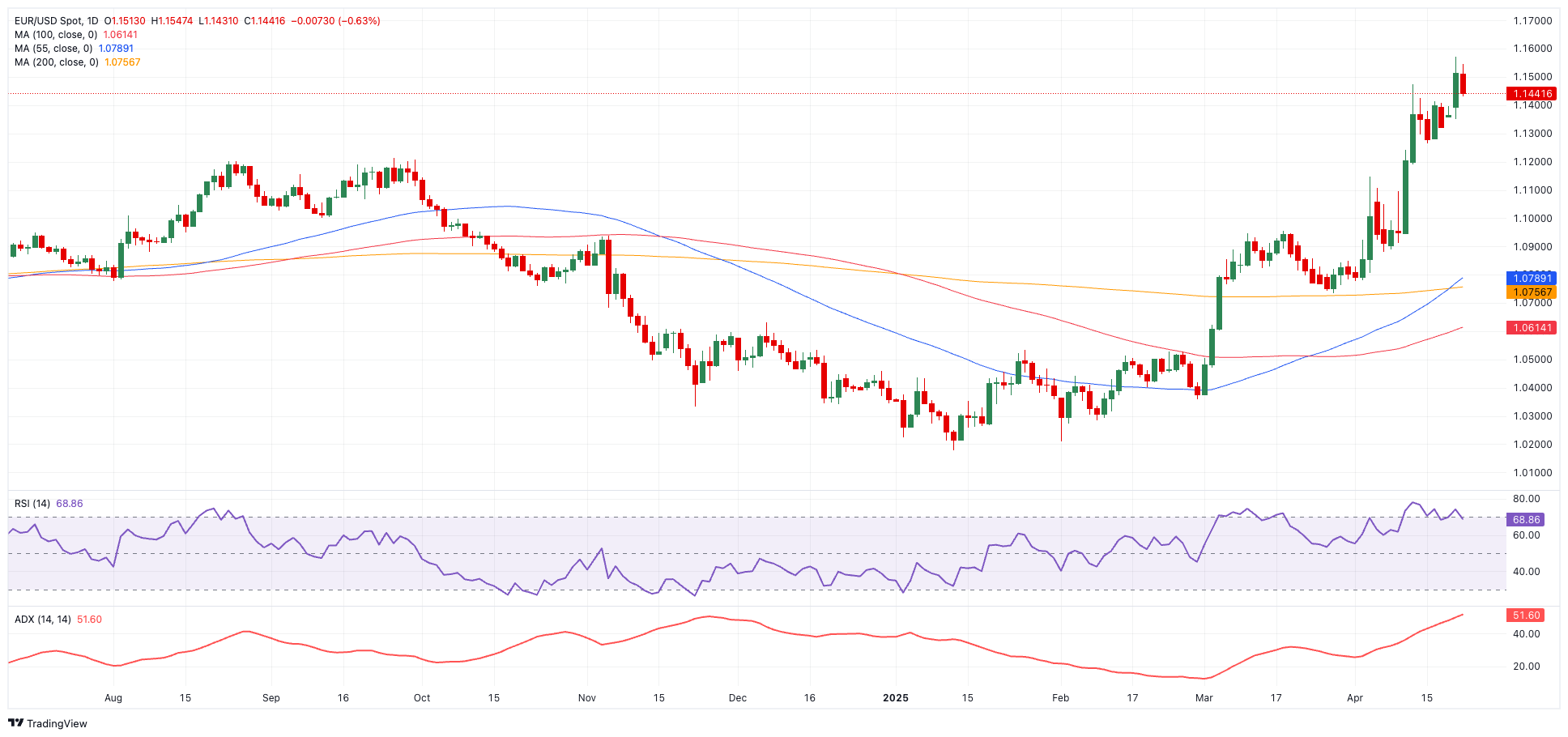
The 2025 high at 1.1572 (April 21) stands as the first notable resistance level for EUR/USD, prior to the October 2021 high at 1.1692 (October 28).
On the other hand, initial support is found at the 200-day simple moving average (SMA) at 1.0762, with further backing from the weekly low of 1.0732 (March 27).
Momentum indicators show a bullish picture: the Relative Strength Index (RSI) has eased just below the 70 yardstick, while the Average Directional Index (ADX) remains elevated above the 51 level, suggesting the broader trend remains firm.
EUR/USD daily chart
Market outlook
With the US Dollar regaining its lustre and tariff headlines still dominating the narrative, EUR/USD looks set for continued choppiness. Every new policy hint from the Fed or ECB, and each fresh trade‑war salvo, will likely trigger swift moves, keeping volatility elevated until greater clarity emerges.
Author

Pablo Piovano
FXStreet
Born and bred in Argentina, Pablo has been carrying on with his passion for FX markets and trading since his first college years.