EUR/USD Price Forecast: Deeper decline awaits below the 200-day SMA
- EUR/USD rebounds sharply, reaching three-day highs near 1.1650.
- The US Dollar comes under fresh selling pressure as US-EU tariff concerns rise.
- Focus remains on Tuesday’s weekly ADP prints and the ZEW’S Economic Sentiment.

EUR/USD manages to leave behind part of its recent steep retracement soon afterwards, confronting its key 200-day SMA. This level remains critical for now, as a break below it could open the taps for extra pullbacks.
Following two consecutive daily declines, EUR/USD picks up a solid pace and advances well past 1.1600 the figure in a promising start to the new trading week. It is worth noting, however, that the pair briefly slipped back below its critical 200-day SMA during early trade, just to bounce afterwards.
The pair’s resurgence of the upside impulse follows renewed downside pressure on the US Dollar (USD), as investors keep assessing a new bout of threats from President Trump to impose tariffs on several EU countries over the Greenland issue.
Against this, the US Dollar Index (DXY) retreated markedly, hitting three-day lows and challenging the 99.00 support at the same time. The buck’s move lower comes amid the generalised reduction in volatility in response to the inactivity in US markets due to the celebration of MLK Jr Day.
The Fed eases, but doesn’t sound relaxed about it
The Federal Reserve (Fed) delivered the December rate cut markets had been expecting, but the real takeaway was less about the move itself and more about the message behind it. A split vote and carefully chosen language from Chair Jerome Powell made it clear the Fed isn’t in any rush to keep cutting.
Powell repeated that inflation remains “somewhat elevated” and stressed that policymakers want clearer evidence the labour market is cooling in an orderly fashion, without tipping into something more troubling. Updated projections barely budged, still pointing to just one additional 25-basis-point cut in 2026, alongside steady growth and only a modest rise in unemployment.
The press conference followed a familiar script. The Fed is comfortable stepping back and letting the data lead. Powell ruled out rate hikes as the base case, but just as importantly, he avoided signalling that another cut is around the corner. He also flagged import tariffs introduced under former President Donald Trump as one reason inflation remains sticky, underlining that some of the pressure is policy-driven rather than cyclical.
Minutes released later showed just how finely balanced the decision really was. Divisions within the Federal Open Market Committee (FOMC) remain pronounced. Some members want to get ahead of labour market cooling, while others worry inflation progress could stall. The message is straightforward: confidence in further easing is fading, and a pause now looks like the path of least resistance unless inflation improves meaningfully or unemployment rises more sharply.
The ECB stays comfortable on the sidelines
Across the Atlantic, the European Central Bank (ECB) also held rates steady at its December 18 meeting and sounded increasingly at ease with that stance. Modest upgrades to parts of the growth and inflation outlook have effectively shut the door on near-term rate cuts.
Recent data have helped stabilise sentiment. Euro area growth has surprised slightly to the upside, exporters have absorbed US tariffs better than expected, and domestic demand has softened the impact of ongoing weakness in manufacturing.
Inflation trends continue to support the ECB’s approach. Price pressures are hovering close to the 2% target, with services inflation doing most of the heavy lifting, a pattern policymakers expect to persist.
Updated projections still show inflation dipping below target in 2026–27 as energy prices ease, before gradually drifting back toward 2%. At the same time, officials highlighted the risk that services inflation could remain sticky, given that wage growth is slowing only gradually.
Growth forecasts were nudged higher as well, reinforcing the sense that the economy is proving more resilient than many feared. As President Christine Lagarde put it, exports remain “sustainable” for now. She again emphasised that policy decisions will be made meeting by meeting and guided by incoming data.
Markets appear to have taken the hint, pricing just over 4 basis points of easing this year, a level consistent with an ECB that sees little urgency to move.
Euro positioning: still long, but running out of steam
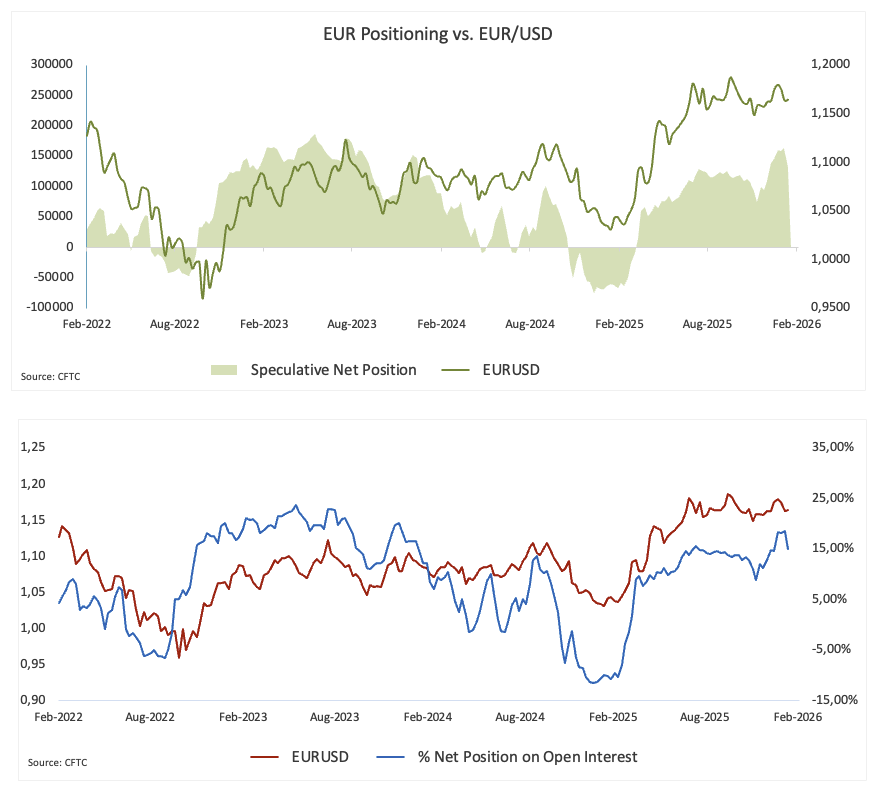
Non-commercial positioning continues to favour the Euro (EUR), though momentum is clearly waning.
According to Commodity Futures Trading Commission (CFTC) data for the week ending January 13, speculative net long positions were reduced to around 132.6K contracts, the lowest level in six weeks. At the same time, institutional players trimmed their short exposure to roughly 179.8K contracts.
Open interest has been rising for a third consecutive week, now nearing 883.7K contracts, or four-week highs, suggesting broader participation even as conviction on the bullish side starts to fade.
What markets are focused on next
Near term: The release of US Personal Consumption Expenditures (PCE) data is unlikely to shift sentiment materially. Instead, attention is likely to centre on preliminary Purchasing Managers’ Index (PMI) releases in the US and the euro area, which should offer a clearer read on momentum.
Risk: A renewed rise in US yields or a more hawkish tilt from the Fed could quickly attract fresh sellers. A clean break below the key 200-day Simple Moving Average (SMA) would open the door to a deeper medium-term correction.
Tech corner
EUR/USD challenged its critical 200-day SMA at 1.1584 before rebounding markedly on Monday. The breach below the latter could prompt spot to slip back toward the November base at 1.1468 (November 5), seconded by the August floor at 1.1391 (August 1).
On the flip side, there is a transitory hurdle at the 100-day SMA at 1.1662, which is expected to be the last defence to a potential assault on the December 2025 peak at 1.1807 (December 24). Once this area is cleared, the pair should face its next up-barrier at the 2025 ceiling at 1.1918 (September 17) ahead of the 1.2000 threshold.
Momentum indicators do not signal further gains for now. Indeed, the Relative Strength Index (RSI) remains around the 45 region, while the Average Directional Index (ADX) near the 19 mark suggests a fairly strong trend.
-1768847798979-1768847798979.png)
Bottom line
For now, EUR/USD is being driven far more by developments in the US than by anything happening in the euro area.
Until the Fed provides clearer guidance on how far it is willing to ease, or the eurozone delivers a more convincing cyclical upswing, any recovery in the pair is likely to be gradual rather than dramatic.
ECB FAQs
The European Central Bank (ECB) in Frankfurt, Germany, is the reserve bank for the Eurozone. The ECB sets interest rates and manages monetary policy for the region. The ECB primary mandate is to maintain price stability, which means keeping inflation at around 2%. Its primary tool for achieving this is by raising or lowering interest rates. Relatively high interest rates will usually result in a stronger Euro and vice versa. The ECB Governing Council makes monetary policy decisions at meetings held eight times a year. Decisions are made by heads of the Eurozone national banks and six permanent members, including the President of the ECB, Christine Lagarde.
In extreme situations, the European Central Bank can enact a policy tool called Quantitative Easing. QE is the process by which the ECB prints Euros and uses them to buy assets – usually government or corporate bonds – from banks and other financial institutions. QE usually results in a weaker Euro. QE is a last resort when simply lowering interest rates is unlikely to achieve the objective of price stability. The ECB used it during the Great Financial Crisis in 2009-11, in 2015 when inflation remained stubbornly low, as well as during the covid pandemic.
Quantitative tightening (QT) is the reverse of QE. It is undertaken after QE when an economic recovery is underway and inflation starts rising. Whilst in QE the European Central Bank (ECB) purchases government and corporate bonds from financial institutions to provide them with liquidity, in QT the ECB stops buying more bonds, and stops reinvesting the principal maturing on the bonds it already holds. It is usually positive (or bullish) for the Euro.
Author

Pablo Piovano
FXStreet
Born and bred in Argentina, Pablo has been carrying on with his passion for FX markets and trading since his first college years.

















