Australian Dollar Price Forecast: Next upside target comes at 0.6800
- AUD/USD advances to multi-day highs, reclaiming the area beyond 0.6700.
- The US Dollar comes under renewed downside pressure on EU-US tariff threats.
- Next on tap in Oz will be the critical labour market report (January 22).
AUD/USD keeps its sidelined trade in place amid the widespread improvement in the risk-associated universe, refocusing its attention on the 0.6700 hurdle and above.
The Australian Dollar (AUD) manages to gather fresh steam in quite a positive start to the new trading week, lifting AUD/USD back above the 0.6700 barrier to hit multi-day tops.
The pair’s renewed bullish attitude comes on the back of a decent pullback in the Greenback, as investors continue to evaluate the latest round of threats from President Trump to several EU countries, all regarding the US stance on Greenland.
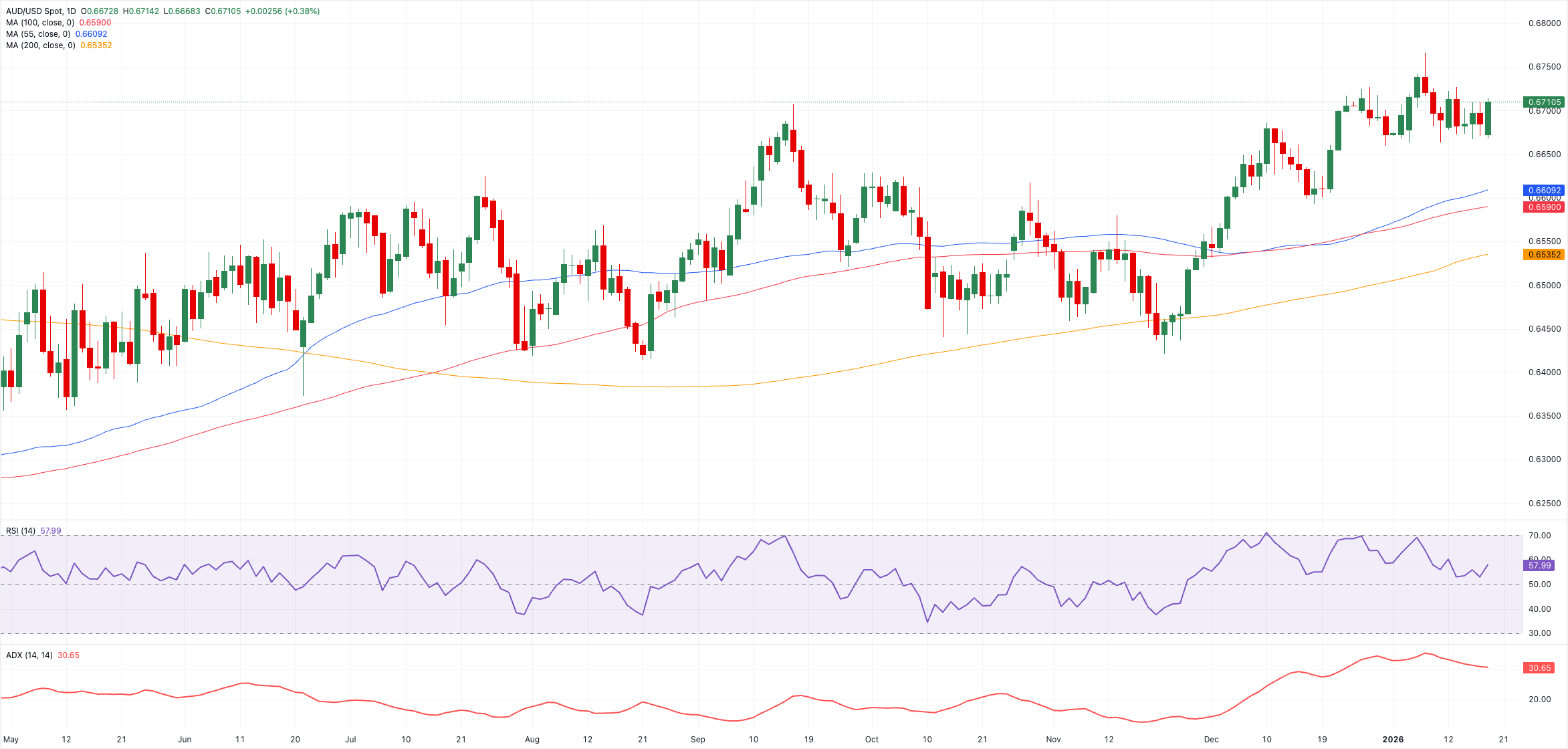
Meanwhile, the pair’s broader picture remains buoyant. That said, spot is still holding above both its 200-week and 200-day Simple Moving Averages (SMAs), at 0.6620 and 0.6530, which keeps the medium-term bias tilted to the upside. Given this context, the recent sideways movement appears to be a temporary pause rather than the beginning of a true trend reversal.
Australia: slowing down, but still on its feet
Australia’s latest run of data hasn’t exactly excited markets, but it hasn’t raised any red flags either. Growth is cooling, yes, but in a way that still fits neatly with the soft-landing story.
The December Purchasing Managers’ Index (PMI) readings were a good example: Both Manufacturing and Services ticked slightly lower, but remained comfortably in expansion territory. Retail Sales are holding up reasonably well, while the trade surplus narrowed to A$2.936 billion in November, still firmly positive.
There are signs that momentum is easing. Gross Domestic Product (GDP) grew 0.4% QoQ in Q3, down from 0.7% previously. That said, annual growth held steady at 2.1%, broadly in line with Reserve Bank of Australia (RBA) forecasts.
The labour market is also cooling gently rather than rolling over. Employment fell by 21.3K in November, but the Unemployment Rate held steady at 4.3%, pointing to moderation rather than outright weakness. Markets will be watching closely when the December labour market report lands later this week.
Inflation remains the most delicate part of the puzzle. Price pressures are easing, but progress is slow. Headline Consumer Price Index (CPI) inflation slowed to 3.4% in November, while the trimmed mean dipped to 3.2%, still uncomfortably above the RBA’s target range. Encouragingly, the Melbourne Institute’s consumer inflation expectations edged lower to 4.6% from 4.7%.
China still helps, just not like it used to
China continues to offer some support to the Aussie, but the impact is far more muted than in past cycles.
The economy grew at an annualised 4.5% pace in the October–December period and 1.2% inter-quarter. Retail Sales rose 0.9% from a year earlier in December. These are solid numbers, but a far cry from the kind of growth that once turbocharged the AUD.
More recent indicators hint at tentative improvement. Both the official Manufacturing PMI and the Caixin index edged back into expansion territory at 50.1 in December. Services activity also firmed, with the non-manufacturing PMI at 50.2 and Caixin’s Services PMI holding at a healthy 52.0.
Trade data stood out as a bright spot. The surplus widened to $114.1 billion in December, with exports up nearly 7% and imports rising 5.7%.
Inflation signals, however, remain mixed. Headline CPI was unchanged at 0.8% over the last twelve months in December, while Producer Price Index (PPI) inflation stayed negative at -1.9%, a reminder that deflationary forces haven’t fully disappeared.
For now, the People’s Bank of China (PBoC) is showing no urgency. Loan Prime Rates (LPR) were left unchanged last month, reinforcing the view that any policy support will be gradual rather than aggressive. The same outcome is expected at Tuesday’s meeting.
RBA stays patient, and resolute
The RBA struck a hawkish hold at its latest meeting, keeping the cash rate unchanged at 3.60% and maintaining a firm policy tone.
Governor Michele Bullock made it clear the central bank isn’t in a hurry to cut rates. She pushed back against expectations of near-term easing, signalling the Board is comfortable staying on hold for longer, and remains prepared to tighten further if inflation refuses to cooperate.
The December Minutes added a bit more nuance, showing policymakers are still debating whether financial conditions are restrictive enough. For now, that keeps rate cuts firmly in the “not a given” camp.
Attention now turns to the Q4 trimmed mean CPI print due later in January, which could help shape the next phase of the policy debate.
Even so, markets are pricing roughly a 28% chance of a rate hike at the February meeting and just over 35 basis points of easing over the course of the year.
Positioning: bearish fatigue, but no real conviction yet
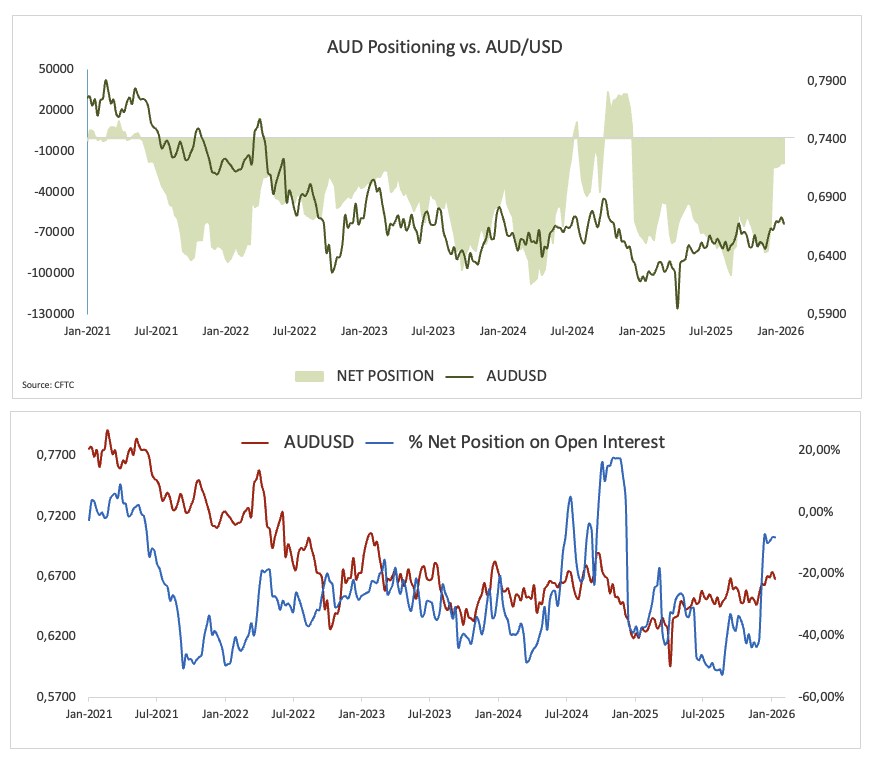
Positioning data suggest the worst of the bearishness may be behind us, but conviction remains thin. Commodity Futures Trading Commission (CFTC) figures for the week ending January 13 showed speculative net short positions in the AUD trimmed slightly, holding near 19K contracts, the smallest bearish stance since September 2024.
Open interest, however, has lost some momentum, easing to around 229.5K contracts. That suggests fresh money is still hesitant to commit, with positioning reflecting caution rather than a decisive shift toward bullish territory.
What markets are watching now
Near term: US data releases and fresh concerns surrounding tariffs should continue to drive the USD side of the equation and the broad-based sentiment. At home, the January 22 labour market report stands out as the key domestic catalyst.
Risks: The AUD remains highly sensitive to swings in global risk appetite. A sudden risk-off move, renewed concerns around China’s outlook, or an unexpected resurgence in the US Dollar could quickly cap any upside.
Technical landscape
Upwards, the next resistance of significance sits at the 2026 ceiling of 0.6766 (January 7), prior to the 2024 top at 0.6942 (September 30), and the 0.7000 milestone.
In case the selling pressure resurfaces, AUD/USD is seen potentially challenging weekly troughs at 0.6659 (December 31) and 0.6592 (December 18), ahead of the 0.6600–0.6585 band, where the transitory 55-day and 100-day Simple Moving Averages (SMAs) are located. Down from here comes the all-important 200-day SMA at 0.6530 prior to the November floor at 0.6421 (November 21).
Meanwhile, extra advances remain in the pipeline as long as the pair navigates the area above its 200-day SMA.
Additionally, momentum indicators keep leaning bullish: the Relative Strength Index (RSI) climbs above the 58 level, while the Average Directional Index (ADX) around 28 indicates a still firm trend.
Bottom line
AUD/USD remains tightly linked to global risk sentiment and China’s trajectory. A clean break above 0.6800 would be needed to send a more convincing bullish signal.
For now, a choppy US Dollar, steady domestic data, an RBA that isn’t blinking, and modest support from China keep the balance tilted toward gradual gains rather than a decisive breakout.
Tariffs FAQs
Tariffs are customs duties levied on certain merchandise imports or a category of products. Tariffs are designed to help local producers and manufacturers be more competitive in the market by providing a price advantage over similar goods that can be imported. Tariffs are widely used as tools of protectionism, along with trade barriers and import quotas.
Although tariffs and taxes both generate government revenue to fund public goods and services, they have several distinctions. Tariffs are prepaid at the port of entry, while taxes are paid at the time of purchase. Taxes are imposed on individual taxpayers and businesses, while tariffs are paid by importers.
There are two schools of thought among economists regarding the usage of tariffs. While some argue that tariffs are necessary to protect domestic industries and address trade imbalances, others see them as a harmful tool that could potentially drive prices higher over the long term and lead to a damaging trade war by encouraging tit-for-tat tariffs.
During the run-up to the presidential election in November 2024, Donald Trump made it clear that he intends to use tariffs to support the US economy and American producers. In 2024, Mexico, China and Canada accounted for 42% of total US imports. In this period, Mexico stood out as the top exporter with $466.6 billion, according to the US Census Bureau. Hence, Trump wants to focus on these three nations when imposing tariffs. He also plans to use the revenue generated through tariffs to lower personal income taxes.
Author

Pablo Piovano
FXStreet
Born and bred in Argentina, Pablo has been carrying on with his passion for FX markets and trading since his first college years.

















