EUR/USD Forecast: Fed´s meeting and Nonfarm Payrolls, two for the price of one
- ECB won't touch rates until September 2019, will the Fed reconsider the 4 rate hikes for this year?
- EUR/USD bearish sentiment increases but fears keep speculators cautious about the future.

An uneventfully ECB meeting put the common currency under pressure this week, with the EUR/USD pair finishing it in the red, but still within familiar levels, at around 1.1660.
The European Central Bank left rates and the QE unchanged, as largely expected, while no relevant changes were made to the usual statement. However, within Draghi's press conference, he was asked about the actual meaning of "through the summer of 2019," in regards to how long with rates remain at record lows, and he clarified that no action should be expected at least until September 2019. Odds of a hike then are now at 57%.
The dollar found additional support at the beginning of the last trading day of the week in comments from US President Trump, who late Thursday, hinted a strong US GDP figure. In a re-opening of a Steel plant, he said that, while not knowing the actual number, he thought " they’re going to be terrific.” The actual number for Q2 growth matched market's expectations, with the economy up 4.1%, the fastest pace of growth in four years. Still, market's reaction was quite limited, as such an outcome was already priced in.
Trade war fears partially ebbed after US President Trump and EU's Juncker met in Washington on Wednesday, as both parts agreed a "new phase" in the trade relationship between both economies. US Trump pulled back from imposing tariffs on cars' imports, and in a joint statement, both pledged to " work together toward zero tariffs, zero non-tariff barriers, and zero subsidies on non-auto industrial goods." There's still a long way to go toward a formal agreement.
However, US confrontation with China over trade continues. Mid-week Trump tweeted: " China is targeting our farmers, who they know I love & respect, as a way of getting me to continue allowing them to take advantage of the U.S. They are being vicious in what will be their failed attempt. We were being nice - until now! China made $517 Billion on us last year." The US government announced this week $12B in subsidies for farmers to sustain agricultural prices, aimed to trim the effect of Chinese retaliatory tariffs on US agricultural products.
The Chinese government announced this week a series of measures to boost local consumption and economic growth, a set of measures aiming to offset effects of US tariffs, combining tax cuts with infrastructure spending. The PBOC injected $74.0B into the banking system, also aimed to prevent an economic slowdown. And while China continues to affirm that they are unwilling to "weaponize" the Yuan, they are actually doing in an incarnate battle with the US.
Next week will be quite a busy one, with German and EU July preliminary inflation and Q2 GDP, US June PCE inflation, and among other relevant figures, the Federal Reserve monetary policy meeting, and the US Nonfarm Payroll report. Regarding this last, the US is expected to have added in July 195K new jobs, the unemployment rate is expected at 3.9% while wages are seen holding within their recent levels, up 0.3% MoM and 2.7% YoY. As for the Fed's meeting, is one of those considered a "non-live" one, with no action expected, although markets will be eagerly looking for any clue on future moves.
EUR/USD technical outlook
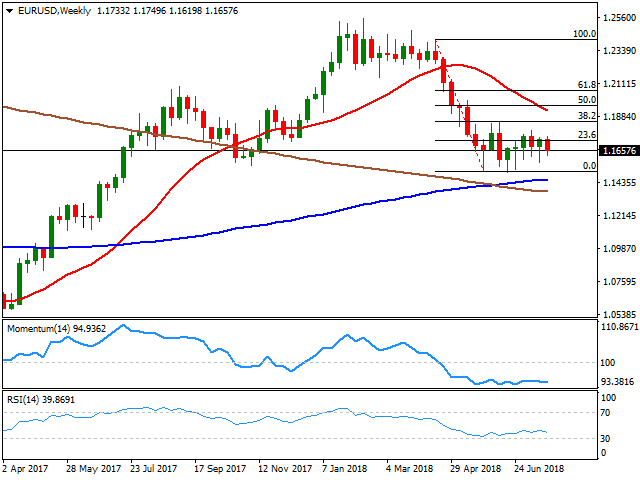
The weekly chart for the EUR/USD pair shows that it was again unable to clear the 23.6% retracement of the April/May decline at around 1.1720, while technical readings maintain the risk skewed to the downside, with the 20 SMA heading sharply south now below the 50% retracement of the same rally, and technical indicators still consolidating within negative levels. In the daily chart, the pair is now below an anyway horizontal 20 SMA, having been hovering around it since late June, but below a strongly bearish 100 DMA, that now converges with the key 1.1855 resistance area, the 38.2% retracement and the high reached during June ECB´s meeting. Technical indicators in this last mentioned time frame hold within negative territory with no certain directional strength, but having lowered their consolidative range when compared to last week's one, leaning the scale toward the downside. Still, summer low volumes may keep the pair subdued for a couple more weeks, particularly if the Fed and NFP don't surprise.
Supports from the current level come at 1.1590, ahead of the yearly lows in the 1.1500 region, with a break below it exposing as first target the 1.1440/60 price zone. To the upside, the pair would need to surpass 1.1790 to retest the key 1.1855 region, with gains beyond this last unlikely considering the current central banks' imbalance.
EUR/USD sentiment poll
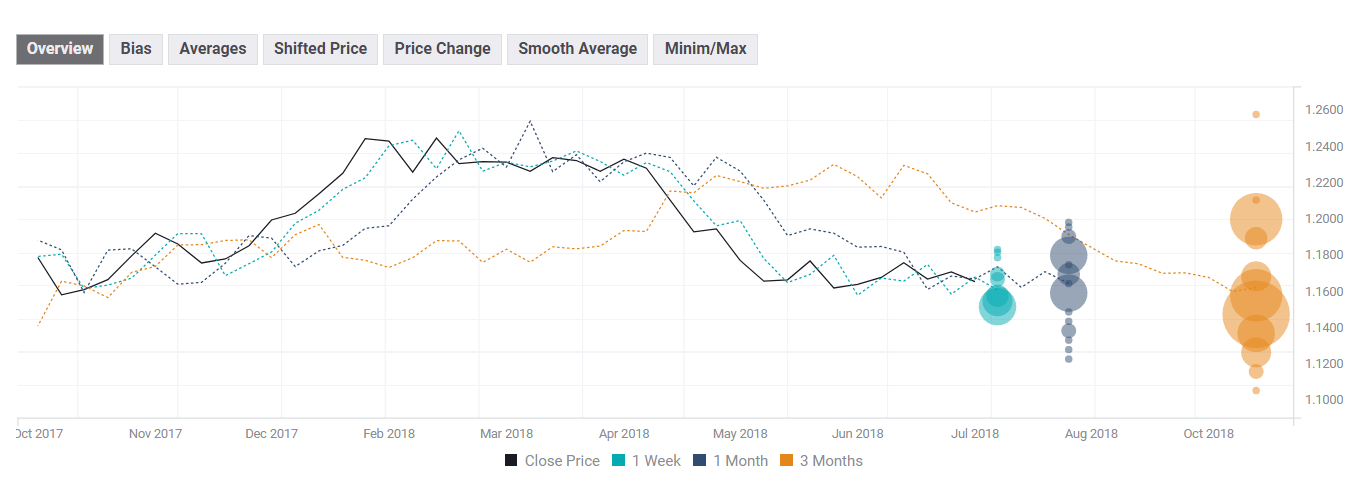
The FXStreet Forecast Poll shows that the EUR/USD pair is set to fall in all the time frames under study, but that the average range of targets shrunk to the 1.1600 price zone. For the weekly view, bears are at 63%, up from 50% last week, while in the monthly perspective, bears increased from 36% to 46%. In the quarterly view, however, they are now at 50%, down from 60% last week. Nevertheless, the Overview FXStreet chart shows that the moving averages present a mild bearish tone, with a large accumulation of possible targets at around 1.1500 for next week, a situation that repeats in the 3-month view. However, in the monthly one, the dispersion is evener. Overall, the bearish sentiment seems to have increased, although speculative interest is not yet ready to fully go short, conditioned by political woes.
Author

Valeria Bednarik
FXStreet
Valeria Bednarik was born and lives in Buenos Aires, Argentina. Her passion for math and numbers pushed her into studying economics in her younger years.

















