Two PMIs, two Chinas
China’s economic data are often treated with a degree of caution by global investors. The challenge is not necessarily that the numbers are incorrect, but that they can describe very different parts of a vast and complex economy. Nowhere is that more evident than in China’s PMIs.
First and foremost, I am, and always have been, extremely sceptical regarding Chinese data. The following remarks are an attempt to shed some light on the different measures used to gauge business activity, either in the manufacturing or the services sector.
Each month, the country publishes multiple surveys measuring industrial activity. On paper they aim to capture the same reality – the direction of China’s manufacturing sector. In practice, these China PMIs often tell two very different stories.
This has been the case so far this year. While one source of the PMIs suggested a minor contraction in business activity, the other gauges pointed to a healthy expansion. What’s going on?
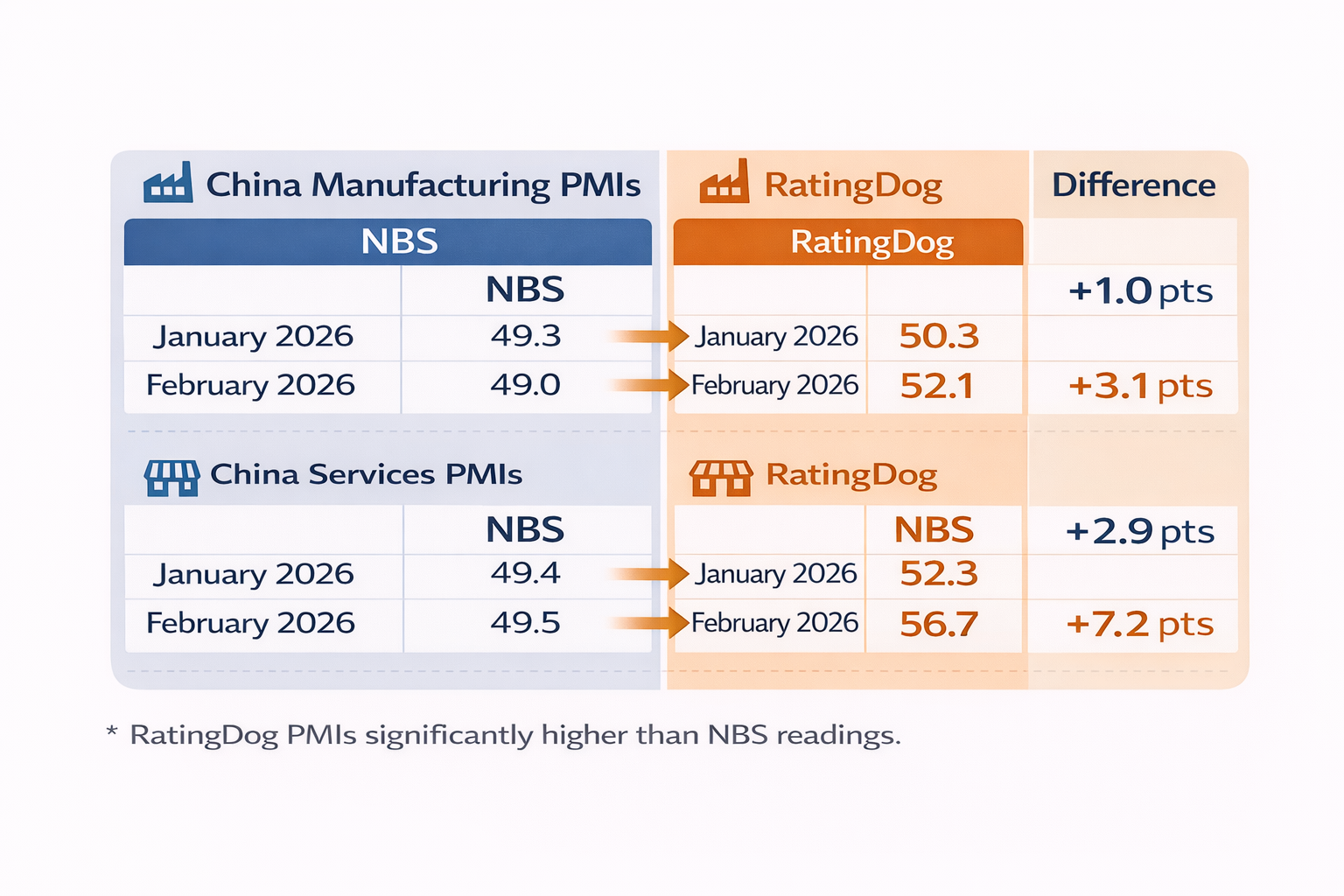
The official Purchasing Managers’ Index released by the National Bureau of Statistics (NBS) tends to signal relative stability. Meanwhile, private-sector gauges such as the RatingDog manufacturing PMI frequently paint a more fragile picture of underlying momentum.
When the two diverge, they reveal something important: they are not necessarily measuring the same China.
The state economy: steadied by policy
The official NBS PMI mainly reflects conditions among China’s large, state-linked companies, particularly those tied to heavy industry. These firms tend to sit much closer to government policy support, infrastructure programmes, and credit stimulus.
So when Beijing opens the liquidity taps or directs funding toward strategic sectors, these companies are usually the first to feel the benefit.
That helps explain why the official PMI often looks relatively stable. Even when momentum in the broader economy appears to be slowing, the parts of the economy most connected to state support can continue to hold up reasonably well.
However, this does not mean the results are inaccurate – they simply reflect the composition of the survey.
Large industrial players remain more insulated from cyclical volatility and policy tightening.
The private economy and the global demand
On the flip side, the RatingDog PMI attempts to reflect smaller and more export-orientated manufacturers. These firms’ activity is closer to the pulse of global demand and domestic consumption trends.
That said, these companies could feel the pressure earlier when external demand softens or financing conditions tighten.
This is why this index can sometimes look more cautious when it comes to China’s underlying growth momentum.
Indeed, when activity in this sector struggles, the implications extend well beyond the country’s borders. They sit at the centre of global supply chains and trade flows.
Divergence as a signal
Furthermore, periods of divergence between the two PMIs are not unusual, and they often highlight that the economy appears to be moving at different speeds.
Policy assistance, infrastructural investment, or strategic industrial initiatives may help state-supported industries. At the same time, smaller manufacturers and exporters have to deal with lower demand and narrower margins.
Global markets are always watchful of that split.
China’s headline growth may appear stable if state investment remains strong. But the private sector often provides a clearer signal about underlying momentum in trade, manufacturing and global demand.
Why markets watch closely
For global markets, the divergence between China’s PMIs is more than a statistical curiosity.
When those signals move apart, the question is not which one is right, but which part of China’s economy is gaining momentum.
Commodity markets tend to watch the answer closely.
If the private manufacturing sector struggles while policy-supported industries hold up, China’s demand for raw materials can soften at the margin even as headline activity appears stable.
For currencies closely tied to China’s industrial cycle, such as the Australian Dollar, those shifts rarely go unnoticed.
The PMIs may measure the same economy. But when they diverge, they can send very different signals to global markets.
Bottom line
China’s two PMI surveys measure the same economy, but they often capture different realities.
When they diverge, they reveal the fault lines between the country’s state-backed industrial engine and its more market-sensitive private sector.
For global markets trying to gauge the true direction of China’s economy, those differences can matter just as much as the headline growth figures themselves.
Author

Pablo Piovano
FXStreet
Born and bred in Argentina, Pablo has been carrying on with his passion for FX markets and trading since his first college years.

















