EUR/USD Forecast: Bears taking over, but Fed in the way
- Central banks not done with extraordinary measures, worst of the outbreak still to be seen.
- US Federal Reserve is foreseen cutting rates by 100 basis points to 0%-0.25%.
- EUR/USD bullish potential to remain capped by economic imbalances.

The EUR/USD pair is ending the week with losses after trading as high as 1.1496 on Monday, a level that was last seen in January 2019. The pair gapped higher on Monday, as the greenback collapsed alongside with Wall Street, both hit by recession-related fears amid the coronavirus outbreak taking its toll on the worldwide economy.
Panic and economic stimulus
Fear was also fueled by Saudi Arabia declaring war to Russia, after this last refused to agree on further production cuts, leading to the first to slash prices and boost production. Speculative interest rushed into safety, particularly demanding US government bonds, which further fueled fears of a US economic collapse while boosting demand for the greenback at the same time.
Wall Street had its worst weekly performance in decades, central banks and global leaders announced liquidity injections and other counter-measures, although the market didn’t feel it was enough.
US President Trump pitched a payroll tax break in an effort to reduce the impact of the coronavirus on the economy, although his announcement didn’t bring relief. It was the Federal Reserve that put a brake on panic, as the New York Federal Reserve pumped massive liquidity into the financial system through a $500B repo operation and announcing plans to pump at least $1.5 trillion. Also, the Federal Reserve compromised to start buying Treasuries.
The ECB had a monetary policy this week and refrained from cutting rates, but policymakers announced a series of measures to support bank lending and expanded its asset purchase program by 120 billion throughout the year. Additionally, the EU Commission announced this Friday a series of measures to support the economy of the Union, which include setting up 27 billion euros to respond to the coronavirus crisis.
Data still indicates the US in better shape than the EU
Data coming from both shores of the Atlantic has been ignored. Still, worth mention that EU Q4 GDP was confirmed at 0.1%, reflecting the bad shape of the Union’s economy ahead of the crisis. US inflation, on the other hand, surprised to the upside, with the core annual CPI up by 2.4% in February, while the preliminary estimate of March Michigan Consumer Confidence beat expectations, printing at 95.9.
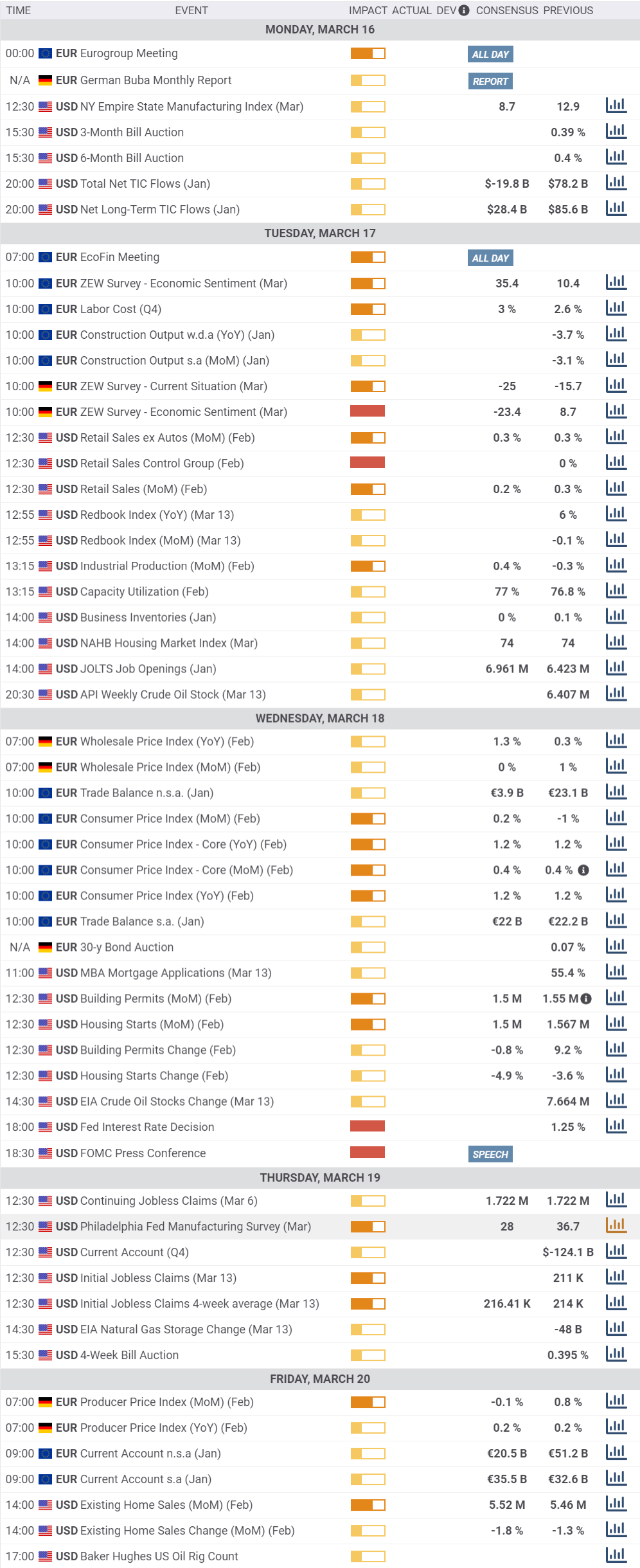
Given the speed of coronavirus and stimulus developments, seems data will continue to be ignored by market players. As most figures are usually referring to what happened in the previous months, the lesser the impact will have on price. That could be the case of US February Retail Sales, to be out next Tuesday. More relevant would be the German March ZEW Survey, as it will reflect the current sentiment among European business.
The event of the week, however, will be the US Federal Reserve decision next Wednesday. After the 50bps emergency cut from the previous week, the central bank is expected to trim rates further, with some analyst calling for a reduction of 100 basis points to 0%-0.25% at this scheduled meeting.
EUR/USD technical outlook
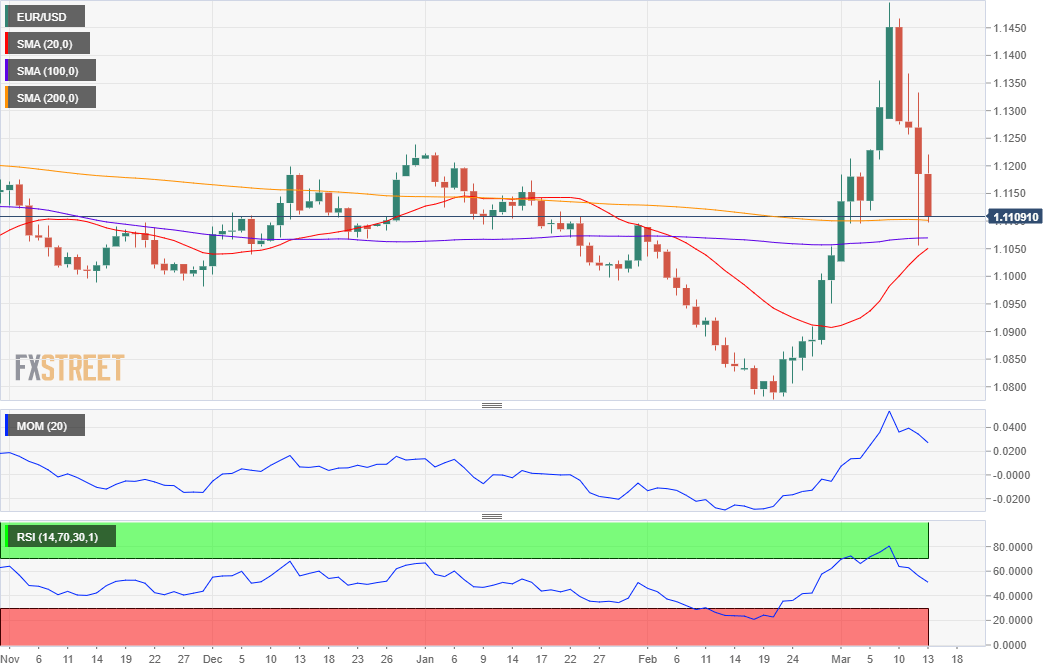
The EUR/USD pair is barely holding above 1.1100, and the weekly chat shows that despite the spike, it was unable to extend gains beyond the 100 and 200 SMA, both converging around 1.1320. The 20 SMA remains directionless, providing mild-support around the weekly low of 1.1054. Technical indicators, in the meantime, turned sharply lower, losing their bullish strength and poised to challenge their midlines, a sign that the market is not ready to trigger a sustainable bullish trend.
The daily chart also shows that technical indicators are nearing their midlines with strong downward slopes and coming from extreme overbought levels. Nevertheless, the pair seems comfortable above moving averages, with the 20 SMA still advancing below the larger ones, indicating is too early to call for a bearish extension.
Erratic sentiment will likely see the pair moving back and forth alongside coronavirus-related headlines until the US Federal Reserve announcement next Wednesday. A shy rate cut could boost the dollar and send the pair below the psychological 1.1000 level. Below it, 1.0920 and 1.0840 are the next bearish targets. Resistances are located at 1.1175, 1.1240 and the 1.1300 figure.
EUR/USD sentiment poll
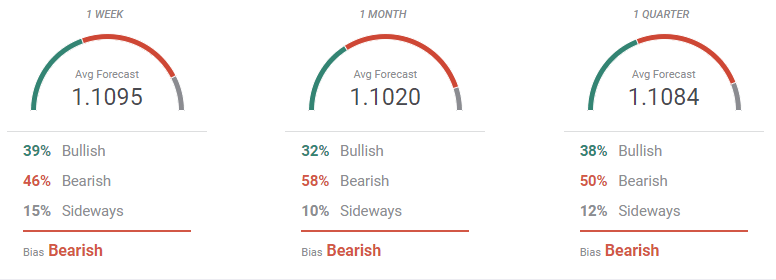
The FXStreet Forecast Poll indicates that the market is willing to keep on selling the pair, seen bearish in the three time-frame under study, although holding above 1.1000 on average. Still, the number of those betting for a recovery is below 40% in all cases, further reinforcing the idea of more slides ahead.
In the overview chart, the weekly moving average offers a sharp bearish slope, which eases in the monthly view. The 3-month media remains flat. Anyway, it seems that investors are on hold ahead of the Fed’s announcement rather than having a clear perspective on where to go next.
Related Forecasts:
Gold Price Forecast: Coronavirus, Oil War and King Dollar
GBP/USD Forecast: Can the UK's leadership advantage dethrone King Dollar? Coronavirus, Fed eyed
Author

Valeria Bednarik
FXStreet
Valeria Bednarik was born and lives in Buenos Aires, Argentina. Her passion for math and numbers pushed her into studying economics in her younger years.