United States: A "K-shaped" investment


Investment in the digital sector, most recently driven by the optimism surrounding artificial intelligence (AI), has become a major driver of US growth.
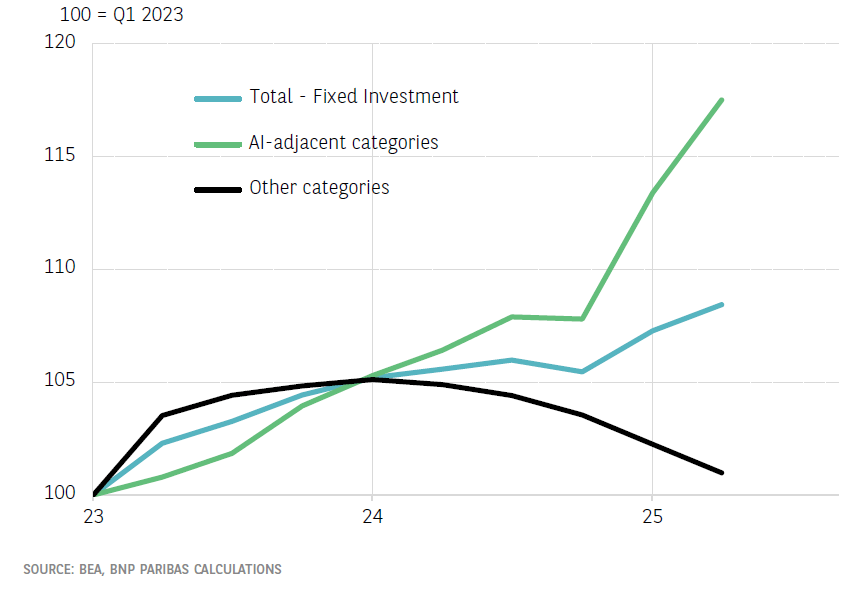
In the first half of 2025, private fixed investment in adjacent categories accounted for 40% of GDP growth (y/y), while its share of GDP was only 9%. Since the end of 2022, investment in data centres and IT equipment has grown by 195% and 61%, respectively. At the same time, investment in non-AI-adjacent components has contracted (see chart). As a result, the US private-investment dynamics are occurring within a “K-shaped” economy. The component that is growing (AI, in this case) is supporting part of the investment and growth potential, but this is adversely affecting the components at the same time. This knock-on effect may be linked to the high cost of AI investments.
US private fixed investment in GDP (volume)
However, investment in AI is particularly import-intensive, which reduces its direct positive impact on growth.
During the first three quarters of 2025, the US trade deficit in digital-related goods widened significantly, rising to USD 84 billion from USD 59 billion in 2024 (quarterly average, in nominal terms). Furthermore, this deficit continued to widen throughout the year, unlike the goods trade deficit as a whole, revealing a specific dynamic for these products. Therefore, it’s not just Americans that are winning out from AI. Indeed, these imports are supporting global trade dynamics and, therefore, growth in the rest of the world, particularly in Asian countries.
Author
BNP Paribas Team
BNP Paribas
BNP Paribas Economic Research Department is a worldwide function, part of Corporate and Investment Banking, at the service of both the Bank and its customers.

















