EUR/USD Forecast: After losing support, the Fed and GDP figures to determine next moves
- EUR/USD has been under pressure amid Trump's tariff threats.
- The Fed decision and GDP figures are set to rock the pair.
- Late January's daily chart is showing the pair lost uptrend support.
- The FX Poll shows rises in the medium and long terms.

The Sino-American trade deal has boosted the mood, but now President Donald Trump is focusing on Europe. EUR/USD has failed to recover amid fears of auto tariffs, a cautious central bank and despite upbeat figures. Will it extend its falls? The last week of the first month of 2020 features the Fed, GDP from both sides of the Atlantic, EZ inflation, and more.
This week in EUR/USD: Upbeat figures, tariff fears
One trade front is closed, but another one has opened. While visiting the World Economic Forum in Davos, the US president met his French counterpart Emmanuel Macron and both men agreed to refrain from new tariffs on each others' countries.
However, Trump later threatened to slap levies on European cars if negotiations fail to advance. The US is unhappy with France's tech tax and with an alleged imbalance in automobile tariffs.
His comments – echoed by other American officials – weighed on the euro. EUR/USD failed to recover even when the dollar came under broad selling pressure amid diminishing fears.
The coronavirus scare initially sent investors to the safety of the greenback and the yen. However, China's steps to curb the spread of the respiratory disease later calmed markets. A case of the SARS-like virus was also reported in America, but the danger seems limited.
The European Central Bank left its policy unchanged and announced a strategic review, as expected. What moved the euro – to the downside – was the caution regarding the recent upbeat economic data. President Christine Lagarde's lackluster comments on the latest data and also her inclusion of climate considerations – that could mean additional stimulus – both weighed on the common currency.
Germany's ZEW Economic Sentiment beat expectations with 15 points – but the common currency's bounce was only temporary.
The same reaction was seen in response to upbeat German Purchasing Managers' Indexes. The forward-looking figures for both the services and manufacturing sectors exceeded forecasts in January, but the rise of EUR/USD was short-lived.
While Trump spent time in Davos, his impeachment trial kicked off back home. Mitch McConnell, the Senate majority leader, set out a tight timetable and refrained from summoning witnesses. The Republicans aim to conclude the process as soon as possible. Without any significant dissents, politicos expect a quick acquittal.
Euro-zone events: IFO, GDP, and inflation eyed
Headlines coming out of EU-US negotiations may continue impacting the euro. Trump complained about the harsh attitude of Jean-Claude Juncker, the former President of the European Commission. His successor Ursula von der Leyen – and the European Commissioner for Trade Phil Hogan – could be even harder to deal with. In his previous role in the Irish government, Hogan criticized Britain's Brexit policy, angering the government in London.
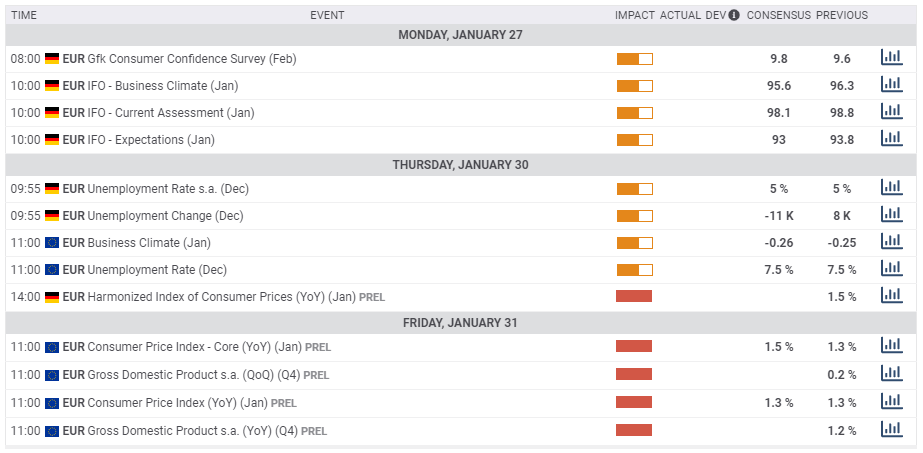
After ZEW and PMIs, the last significant business survey comes from IFO on Monday. Economists expect Germany's No. thinktank to show a minor decline in its Business Climate gauge as well as other figures.
The continent's powerhouse remains in the spotlight on Tuesday. The number of unemployed disappointed with an increase in November, and December's statistics are set to show a recent decline. Preliminary German Consumer Prices Index data sets the stage for the all-European figure on the following day.
The best is kept for last. On Friday, the eurozone publishes initial CPI estimates for January. While headline prices are forecast to rise to 1.5% annually, economists expect Core CPI to remain unchanged at 1.3%. The ECB is closely watching.
Updated Gross Domestic Product figures are published at the same time, and they will likely confirm the 0.2% quarterly growth rate in the fourth quarter. Any deviation would rock the euro.
The bigger question for markets is: will the German government open its purse strings? Apart from the ECB's constant calls, Berlin is also pressured by Brussels – the European Commission's ambitious Green Deal requires spending to reach the 2050 carbon-neutral goal. Any such signs from the continent's locomotive may boost the euro while sticking to its fiscal orthodoxy will likely keep the lid on the common currency.
Here are the events lined up in the euro-zone on the forex calendar:
US events: Fed and GDP compete for attention
While the US wants to advance with Phase Two of the trade talks soon, China seems reluctant, and many expect earnest negotiations only after the US presidential elections.
Trump's impeachment trial continues in Washington, but as long as critical witnesses remain out of the debate, markets are unlikely to react to the political drama. The Republican-controlled Senate is set to acquit Trump, probably in early February.
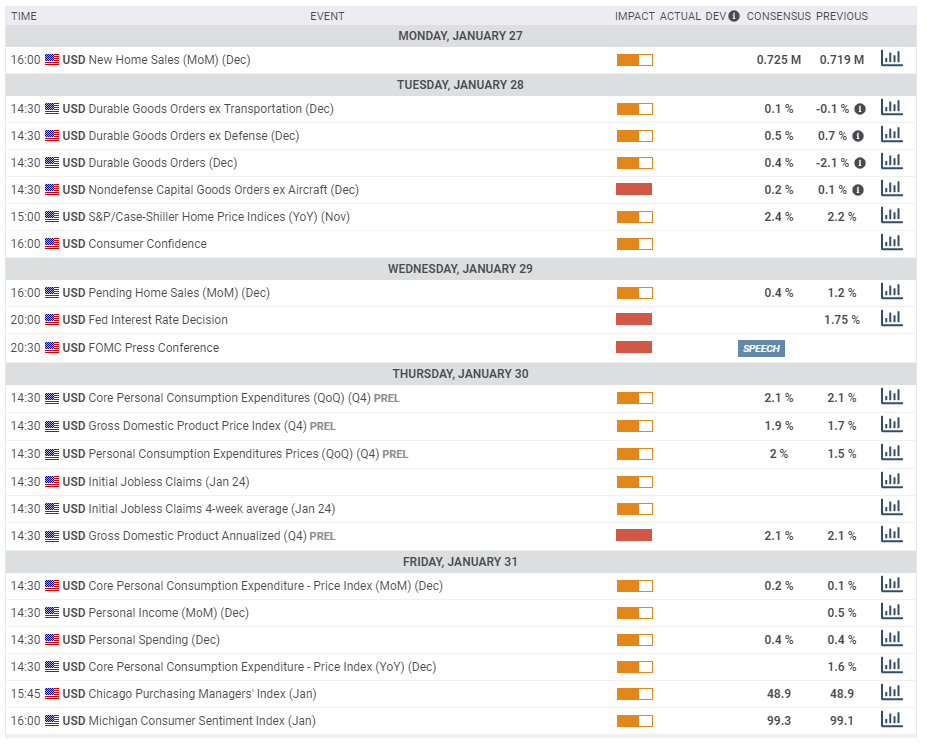
The US economic calendar is busy. It starts with New Home Sales for December, which are forecast to hold onto elevated levels above 700K annualized.
Durable Goods Orders for the last month of 2019 will be closely watched, as these investment figures feed into growth calculations. After a substantial drop in November, a bump up is on the cards. The nondefense ex-aircraft measure – the "core of the core" – is projected to edge up as well.
The Federal Reserve announces its initial decision for 2020, and it is expected to leave the interest rate unchanged. After three consecutive cuts, the Fed signaled that it is taking a long pause as officials are satisfied with the economic situation and with their policies.
Jerome Powell, Chairman of the Federal Reserve, set a higher bar for raising rates than for cutting them. A deteriorating outlook would be sufficient for a rate cut. On the other hand, he would wait for inflation to sustainably top the 2% level before considering a hike to borrowing costs. Will this skepticism about inflation persist? Hints about future borrowing costs and several other factors are set to rock markets.
See Fed Preview: Five things that will determine the dollar's direction
The action continues after the Fed, primarily with the first release of GDP figures for the fourth quarter of 2019. After posting annualized growth of 2.1% in the third quarter, economists expect the expansion to have hovered around the 2% mark once again. Apart from the headline, markets will want to see a pick up in investment that has been lagging behind robust consumer spending.
It is essential to note that the Fed probably receives early access to the figures, and Chair Powell may drop a hint ahead of the publication is he is not cautious enough.
The central bank's preferred gauge of inflation is the last substantial release of the week. The Core Personal Consumption Expenditure gauge stood at 1.6% in November and will likely remain around those levels in the report for December. Personal Income, Personal Spending, and also the revised version of the University of Michigan's Consumer Sentiment are of interest.
Here are the scheduled events in the US:
EUR/USD Technical Analysis
Euro/dollar broke below the uptrend support that accompanied it hit 1.0879 – 2019 low – in early October. The world's most popular currency pair crashed below the 100-day Simple Moving Average and completed the loss of the trio of the 50, 100, and 200-day SMAs. The Relative Strength Index is still above 30, thus shying away from oversold conditions.
All in all, bears are in firm control.
Support awaits at 1.0980, which was the low point in December. It is followed by 1.0925, a double-bottom dating back to the summer. The 1.0879 level mentioned earlier is the next level to watch.
1.1040 was a swing low in December and is still fought over. Further resistance awaits at 1.1120, which worked as both support and resistance in January. It is followed by 1.1175, a high point earlier in the month. The late December peak of 1.1240 is the next upside target.
-637154584477019455.png)
EUR/USD Sentiment
How long can the common currency ignore improving fundamentals? EUR/USD has room to rebound from the lows, especially if the Fed echoes the ECB's caution.
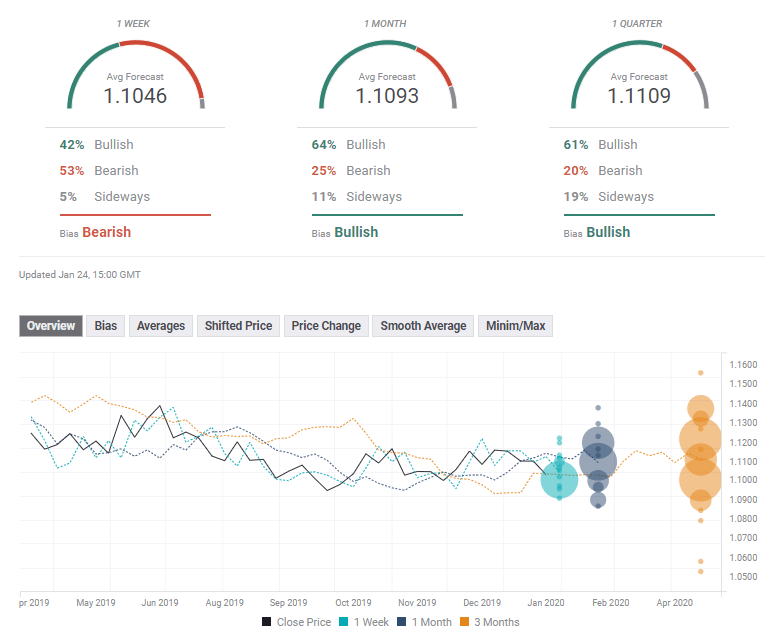
The FXStreet Poll is showing a bearish trend in the short term and rises afterward. However, the ranges remain tight, reflecting recent low volatility. Average targets have been marginally revised to the downside.
Related Forecasts
- EUR/USD Price Forecast 2020: Lean times soon to turn into flush times for euro dollar
- GBP/USD Forecast: Hundreds of pips at stake on the BOE's close call, Fed, Brexit also eyed
- USD/CAD Forecast: Welcome to the statistical derby
Author

Yohay Elam
FXStreet
Yohay is in Forex since 2008 when he founded Forex Crunch, a blog crafted in his free time that turned into a fully-fledged currency website later sold to Finixio.

















