Fed Preview: Five things that will determine the dollar's direction
- The Federal Reserve is set to leave interest rates unchanged in its January meeting.
- Markets would like to know the Fed's take on recent data and hints about future moves.
- There are five key topics to watch out for.

"The current rate is appropriate" – These words by the Federal Reserve in December set the stage for a long pause in changing interest rates. The world's most powerful central bank's words accompanied the third consecutive cut of borrowing costs, that it had previously labeled as a "mid-cycle adjustment."
In the upcoming decision – the first in 2020 – the Fed is set to make good on its pledge to hold onto the current Federal Funds Rate of 1.75%. Contrary to the previous event, the bank does not publish new forecasts. Nevertheless, the Fed's statement and the accompanying press conference by Jerome Powell, Chairman of the Federal Reserve still consist of significant information to chew on.
What happened since the Fed's last meeting?
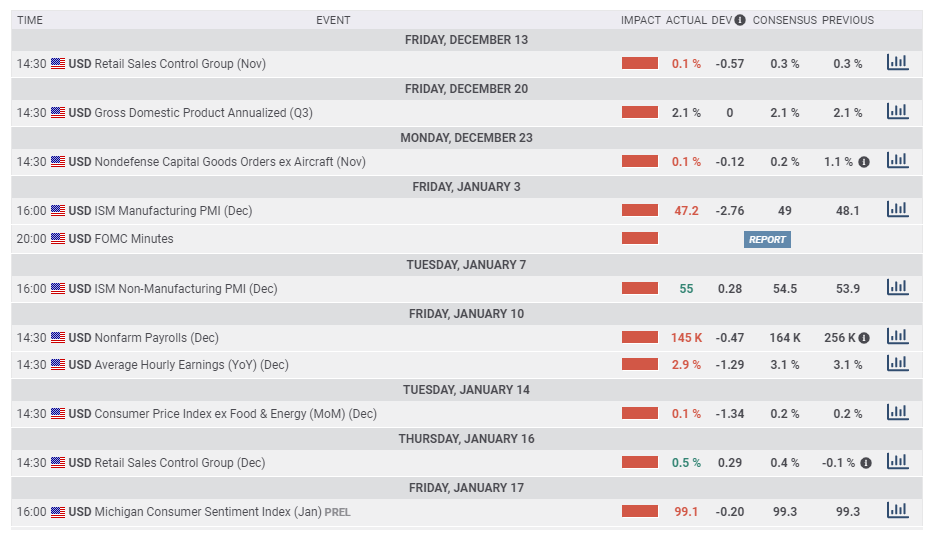
Since mid-December, economic indicators have been leaning lower. Retail sales figures disappointed in November but rebounded in December. Third-quarter growth was confirmed at 2.1% while yearly core inflation stood at 2.3%.
The last jobs report for 2019 disappointed with only 145,000 jobs gained and wage growth decelerating to 2.9%. The University of Michigan's Consumer Sentiment for January ticked down but remained at a high level of 99.1 points. ISM's forward-looking Purchasing Managers' Indexes have shown a growing divide between the slump in manufacturing and the robust services sector.
But while economic indicators were on the softer side, the political landscape has improved. On the day following that December decision, Brits handed a landslide victory to the Conservatives, providing clarity on Brexit. More importantly for the global and local economies, the US and China signed Phase One of the trade deal, alleviating fears of further tit-for-tat tariff hikes.
Here are five things to watch out for:
1) Dovish bias
Fed Chair Powell set a higher bar for raising rates than for cutting them. A deteriorating outlook would be sufficient for a rate cut. On the other hand, he would wait for inflation to sustainably top the 2% level before considering a hike to borrowing costs.
He laid down this asymmetry back in October and confirmed it in December. The stance stems from skepticism about inflation. Economists are baffled by the breakdown of the correlation between low unemployment and rising inflation. Powell and several of his colleagues have seemed to throw the towel and expect weak price development to last for an extended period.
Given stagnant inflation and slowing wage growth, Powell is likely to confirm his approach. In this case, it would be mildly dollar negative. In the unlikely scenario that he abandons this bias, the dollar has room to shoot higher.
2) Is growth good enough?
The "new normal" refers to a mediocre Gross Domestic Product growth rate of 2-2.5%. The world's largest economy received a sugar rush in 2018 via President Donald Trump's tax cuts. However, the expansion rate has returned to the well-known range.
Powell will likely express dry satisfaction with recent GDP rates, leaving other topics to impact the dollar. However, if he is overly enthusiastic, such as saying that the economy is "doing very well" as he did in 2018, the greenback has room to rise. Conversely, if the Fed Chair is concerned, the currency may suffer.
The tone on growth has an additional purpose – serving as a clue towards Thursday's first release of GDP for the fourth quarter. Powell, as well as a few other privileged top officials, have early access to the figures. Any hint may not only have an immediate impact on markets but could also shape expectations for the following day's publication.
3) Any dissents?
Several voting members have dissented from supporting the Fed's rate cuts in 2019. Esther George, President of the Kansas City branch of the Federal Reserve, and Eric Rosengren, her peer from Boston, both objected to the rate reductions. And in September, James Bullard, their peer from the Saint Louis Fed, voted for slashing borrowing costs by a double-dose of 50 basis points.
The voting composition changes every year and it will be interesting to see if Powell managed to unify the Federal Open Markets Committee (FOMC) around the stance of the long pause. Recent statements suggest that all are on board.
If one member surprises and supports a rate hike, the dollar may advance while a dovish dissent could send the dollar falling. Both phenomena would be surprising given the recent statements.
4) Is the labor market losing momentum?
The last year of the decade saw a drop of 21% in net job creation in comparison to 2018. Zooming out to the full decade, it was one of the slowest years, ranked eight. Wage growth decelerated in December to 2.9% yearly the first drop below the 3% mark since mid-2018.
Should these figures concern the Fed?
Not so fast. The Unemployment Rate held at 3.5%, the lowest in 50 years. Moreover, the Underemployment Rate – a broader measure that includes discouraged people and those who work part-time but seeks full-time positions – fell to 6.7%, a 25-year low.
Will Powell see the glass half full or half-empty? The bank has been upbeat on the labor market, so repeating this positive stance is unlikely to move markets. In case the Fed is worried about the most recent trends, the greenback may drop.
5) Happy with trade?
The Washington-based institution cited trade uncertainty – stemming from their neighbors in the American capital – as one of the reasons for cutting rates. After the US and China signed the trade deal, markets expect the Fed to acknowledge this development and express optimism.
However, the success of Phase One depends on China buying a vast amount of US goods – and that will happen only if prices are "competitive" – as Beijing phrases it. Moreover, it is unclear when and how Phase Two talks will shape out.
Also, President Donald Trump has upped the ante against Europe, threatening to slap tariffs if negotiations on contentious issues are not resolved. If the Fed errs to the side of caution, markets may suffer and the greenback may benefit from safe-haven flows – albeit not against the yen.
Conclusion
While the Federal Reserve is set to leave its policy unchanged in its first meeting of 2020, five topics are high on the agenda for markets. These are the bias on interest rates, the approach toward growth, dissents within the FOMC, comments on the labor market, and on trade.
Author

Yohay Elam
FXStreet
Yohay is in Forex since 2008 when he founded Forex Crunch, a blog crafted in his free time that turned into a fully-fledged currency website later sold to Finixio.