|

EUR/USD falls to new 20-year low

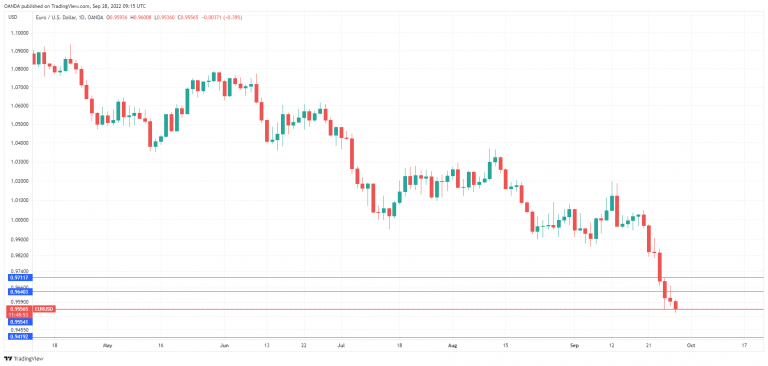
The euro is in negative territory today, after posting six straight days of losses. EUR/USD is trading at 0.9553 in Europe, down 0.41%.

Referendums, Nord Stream explosions weigh on euro

September can’t end fast enough for the euro, which has declined a massive 4.8% against the dollar. Earlier today, EUR/USD fell to 0.9536, its lowest level since June 2002. With the war in Ukraine escalating and Nord Stream reporting that its pipeline was deliberately damaged, it’s hard to be optimistic about the euro’s outlook.

The sham referendums in Russian-occupied Ukraine have ended and predictably, the vote to join Russia was close to 100%. Moscow could announce as early as Friday that the territories are being annexed to the Russian Federation, sparking fears that Russia could resort to nuclear weapons to defend what it claims is Russian territory.

There was a further escalation in the Ukraine war last week, as explosions at the Nord Stream 1 and 2 pipelines are suspected to have been sabotaged. Nord Stream 2 has been shelved and Nord Stream 1 has been shut down for weeks, and any faint hopes that Russia might renew gas exports through Nord Stream have been dashed. European natural gas prices have jumped in response to the news.

The US dollar continues to rally, and 10-year Treasury yields pushed above 4.00% earlier today, for the first time since 2008. The markets are showing a healthy respect for Fed hawkishness, even after inflation weakened in the past two inflation reports. There is some optimism that the current rate-tightening cycle is reaching its end, with Fed member Evans stating that it will be appropriate to slow the pace of tightening at some point. For now, the US dollar has momentum, driven by an aggressive Fed and weak risk appetite.

EUR/USD technical

  • EUR/USD is testing support at 0.9554. Next, there is support at 0.9419.

  • There is resistance at 0.9640 and 0.9711.
EURUSD

Author

Kenny Fisher

Kenny Fisher

MarketPulse

A highly experienced financial market analyst with a focus on fundamental analysis, Kenneth Fisher’s daily commentary covers a broad range of markets including forex, equities and commodities.


More from Kenny Fisher
Share:

Editor's Picks

GBP/USD off highs, back to 1.3620

GBP/USD remains slightly on the defensive at the end of the week, receding to the low 1.3600s after hitting fresh tops past 1.3670 earlier in the day. Cable’s correction comes after two daily gains in a row and amid a tepid advance in the Greenback, while poor UK data also accompany the downside.

EUR/USD treads water below 1.1700

EUR/USD now trades with modest losses around 1.1670 following another unsuccessful atempt to advance past 1.1700 the figure in a convincing fashion. The pair’s decline follows a maginal rebound in the US Dollar as market participants continue to assess recent US data as well as developments from the US bond market.

Gold trims gains, recedes to the sub-$4,600 area

Gold rapidly leaves behind Thursday’s inconclusive price action and advances markedly on Friday, briefly surpassing the $4,600 mark per troy ounce to hit three-month peaks. Meanwhile, the precious metal’s solid performance comes despite marginal gains in the buck coupled with another day of rising US Treasury yields across the curve.

Crypto Today: Bitcoin, Ethereum, XRP bulls accelerate rally amid rising ETF inflows

The cryptocurrency market remains bullish on Friday, led by Bitcoin’s surge above $77,000. Altcoins, including Ethereum and Ripple, mirror BTC’s positive outlook, trading near $2,400 and $1.35, respectively.

Week ahead – Fed’s Jackson Hole and Nvidia earnings to dictate markets

Kevin Warsh to make his Jackson Hole debut amid confusing messaging. But a major hawkish surprise unlikely after bond market intervention. Nvidia earnings to also determine market direction as stock rally cools.

$20 billion offered, $2 billion taken: Why Treasury doubled its buyback cap

The US Treasury moved off its own calendar on Wednesday, and that is the part worth sitting with. At 12:32 GMT, the department said it would at least double the size of liquidity support buyback operations in the 10-year to 20-year and 20-year to 30-year sectors, lifting the maximum from $2 billion per operation to at least $4 billion, effective September 9 and running to November 4.