Australian Dollar Price Forecast: A corrective move could be shaping up
- AUD/USD finally revisits the 0.7000 barrier and a tad above on Wednesday.
- The US Dollar’s sell-off meets some respite ahead of the Fed meeting.
- Australian inflation data seem to reinforce the idea of an RBA rate hike next week.

Despite the small pullback, the outlook for AUD/USD remains tilted to extra gains in the short-term horizon, helped by renewed weakness in the Greenback and the likelihood of an interest rate hike by the RBA at its gathering on February 3.
The Australian Dollar (AUD) built on its recent strength on Wednesday, lifting AUD/USD to the psychologically important 0.7000 handle for the first time in a while, although some steam faded soon after.
That loss of momentum came as the US Dollar (USD) staged a marked rebound, clawing back part of its recent multi-day slide as markets positioned ahead of the upcoming Federal Open Market Committee (FOMC) meeting.
Australia: cooling, not cracking
Recent Australian data may not have impressed at first glance, but they still point to an economy easing gently rather than rolling over. On this, growth momentum has slowed, but the broader soft-landing narrative remains intact.
January’s Purchasing Managers’ Index (PMI) surveys reinforce that view. Both Manufacturing and Services activity improved and stayed comfortably in expansion territory, with readings of 52.4 and 56.0, respectively. Retail Sales continue to hold up reasonably well, and while the trade surplus narrowed to A$2.936 billion in November, it remains firmly positive.
Economic growth is cooling, but only gradually. Gross Domestic Product (GDP) rose 0.4% inter-quarter in the July–September period, down from 0.7% previously. On an annual basis, growth held steady at 2.1%, exactly in line with RBA projections.
The labour market remains a clear bright spot. Employment surged by 65.2K in December, while the Unemployment Rate unexpectedly edged down to 4.1% from 4.3%.
Inflation, however, continues to be the awkward piece of the puzzle. December’s Consumer Price Index (CPI) surprised to the upside, with headline inflation jumping to 3.8% YoY from 3.4% previously. The policy-relevant trimmed mean came in at 3.3% from a year earlier, matching consensus and slightly above November’s 3.2%, but crucially overshooting the RBA’s own 3.2% December forecast. On a quarterly basis, trimmed mean inflation rose to 3.4% year-on-year in Q4, its highest since Q3 2024. That combination keeps the case for a 25 basis points hike at the February 3 meeting firmly alive.
China: steady support, no spark
China continues to provide a supportive backdrop for the AUD, though without the fireworks seen in past upswings.
The economy expanded at an annualised pace of 4.5% in the October–December quarter, with quarterly growth of 1.2%. Retail Sales rose 0.9% over the last twelve months in December. Solid readings, but not the kind that typically trigger sharp AUD rallies.
More recent data point to stabilisation rather than acceleration. Both the official Manufacturing PMI and the Caixin index nudged back into expansion territory at 50.1 in December. Services activity also improved, with the Non-Manufacturing PMI at 50.2 and the Caixin Services PMI holding at a healthy 52.0.
Trade was one of the few clear bright spots: The surplus widened sharply to $114.1 billion in December, helped by a near-7% surge in exports alongside a solid 5.7% rise in imports.
Inflation, however, remains a mixed picture, as the consumer price inflation was unchanged at 0.8% YoY in December, while producer prices stayed in negative territory at -1.9%, a reminder that deflationary pressures have not fully disappeared.
For now, the People’s Bank of China (PBoC) is sticking to a cautious stance. Loan Prime Rates (LPR) were left unchanged earlier in January at 3.00% for the one-year and 3.50% for the five-year, reinforcing expectations that policy support will remain gradual rather than aggressive.
RBA: no rush, no pivot
The RBA struck a firm tone at its December meeting, leaving the Official Cash Rate (OCR) unchanged at 3.60% and signalling little urgency to tweak policy.
Governor Michele Bullock pushed back against expectations of near-term rate cuts, making it clear the Board is comfortable keeping rates higher for longer and stands ready to tighten further if inflation proves stubborn.
The December Minutes added some nuance, revealing internal debate over whether financial conditions are restrictive enough. That discussion keeps rate cuts firmly in the “not guaranteed” category.
However, and following the latest inflation data, markets are now pricing roughly a 71% chance of a rate hike at next week’s gathering, with nearly 54 basis points of tightening priced in by year-end.
Positioning: sentiment improves, but caution remains
Positioning data hint that the worst of the bearish sentiment towards the AUD may be behind us, even if confidence is still thin. Commodity Futures Trading Commission (CFTC) figures for the week ending January 20 show speculative net shorts cut back to around 14K contracts, the least negative positioning since late September 2024.
Open interest has also edged higher to roughly 230.6K contracts, suggesting some fresh participation is coming back into the market. That said, this still looks more like tentative re-engagement than a full-blown shift to bullish conviction.
What to watch next
Near term: US data releases, tariff headlines and the upcoming Fed meeting are likely to drive the USD side of the story. On the domestic front, next week’s RBA rate decision will be key in determining whether the AUD can build on recent gains.
Risks: The AUD remains highly sensitive to swings in global risk sentiment. Any sharp risk-off move, renewed worries around China, or a stronger-than-expected rebound in the USD could quickly put the brakes on further upside.
Technical landscape
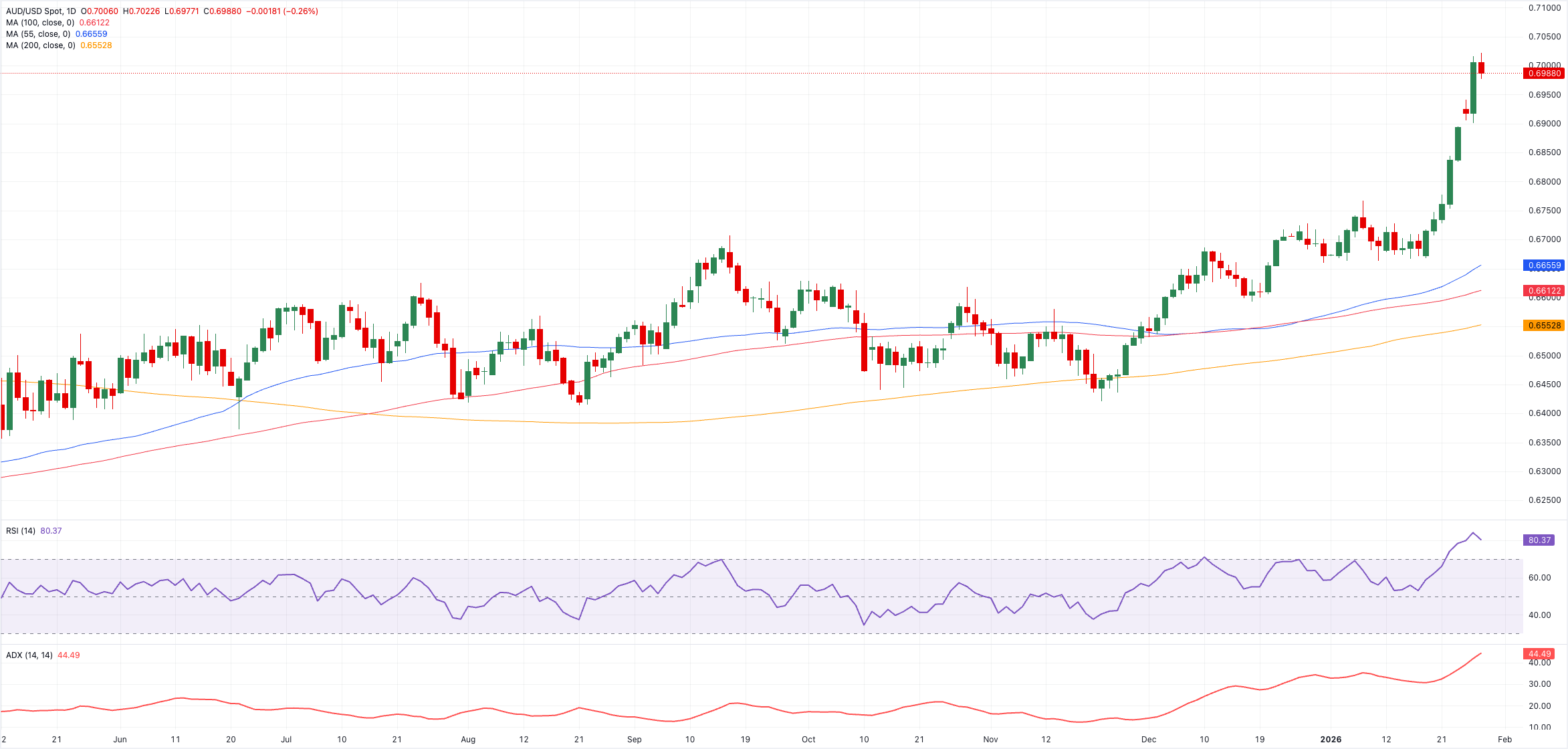
AUD/USD has finally tested the key 0.7000 hurdle, although it has come under some mild downside pressure since then. The current overbought condition continues to reinforce the case for a near-term “technical correction”.
From the bullish perspective, the surpass of the 2026 ceiling at 0.7022 (January 28) could expose a probable move to the 2023 top at 0.7157 (February 2).
In the opposite direction, there is an initial support at the 2026 bottom at 0.6663 (January 9) prior to the interim 55-day and 100-day SMAs at 0.6649 and 0.6609, respectively. Down from here sits the critical 200-day SMA at 0.6548 ahead of the November floor at 0.6421 (November 21).
In the meantime, extra advances remain on the card as long as the pair trades above its 200-day SMA.
Furthermore, momentum indicators remain firm, although they flag some caution: the Relative Strength Index (RSI) remains well in the overbought region above the 80 level, while the Average Directional Index (ADX) near 43 suggest the current trend remains strong.
Bottom line
AUD/USD remains closely tied to global risk sentiment and China’s economic path. A sustained break above 0.7000 would be needed to deliver a clearer bullish signal.
For now, a softer USD, steady, if unspectacular, domestic data, an RBA leaning towards renewed tightening, and modest support from China keep the bias tilted towards further gains.
US-China Trade War FAQs
Generally speaking, a trade war is an economic conflict between two or more countries due to extreme protectionism on one end. It implies the creation of trade barriers, such as tariffs, which result in counter-barriers, escalating import costs, and hence the cost of living.
An economic conflict between the United States (US) and China began early in 2018, when President Donald Trump set trade barriers on China, claiming unfair commercial practices and intellectual property theft from the Asian giant. China took retaliatory action, imposing tariffs on multiple US goods, such as automobiles and soybeans. Tensions escalated until the two countries signed the US-China Phase One trade deal in January 2020. The agreement required structural reforms and other changes to China’s economic and trade regime and pretended to restore stability and trust between the two nations. However, the Coronavirus pandemic took the focus out of the conflict. Yet, it is worth mentioning that President Joe Biden, who took office after Trump, kept tariffs in place and even added some additional levies.
The return of Donald Trump to the White House as the 47th US President has sparked a fresh wave of tensions between the two countries. During the 2024 election campaign, Trump pledged to impose 60% tariffs on China once he returned to office, which he did on January 20, 2025. With Trump back, the US-China trade war is meant to resume where it was left, with tit-for-tat policies affecting the global economic landscape amid disruptions in global supply chains, resulting in a reduction in spending, particularly investment, and directly feeding into the Consumer Price Index inflation.
Author

Pablo Piovano
FXStreet
Born and bred in Argentina, Pablo has been carrying on with his passion for FX markets and trading since his first college years.

















