AUD/USD Price Forecast: Further range bound in the pipeline
- AUD/USD maintained the erratic performance well and sound on Thursday.
- The US Dollar charted a decent advance on the Fed and geopolitical tensions.
- The Australian labour market report came in on the soft side in May.


The Australian Dollar (AUD) came under renewed selling pressure against the US dollar on Thursday, sending AUD/USD well south of the 0.6500 barrier to reach fresh four-week lows, always locked in its consolidative range established since mid-April.
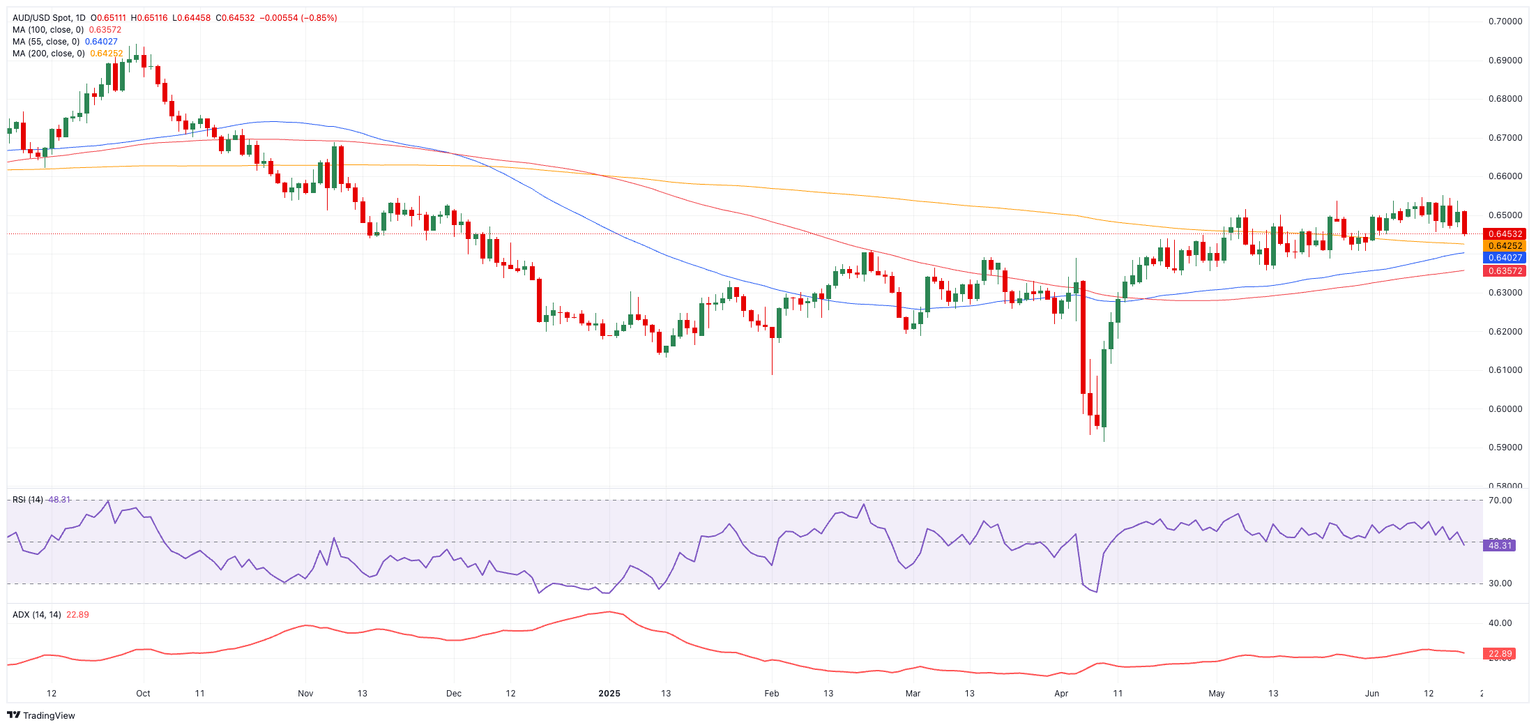
The pair’s near-term outlook stays constructive so long as it holds above the 200-day simple moving average (SMA), currently near 0.6430.
Central bank policy divide
A growing divergence between the Reserve Bank of Australia (RBA) and the Federal Reserve (Fed) continues to drive part of the Aussie’s direction for the time being.
In June, the RBA cut its cash rate by 25 basis points to 3.85%, citing easing inflation and slowing GDP growth, and signalled further reductions “gradually toward” 3.20% by 2027—while reserving the option to pause if global conditions deteriorate.
By contrast, in a widely anticipated decision, the Fed left interest rates unchanged while maintaining its projection for a half-percentage-point in rate cuts by year-end, though policymakers remain divided on the timing and necessity of easing.
Fed Chair Jerome Powell cautioned that as President Trump's tariffs start to impact consumers, goods price inflation is expected to increase over the summer. His remarks underscored the challenging balance the Fed must maintain while dealing with trade policy uncertainty and increased geopolitical risk.
The cautious tone left markets uneasy about the trajectory of US interest rates. While traders continue to price in at least two rate cuts this year, analysts remain divided over when the Fed might begin to move.
China’s lingering headwinds
Australia’s economic outlook remains tethered to demand from its largest trading partner. May data from Beijing showed gains in industrial output, retail sales and services—supporting annual growth above 5%—but a faltering property sector and fading stimulus raise doubts about momentum into late 2025.
Positioning outlook
Speculative net shorts on the Aussie have climbed to their highest level since April, according to CFTC data through June 10, suggesting traders await a decisive catalyst to shift sentiment.
Technical landscape
Immediate resistance lies at this year’s high of 0.6551 (June 16), while a clear break above this level could target the November 2024 top at 0.6687 (November 7) and the 2024 ceiling at 0.6942 (September 30).
On the downside, the 200-day Simple Moving Average (SMA) at 0.6428 shows decent contention, preceding the May trough of 0.6356 (May 12).
Momentum indicators look southwards: The Relative Strength Index (RSI) weakened toward 48, opening the door to potential extra corrections, and an Average Directional Index (ADX) above 25 point to moderate trend strength.
AUD/USD daily chart
Upcoming calendar
Next on tap on the Australian calendar will be the release of the flash S&P Global Manufacturing and Services PMIs on June 23.
RBA FAQs
The Reserve Bank of Australia (RBA) sets interest rates and manages monetary policy for Australia. Decisions are made by a board of governors at 11 meetings a year and ad hoc emergency meetings as required. The RBA’s primary mandate is to maintain price stability, which means an inflation rate of 2-3%, but also “..to contribute to the stability of the currency, full employment, and the economic prosperity and welfare of the Australian people.” Its main tool for achieving this is by raising or lowering interest rates. Relatively high interest rates will strengthen the Australian Dollar (AUD) and vice versa. Other RBA tools include quantitative easing and tightening.
While inflation had always traditionally been thought of as a negative factor for currencies since it lowers the value of money in general, the opposite has actually been the case in modern times with the relaxation of cross-border capital controls. Moderately higher inflation now tends to lead central banks to put up their interest rates, which in turn has the effect of attracting more capital inflows from global investors seeking a lucrative place to keep their money. This increases demand for the local currency, which in the case of Australia is the Aussie Dollar.
Macroeconomic data gauges the health of an economy and can have an impact on the value of its currency. Investors prefer to invest their capital in economies that are safe and growing rather than precarious and shrinking. Greater capital inflows increase the aggregate demand and value of the domestic currency. Classic indicators, such as GDP, Manufacturing and Services PMIs, employment, and consumer sentiment surveys can influence AUD. A strong economy may encourage the Reserve Bank of Australia to put up interest rates, also supporting AUD.
Quantitative Easing (QE) is a tool used in extreme situations when lowering interest rates is not enough to restore the flow of credit in the economy. QE is the process by which the Reserve Bank of Australia (RBA) prints Australian Dollars (AUD) for the purpose of buying assets – usually government or corporate bonds – from financial institutions, thereby providing them with much-needed liquidity. QE usually results in a weaker AUD.
Quantitative tightening (QT) is the reverse of QE. It is undertaken after QE when an economic recovery is underway and inflation starts rising. Whilst in QE the Reserve Bank of Australia (RBA) purchases government and corporate bonds from financial institutions to provide them with liquidity, in QT the RBA stops buying more assets, and stops reinvesting the principal maturing on the bonds it already holds. It would be positive (or bullish) for the Australian Dollar.
Premium
You have reached your limit of 3 free articles for this month.
Start your subscription and get access to all our original articles.
Author
Pablo Piovano
FXStreet
Born and bred in Argentina, Pablo has been carrying on with his passion for FX markets and trading since his first college years.

















