AUD/USD Forecast: trade war and base metals weighed Aussie lower
- Chinese and Australian PMI alongside with the RBA monthly meeting to stand out next week.
- AUD/USD back under pressure but a resumption of the bearish trend still unclear.

The AUD/USD pair gave back some of its previous weekly gains, retracing toward the 0.7200 region on the back of the dollar's self-strength, which affected sharply base metals' prices. Copper, palladium, platinum, all lost ground alongside with gold, and other bright metals ever since the week started, although the Fed's already known decision to hike rates last Wednesday exacerbated the sell-off there, alongside with solid US data released Thursday.
Meanwhile, the trade war continues, despite moving to the background these last couple of days. On Monday, the latest round of reciprocal tariffs come into effect between the US and China, with the first levying tariffs of 10% on $200B of Chinese Goods and China imposing taxes on $60B of US products. President Trump, has menaced to extend tariffs to another $267B on Chinese good, to reach the total of annual imports from the Asian country. China has refused to resume trade talks afterward, later announcing it would cut import tariffs on multiple non-American goods by about 60 billion Yuan, aiming to protect local consumers and companies from the effects of the trade war with the US. Trade tensions weigh the Aussie lower, and there's no relief at sight.
The greenback, on the other hand, recovered some of its bright following the latest Fed's meeting, not because the largely priced in rate hike, but because policymakers confirmed their conviction that the economy is strong enough to deal with the gradual path of rate hikes, with one more for this year and three seen in the next one. Thursday's US Q2 GDP pretty much confirmed it.
In the data front, nor Australia neither China had something relevant to offer these last days, although the next one will be a bit more busy, with multiple PMI figures coming in since early Monday. China will release official data to start with, and poor figures there will likely affect the AUD. There are several holidays in China which will likely lower the trading volume around the pair during the Asian sessions. Also, the RBA is having a monetary policy meeting next Tuesday, but as usual, little could be expected in that front.
AUD/USD technical outlook
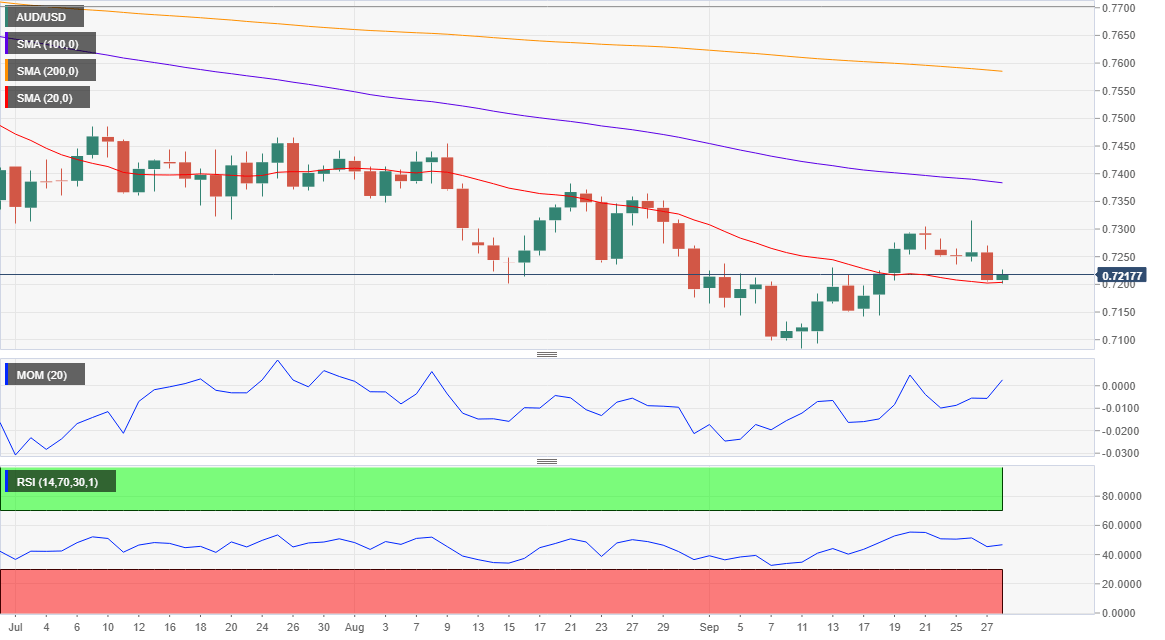
The previous weeks' advance in the AUD/USD pair looks corrective in the long run, but whether the pair will resume its bearish trend and get to fresh yearly lows is not yet clear, given that the pair is hovering in the 0.7200/50 region, now poised to finish the day around the 50% retracement of its latest daily slump. A bearish extension would seem more likely on a daily close below the 38.2% retracement of the same decline, at around the 0.7180 level.
Technical readings in the weekly chart showed that technical indicators corrected extreme oversold conditions, also that the recoveries stalled well below their midlines and with both currently gaining downward traction, leaning the scale toward the downside. The 20 SMA in the mentioned chart maintains a strong bearish slope, and nears the top of the mentioned daily decline, making of the 0.7370 region a line in the sand for the dominant bearish trend.
In the daily chart, a downward extension is unclear as the pair is finding buyers for a second consecutive day around a flat 20 DMA, still below firmly bearish 100 and 200 DMA, while the Momentum indicator retreats within positive territory and the RSI hovers around 48, losing bearish strength.
In the daily chart, technical indicators have lost upward momentum, but remain at levels last seen in May, while the price is far above its 20 DMA, currently converging with the 38.2% retracement of the mentioned decline at around 0.7190. Bears could retake control of the pair on a break below it. Below 0.7180, the 0.yearly low at 0.7084 is the next probable bearish target, en route to 0.6826, 2016 low.
AUD/USD sentiment poll
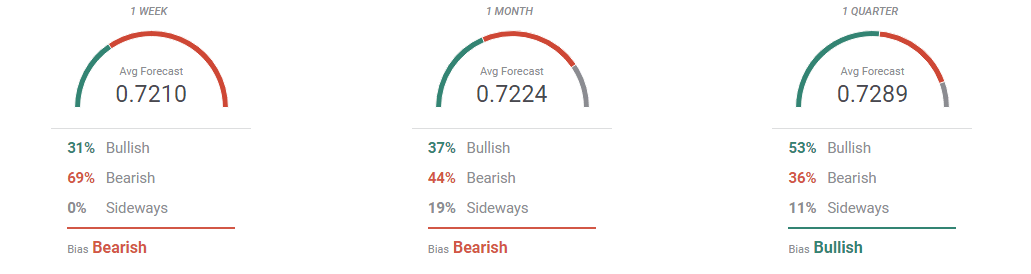
According to the FXStreet Forecast Poll, the Aussie is set to remain under pressure during the upcoming weeks, with bears surging to 69% weekly basis, from the previous 53% and the average target down to 0.7210 from 0.7191. In the three months' view, however, bulls still dominate the pair, although it doesn't seem to be anywhere further, as the average target falls in 0.7289, amid a wide range of possible targets. What's clear from the poll, is that traders tend to see it lower, while banks tend to see it higher. In the Overview chart, the moving averages offer modest downward slopes in the three months under study. The largest accumulation of targets in the shorter-term come at 0.7100, while in the 3-month perspective, comes closer to 0.7400.
Related content:
USD/JPY Forecast: Entering overbought conditions after the Fed, NFP is next
GBP/USD Forecast: never about data, always about Brexit
EUR/USD Forecast: EUR collapses on Italian jitters, but will be enough for USD bulls?
Author

Valeria Bednarik
FXStreet
Valeria Bednarik was born and lives in Buenos Aires, Argentina. Her passion for math and numbers pushed her into studying economics in her younger years.

















