EUR/USD Forecast: EUR collapses on Italian jitters, but will be enough for USD bulls?
- US Nonfarm Payrolls to be out next Friday, solid figures anticipated again.
- EUR/USD seen falling further, but long-term sustainable gains unclear.

For sure, it wasn't EUR's week. The EUR/USD broke below the 1.1600 figure, falling to its lowest in two weeks. The sharp decline was a consequence of renewed dollar's strength following late Wednesday US Federal Reserve monetary policy meeting, which not only provided the expected rate hike but also indicated that the US economy is strong enough to continue moving toward a neutral rate. However, it was not just the Fed. The largest intraday decline took place Thursday, as strong US data confirmed what Powell said the previous day. US growth was confirmed at an annual rate of 4.2%, according to the final version of Q2 GDP, while for the three months to June, growth was revised to 3.3% from the previous estimate of 3.2%, also beating expectations of 3.0%. Further fueling USD advance, Durable Goods Orders more than double the market's forecast, up 4.5% in August, although the ex-transportation figure posted a modest 0.1% increase, missing the market's expectations of 0.5%.
The common currency took a huge hit from the Italian government's decision to approve a 2.4% budget deficit, that defies EU rules. Tensions escalated after the Interior Minister Salvini said that: "Italian's rights to jobs and pensions come before EU's bureaucrats." The deficit target for 2019 is now three times higher than that planned by the previous government. The EU has a 3.0% threshold deficit as a general rule and while this budged technically fits in, but the issue is that the EU has already asked Italy to reduce its public debt, fearing a debt crisis in the country. Furthermore, is yet to be seen if Italian's deficit will end there, at 2.4%, or if there will be further slippages.
EU data didn't help, as despite an uptick in German's inflation, the preliminary estimates for September EU CPI came in below expected, with core yearly inflation calculated at 0.9%, below the previous 1.0% and the expected 1.1%.
The next week will be a busy one, with multiple figures scheduled, including the final versions of Markit PMI for both economies, although no doubts, the star will be the Nonfarm Payroll Report that will be out on Friday. Ahead of the event, the economy is expected to have added 188K new jobs in September, while the unemployment rate is foreseen down to 3.8%. However, and despite the market tends to wait-and-see ahead of the release, no fireworks should be expected unless the numbers offer huge divergences from market's forecasts.
Anyway, current dollar's strength seems a bit overstretched, probably exacerbated by quarter-end profit taking. Doesn't seem that the Fed or the latest GDP figures are enough to give the dollar its lost crown. For sure, it has recovered a good bunch of ground, but that doesn't guarantee more gains ahead.
EUR/USD Technical Outlook
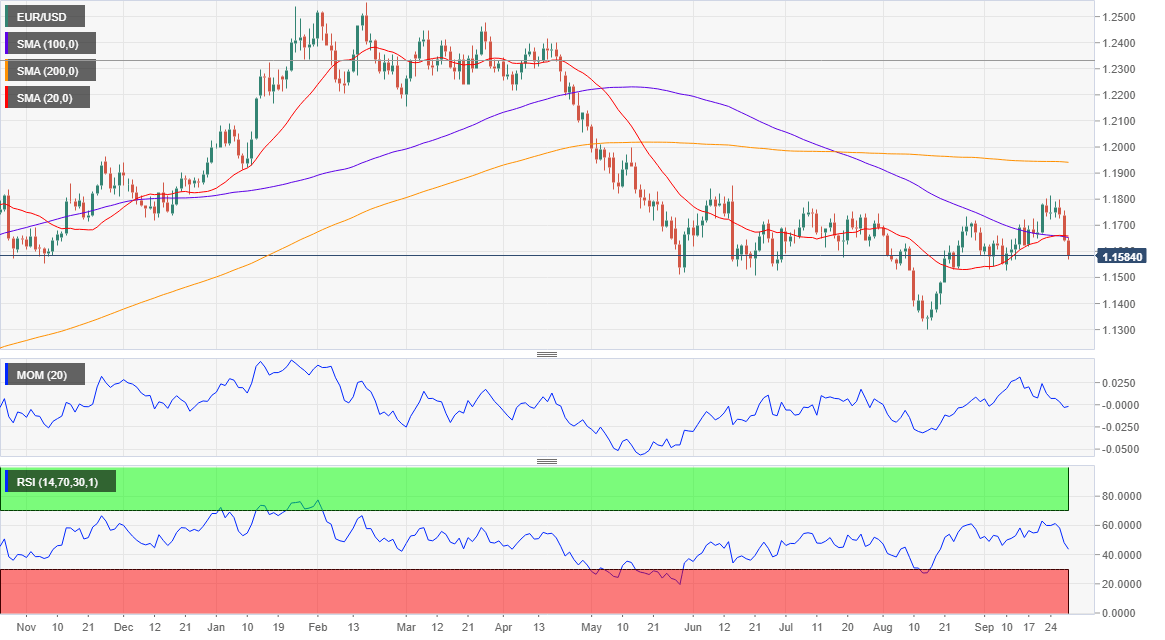
Technically, the weekly chart for the pair shows that its poised to close a bearish 20 SMA, still above the larger ones, while technical indicators have lost their upward strength and turned south within neutral levels, rather signaling a limited upward potential than further declines ahead. The close below the previous weekly opening, somehow leans the scale toward the downside, although to confirm further declines, a break of the 1.1500 level would be nice.
In the daily chart, the pair has a clearer downward potential, as it broke back below the 20 and 100 DMA, which lack directional strength, while technical indicators have entered negative territory, and while still within neutral readings, leaning anyway the risk toward the downside. 1.1550 is an immediate short-term support ahead of the mentioned 1.1500 figure, with a stronger, more relevant one coming in the 1.1440/60 region. A clear break of this last should open doors for a steeper decline that could extend to 1.1250. On the upside, 1.1660 is the immediate resistance, followed by 1.1730. Beyond it, a retest of 1.1800 seems likely albeit gains beyond this last are out of spectrum for next week.
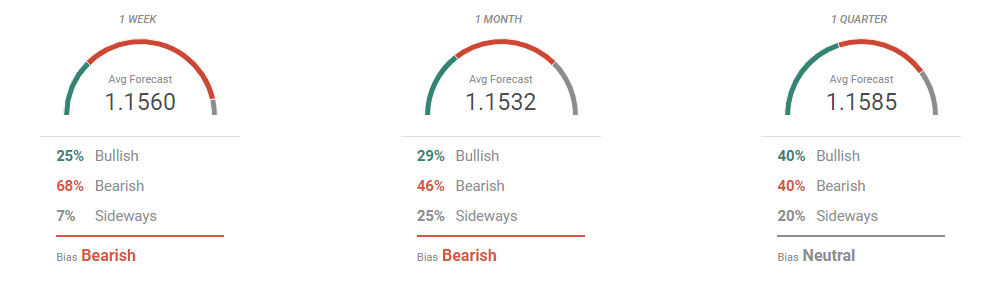
EUR/USD sentiment poll
The market is once again bullish on the greenback, according to the FXStreet Forecast Poll, with the EUR/USD pair seen bearish for the next week and month. In both cases, the pair is seen extending the decline below the 1.1600 threshold although the downward conviction eases in the longer perspective, leaving a neutral stance in the quarterly view. For the upcoming week, bears are up to 68% from 44% previously, with the average target downgraded from 1.1727 to 1.1560-In the monthly view, bears were 60% targeting 1.1684, and decreased to 46%, although the average target is now 1.1532.
The Overview chart shows that the moving average turned sharply lower, a situation that replicates in the monthly one. Longer term, however, it remains flat with most targets accumulating well above the current level, between 1.18 and 1.20.
Related content:
USD/JPY Forecast: Entering overbought conditions after the Fed, NFP is next
GBP/USD Forecast: never about data, always about Brexit
AUD/USD Forecast: trade war and base metals weighed Aussie lower
Author

Valeria Bednarik
FXStreet
Valeria Bednarik was born and lives in Buenos Aires, Argentina. Her passion for math and numbers pushed her into studying economics in her younger years.

















