Xiaomi Stock Analysis: XIACF shares rather ho-hum for world's second biggest smartphone maker
- Chinese conglomerate Xiaomi surpassed Apple in smartphones sales in Q2
- XIACF is trading near its 20 and 50-day moving averages.
- Xiaomi raised smartphone sales by 83% YoY.

Research firm Canalys published a report on Thursday saying Xiaomi (OTC: XIACF) had now overtaken Apple (NASDAQ: AAPL) in the second quarter to become the second biggest smartphone maker after Samsung Electronics (KSE: 005930.KS). Despite this resounding moment in the company’s only 11-year history, Xiaomi’s primary listing in Hong Kong (HKSE: 1810.HK) rose just 4.8%. XIACF, which trades in the over-the-counter market, fell 0.6% on Thursday before the news was released.
XIACF stock news: stepping into Huawei’s shadow
This is quite the coup as Xiaomi was ranked fourth as recently as the same quarter of last year. However, then number one Huawei has since faced regulatory sanctions from the US government and lost access to the Google suite of mobile software because of it. Huawei has since fallen to only 4% of the smartphone market worldwide after selling off its Honor subsidiary. Xiaomi switched market share figures with Apple from the first quarter. Apple fell from 17% of the global market in Q1 to 14% in Q2, while Xiaomi went from 14% to 17%. The general electronics and apparel conglomerate rose to second place by growing its business an astounding 82% YoY.
It is clear from company chatter, however, that the newly-minted runner-up is not resting on its laurels. In a company memo to employees, co-founder Lei Jun said Xiaomi must “quickly consolidate the position,” according to Bloomberg. Apple earlier this week was rumored to be unveiling a 20% increase in iPhone production for the latter half of the year. Two months ago, Xiaomi successfully got itself off the Chinese tech blacklist instituted by former US President Donald Trump. Earlier this year Xiaomi publically mulled making an investment in AI-chip maker Black Sesame Technologies.
Lei Jun was also in the news recently for donating the equivalent of $2.2 billion of his Xiaomi shares to charity – a move seen by many as an overture to the Chinese government, which has been cracking down on its most successful technology companies of late. Both Alibaba (NYSE: BABA) and Didi Chuxing (NYSE: DIDI) have fallen under regulatory scrutiny this year. Xiaomi has been relatively untarnished. One wrinkle that might get in the way of sustaining Xiaomi’s smartphone rise is that management has announced a brand new $10 billion push into electric vehicles. This new strategy could reduce research and development funding and focus for the smartphone division.
XIACF price prediction: stock geared for move above moving averages
There is little data to go on for XIACF since it has only traded since March 16. Closing yesterday at $3.44, it seems likely that the stock will witness at least a 4.8% rise to $3.61 like its Hong Kong-listed cousin. To do so, it will have to surmount both the 20-day and 50-day Simple Moving Averages (SMAs), which sit at $3.48 and $3.49, respectively. This should not be a problem since neither has been respected by the XIACF price all that much. However, both are aligned at present and may supply at least some resistance. Beyond there the target for bulls will be $3.74, where the stock faced strict resistance in mid-June.
On the downside, XIACF shares have support at $3.18, $3.10, $3.05 and $2.95. Since the recent news is so promising, however, it is more likely that Xiaomi will jump the 50-day SMA resistance and remain in a rising trend for the next few weeks. When Xiaomi opened way down at $3.10 last week, the stock closed up at $3.26 in the same session, so it appears that there are buyers in this market willing to build serious positions. On the other hand, the Relative Strength Index (RSI) is still in bearish territory at 47, meaning XIACF has not firmly committed to a serious upside move yet.
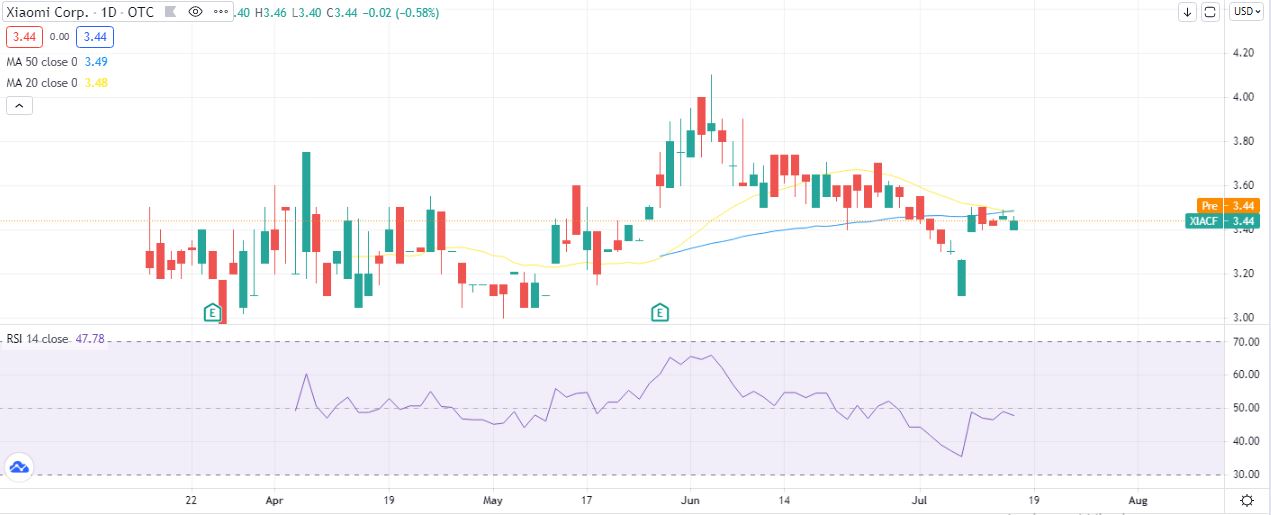
XIACF daily chart
Author

Clay Webster
FXStreet
Clay Webster grew up in the US outside Buffalo, New York and Lancaster, Pennsylvania. He began investing after college following the 2008 financial crisis.

















