|

WTI soars over 3% on growing optimist amidst US debt ceiling talks and IEA forecast

  • International Energy Agency predicts supply to fall behind demand by 2 million bpd in H2.
  • Positive developments in US debt ceiling talks boost market sentiment, lifting oil prices.
  • US crude oil prices rise despite increased inventories as China’s economic growth tempers.
WTI soars over 3% on growing optimist amidst US debt ceiling talks and IEA forecast

Western Texas Intermediate (WTI) advanced more than 3% in the late New York session, exchanging hands at around the $72.90 area due to renewed optimism after UD debt ceiling negotiations pointed to an agreement. At the same time, the International Energy Agency (IEA) revealed that demand would outpace supply, bolstering oil prices.

Oil demand is set to outpace supply, while China accounts for 60% of the demand increase in 2023

The IEA revealed that supply would surpass demand by 2 million barrels per day (bpd) in the second half of the year, with China’s making up 60% of the oil demand increase in 2023.

In the meantime, US President Joe Biden commented that he’s confident about reaching a debt ceiling as he embarks on a trip to Japan. The US House Speaker Kevin McCarthy commented that he planned to be engaged in negotiations, while Biden said he planned to remain in close contact with the speaker and negotiators.

US crude oil prices defy the increase in US inventories, according to the US Energy Information Administration (EIA). Stockpiles rose 5 million barrels in the last week to 467.6 million barrels, compared to analysts’ expectations for a drop of 900K.

Aside from this, China’s recent economic data revealed that the economy is tempering its growth. According to sources cited by Reuters, “A bunch of Chinese macro-economic data for April released on Tuesday confirmed the narrative of a patchy and slow recovery in the country and continue to weigh on oil market sentiment.”

WTI Price Analysis: Technical outlook
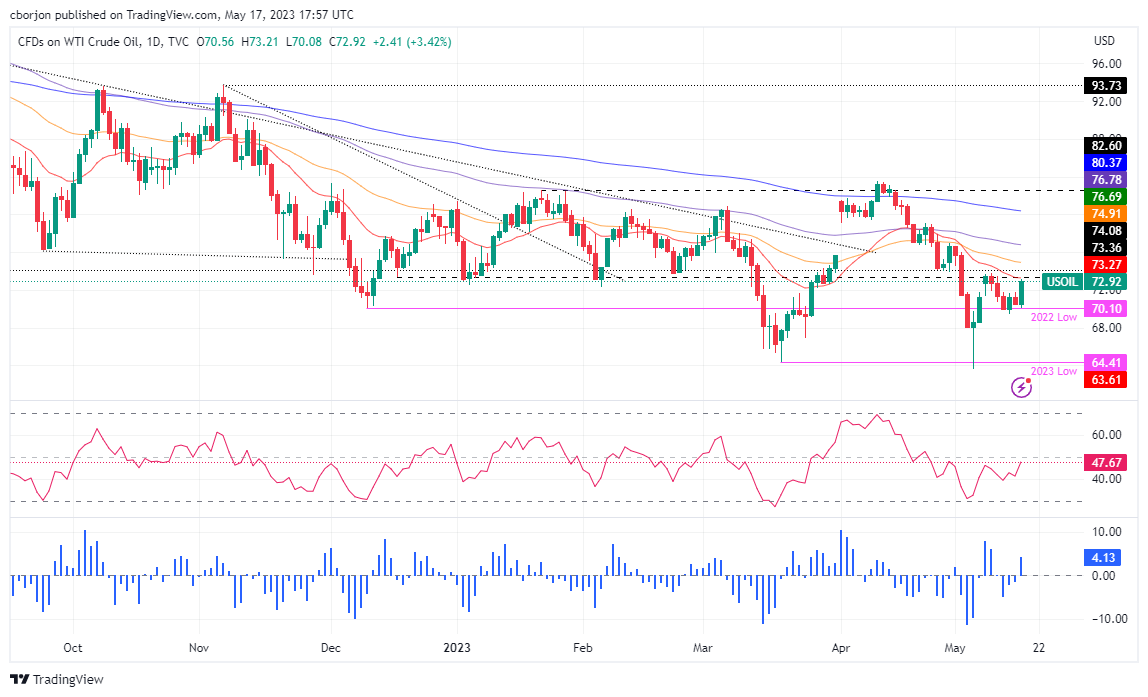
WTI Daily chart

WTI has recovered some ground after dipping below the last year’s low of $70.10, reaching a two-week low of $69.44. However, WTI buyers moved in, lifting the price toward the 20-day Exponential Moving Average (EMA), which, once cleared, could pave the way to test the 50-day EMA at $74.91. Once cleared and up next would be the 100-day EMA at $76.78. Nevertheless, the Relative Strength Index (RSI) indicator continues at bearish territory, suggesting that sellers remain in charge. Therefore, WTI’s failure to crack the $73.00 PB area and a dip towards the $69.00 area is on the cards.

WTI US OIL

Overview
Today last price73.07
Today Daily Change2.53
Today Daily Change %3.59
Today daily open70.54
 
Trends
Daily SMA2073.64
Daily SMA5074.76
Daily SMA10076.41
Daily SMA20080.3
 
Levels
Previous Daily High71.76
Previous Daily Low70.45
Previous Weekly High73.81
Previous Weekly Low69.94
Previous Monthly High83.4
Previous Monthly Low73.88
Daily Fibonacci 38.2%70.95
Daily Fibonacci 61.8%71.26
Daily Pivot Point S170.07
Daily Pivot Point S269.61
Daily Pivot Point S368.76
Daily Pivot Point R171.38
Daily Pivot Point R272.23
Daily Pivot Point R372.69

Author

Christian Borjon Valencia

Markets analyst, news editor, and trading instructor with over 14 years of experience across FX, commodities, US equity indices, and global macro markets.


More from Christian Borjon Valencia
Share:

Editor's Picks

AUD/USD crashes to January lows near 0.6650 after awful Aus jobs data

AUD/USD falls hard to its lowest since January, near 0.6650, in the Asian session on Thursday. The Australian Dollar (AUD) faces intense selling pressure against the US Dollar (USD) following weaker-than-expected Australian employment data, which ramped up RBA interest rate cut bets for next year. The weekly US Initial Jobless Claims report is due later on Thursday.


USD/JPY keeps its range near 159.50 despite hawkish BoJ Ueda

The Dollar rose against most major currencies but not the Yen, which is backed by intervention warnings near 160.00 and hawkish BoJ Ueda's commentary. USD/JPY is keeping its range around 159.50 in Asia on Thursday after a few sessions of small declines from a high just above 160.00. That high was its highest since early September.


Gold sellers return and crack $3,700 for first time in 14 months

Gold fades its tepid bounce and resumes its downside, hitting fresh 14-month lows below $3,700 in the Asian session on Thursday. The precious metal remains vulnerable as hawkish Federal Reserve signals have raised expectations that interest rate hikes will continue in 2027. Further, reports that the US is considering joint strikes with Israel as Iran begins rebuilding military strength add to the US Dollar rally at the expense of Gold.


Ripple, Cardano, and Solana capped and vulnerable to downfall
Top altcoins, Ripple (XRP), Cardano (ADA), and Solana (SOL), remain vulnerable to further losses as selling pressure persists. Nvidia CEO Jensen Huang resignation and inflation concerns continue to keep broader market conditions volatile. CoinMarketCap’s Fear and Greed Index sits at a four-month low of 11 on Thursday, suggesting intense risk-off sentiment in the market.
The US Dollar's new strength has a circular flaw built into it

Asian chip exporters supply much of the new foreign money that funds the United States, and they send it through the stock market. The shares they buy belong to their biggest customers, so a slowdown in AI spending would cut the US Dollar's support twice. For half a century, the US Dollar's standing abroad has leaned on Oil.

Gold just broke below $3,800 for the first time in 14 months
Gold (XAU/USD) extends its decline on Wednesday, breaking below the psychological $3,800 level for the first time since September 2025 and continuing a sell-off that has accelerated in recent days. The latest decline marks a significant deterioration in Gold's outlook.