WTI Price Forecast: Momentum improves as prices rebound from eight-month lows
- WTI trades firmer as geopolitical tensions between the US and Venezuela provide modest support.
- Short-term technicals turn constructive, while the broader downtrend remains intact.
- Immediate resistance sits at $58.00-$59.00, reinforced by former support and the 21-day and 50-day SMAs.

West Texas Intermediate (WTI) Crude Oil edges higher on Monday as escalating tensions between the United States (US) and Venezuela add a modest geopolitical risk premium to Oil markets. At the time of writing, the US benchmark trades around $57.70, up nearly 2% on the day, extending its rebound after retesting year-to-date lows last week.
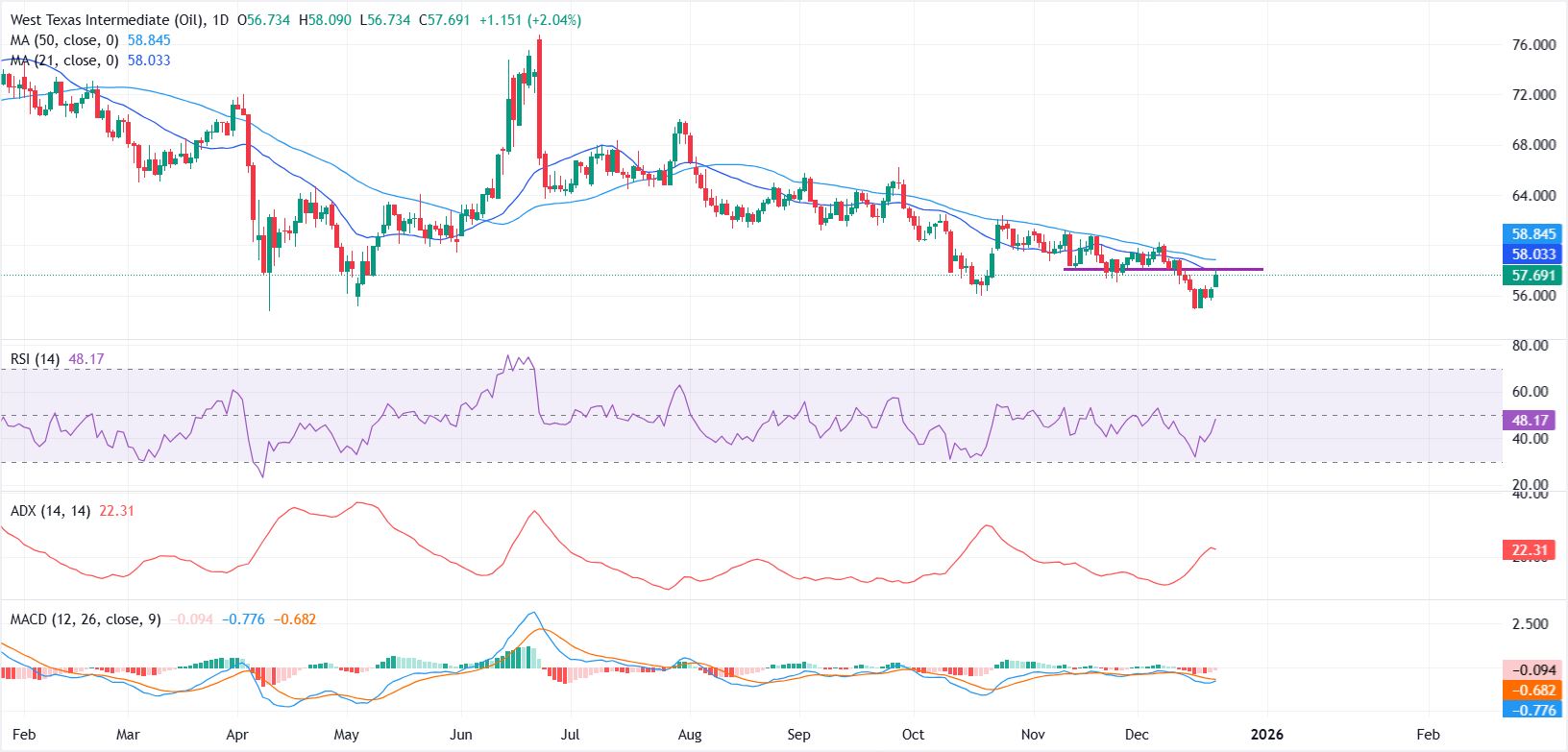
From a technical standpoint, the near-term outlook for WTI has turned slightly constructive, though the broader trend remains tilted to the downside, with prices down nearly 27% year-to-date.
On the daily chart, WTI is currently testing the $58.00-$59.00 zone, a former support zone now acting as resistance, aligned with the 21-day and 50-day Simple Moving Averages (SMAs). This confluence continues to cap immediate upside, with the $60.00 psychological level emerging as the next key hurdle should prices break higher.
On the downside, initial support is seen near $56.50, followed by the $55.00 round figure. A break below this area would reopen downside risks toward multi-year lows within the broader bearish structure.
Momentum indicators show early signs of improvement. The Relative Strength Index (RSI) hovers near the 50 mark after rebounding from near-oversold levels, while the Average Directional Index (ADX), around 22, is trending higher, suggesting that trend strength is gradually building.
The Moving Average Convergence Divergence (MACD) line remains below the Signal line and under zero, while the negative histogram contracts, suggesting fading downside momentum.
(This story was corrected on December 22 at 16:40 GMT to say in the first paragraph that WTI rebounded after retesting year-to-date lows last week, not sliding to year-to-date lows.)
WTI Oil FAQs
WTI Oil is a type of Crude Oil sold on international markets. The WTI stands for West Texas Intermediate, one of three major types including Brent and Dubai Crude. WTI is also referred to as “light” and “sweet” because of its relatively low gravity and sulfur content respectively. It is considered a high quality Oil that is easily refined. It is sourced in the United States and distributed via the Cushing hub, which is considered “The Pipeline Crossroads of the World”. It is a benchmark for the Oil market and WTI price is frequently quoted in the media.
Like all assets, supply and demand are the key drivers of WTI Oil price. As such, global growth can be a driver of increased demand and vice versa for weak global growth. Political instability, wars, and sanctions can disrupt supply and impact prices. The decisions of OPEC, a group of major Oil-producing countries, is another key driver of price. The value of the US Dollar influences the price of WTI Crude Oil, since Oil is predominantly traded in US Dollars, thus a weaker US Dollar can make Oil more affordable and vice versa.
The weekly Oil inventory reports published by the American Petroleum Institute (API) and the Energy Information Agency (EIA) impact the price of WTI Oil. Changes in inventories reflect fluctuating supply and demand. If the data shows a drop in inventories it can indicate increased demand, pushing up Oil price. Higher inventories can reflect increased supply, pushing down prices. API’s report is published every Tuesday and EIA’s the day after. Their results are usually similar, falling within 1% of each other 75% of the time. The EIA data is considered more reliable, since it is a government agency.
OPEC (Organization of the Petroleum Exporting Countries) is a group of 12 Oil-producing nations who collectively decide production quotas for member countries at twice-yearly meetings. Their decisions often impact WTI Oil prices. When OPEC decides to lower quotas, it can tighten supply, pushing up Oil prices. When OPEC increases production, it has the opposite effect. OPEC+ refers to an expanded group that includes ten extra non-OPEC members, the most notable of which is Russia.
Author

Vishal Chaturvedi
FXStreet
I am a macro-focused research analyst with over four years of experience covering forex and commodities market. I enjoy breaking down complex economic trends and turning them into clear, actionable insights that help traders stay ahead of the curve.















