How AI, blockchain, stablecoins are shaping a new global economy – Circle CEO Jeremy Allaire
- Circle’s CEO Jeremy Allaire says that AI, blockchain and stablecoins are the foundation of an emerging global economic system.
- Circle reported a 77% increase in Q4 revenue to $770 million, as USDC’s share of stablecoin volume neared 50%.
- The crypto AI sector is making a comeback, with total market capitalization rising above $14 billion.

Artificial Intelligence (AI), blockchain technology and stablecoins are emerging as core pillars of a new global economic system, according to Circle’s CEO, Jeremy Allaire.
During Circle’s fourth-quarter 2025 earnings call on Wednesday, Allaire doubled down on a vision of AI, blockchain, and stablecoins unifying into a much larger infrastructure.
“We are entering a world where, in my view, tens or even hundreds of billions of AI agents will interact and perform economic functions over the internet,” Allaire said in an X post.
Circles Q4 revenue, income reserves hit $770 million
Allaire’s bold outlook on the unified futures of AI, blockchain technology, and stablecoins comes on the heels of Circle’s Q4 2025 results, in which revenue and income reserves increased by 77% YoY to a record $770 million. This performance exceeded Wall Street’s $747 million projection, underscoring growing demand for regulated stablecoin infrastructure.
Circle’s stablecoin USDC had a circulation of $75.3 billion by the end of 2025, growing by 75%, supported by $11.9 trillion in on-chain volume, up 247% in Q4.
Allaire anchored his thesis for a new global economic system on the rise of agentic compute, in which billions of autonomous AI agents would continue to require a programmable medium of exchange to function.
“AI agents will be conducting economic activity continuously, at high velocity, and often in fractions of a cent,” Allaire stated.
Circle’s CEO argued that traditional banking systems are continually falling short of supporting the machine-driven economy, leaving stablecoins as the most viable option.
Crypto AI sector rebounds
The crypto AI segment has posted modest gains over the past 24 hours, with its market capitalization rising by over 8% to $14.1 billion. AI-related tokens such as Internet Computer (ICP), PIPPIN, Unbase (UB), and GRASS are up by double digits, according to CoinGecko.
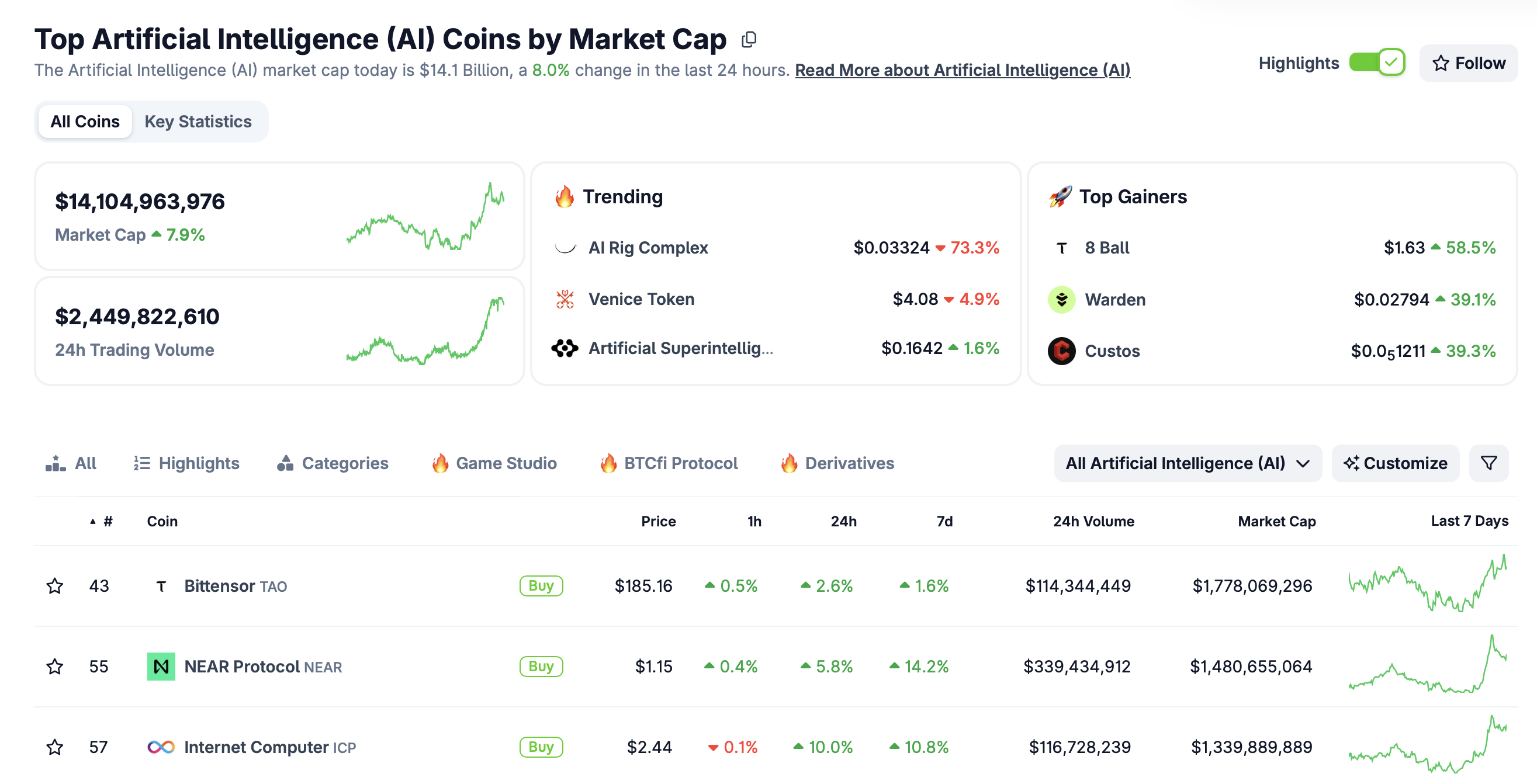
Looking ahead, as investors consider the structural and fundamental growth of the crypto AI sector, the market outlook remains delicate, weighed down by macroeconomic uncertainty, geopolitical tensions, and bear-market doldrums. Hence, the need to be cautiously bullish while implementing risk mitigation systems.
Bitcoin, altcoins, stablecoins FAQs
Bitcoin is the largest cryptocurrency by market capitalization, a virtual currency designed to serve as money. This form of payment cannot be controlled by any one person, group, or entity, which eliminates the need for third-party participation during financial transactions.
Altcoins are any cryptocurrency apart from Bitcoin, but some also regard Ethereum as a non-altcoin because it is from these two cryptocurrencies that forking happens. If this is true, then Litecoin is the first altcoin, forked from the Bitcoin protocol and, therefore, an “improved” version of it.
Stablecoins are cryptocurrencies designed to have a stable price, with their value backed by a reserve of the asset it represents. To achieve this, the value of any one stablecoin is pegged to a commodity or financial instrument, such as the US Dollar (USD), with its supply regulated by an algorithm or demand. The main goal of stablecoins is to provide an on/off-ramp for investors willing to trade and invest in cryptocurrencies. Stablecoins also allow investors to store value since cryptocurrencies, in general, are subject to volatility.
Bitcoin dominance is the ratio of Bitcoin's market capitalization to the total market capitalization of all cryptocurrencies combined. It provides a clear picture of Bitcoin’s interest among investors. A high BTC dominance typically happens before and during a bull run, in which investors resort to investing in relatively stable and high market capitalization cryptocurrency like Bitcoin. A drop in BTC dominance usually means that investors are moving their capital and/or profits to altcoins in a quest for higher returns, which usually triggers an explosion of altcoin rallies.
Author

John Isige
FXStreet
John Isige is a seasoned cryptocurrency journalist and markets analyst committed to delivering high-quality, actionable insights tailored to traders, investors, and crypto enthusiasts. He enjoys deep dives into emerging Web3 tren