USD/TRY resumes the downside below 7.0000
- USD/TRY extends further the breakdown of 7.0000.
- The CBRT left the monetary policy unchanged on Thursday.
- The central bank reinforces its tight stance for the next months.

The Turkish lira extends the upside momentum and drags USD/TRY to the proximity of 6.9000, where some initial support has emerged.
USD/TRY weaker post-CBRT
USD/TRY loses ground for the second session in a row on Thursday and trades at shouting distance from the 2021 lows just below 6.9000 recorded earlier in the week.
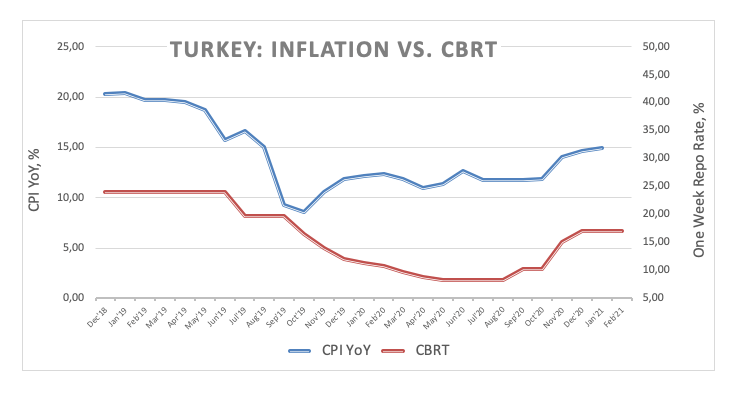
TRY gains extra pace after the Turkish central bank (CBRT) left the One-Week Repo rate unchanged at 17.00% at its event on Thursday. The move, while largely anticipated by market participants, comes to reinforce the orthodox shift by the monetary authority announced back in November 2020 and the continuation of the tight monetary stance in the country.
Earlier in the session, Turkey’s Consumer Confidence ticked higher to 84.5 for the current month (from 83.3).
What to look for around TRY
The lira remains bid and manages to extend the decline below the psychological 7.00 mark. The much-improved sentiment around the currency comes after the CBRT once again reiterated its commitment to fight high inflation via the current orthodox approach of the monetary conditions. Additionally, the CBRT appears to have regained some lost credibility/independence during the past months and this is no minor issue considering the well-known opinion of President Erdogan when comes to higher interest rates. The lira will closely follow this theme in 2021 along with the Biden’s Administration stance on Turkey, the post-pandemic recovery and occasional bouts of geopolitical effervescence.
Eminent issues on the back boiler: Potential US sanctions against Ankara. Government pressure on the CBRT vs. bank’s credibility. Bouts of geopolitical concerns. Much-needed structural reforms. High inflation.
USD/TRY key levels
At the moment the pair is retreating 0.26% at 6.9495 and a drop below 6.8923 (2021 low Feb.16) would expose 6.8796 (monthly low Aug.4 2020) and then 6.6834 (monthly low Jun.3 2020). On the other hand, the next hurdle is located at 7.1567 (21-day SMA) followed by 7.3632 (200-day SMA) and finally 7.5415 (2021 high Jan.18).
Author
Pablo Piovano
FXStreet
Born and bred in Argentina, Pablo has been carrying on with his passion for FX markets and trading since his first college years.