|

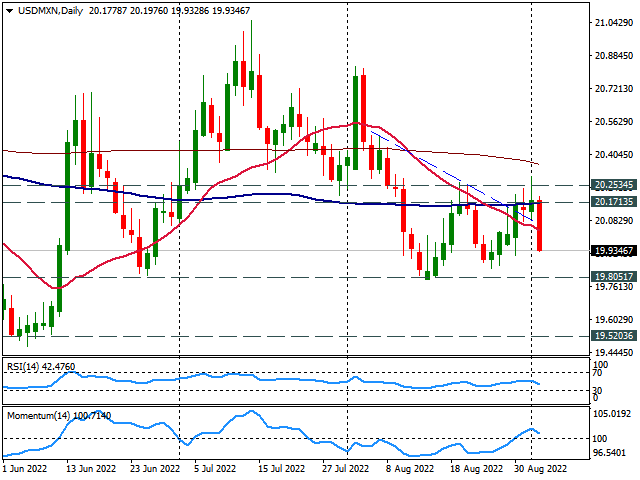
USD/MXN Price Analysis: Sharp decline after being unable to break 20.25

  • USD/MXN fails to break critical resistance at 20.25.
  • Below 20.00, next strong support stands at 19.80.

The USD/MXN is falling sharply on Friday, amid a broad-based decline of the US Dollar. The decline of the pair takes place after being unable to break a key resistance area around 20.25.

So far, USD/MXN bottomed at 19.92 and is it about to test the 19.90 short-term support. Technical indicators favor the downside, with RSI turning shout, like Momentum which still remains above 100. Price is back under the 20-day Simple Moving Average.

Since mid-August, the pair is moving sideways in a range between 19.80 and 20.25. If reached, the 19.80 zone is likely to offer a rebound. A break lower, would point to the next support around 19.65.

The 20.25 has become critical to the upside. A break above should clear the way to more gains, targeting initially the 20.45 zone.

USD/MXN daily chart
USD/MXN

Overview
Today last price19.9474
Today Daily Change-0.2335
Today Daily Change %-1.16
Today daily open20.1809
 
Trends
Daily SMA2020.0589
Daily SMA5020.2878
Daily SMA10020.1676
Daily SMA20020.37
 
Levels
Previous Daily High20.2946
Previous Daily Low20.128
Previous Weekly High20.2483
Previous Weekly Low19.8495
Previous Monthly High20.8261
Previous Monthly Low19.8019
Daily Fibonacci 38.2%20.2309
Daily Fibonacci 61.8%20.1916
Daily Pivot Point S120.1077
Daily Pivot Point S220.0346
Daily Pivot Point S319.9412
Daily Pivot Point R120.2743
Daily Pivot Point R220.3677
Daily Pivot Point R320.4409

Author

Matías Salord

Matías started in financial markets in 2008, after graduating in Economics. He was trained in chart analysis and then became an educator. He also studied Journalism. He started writing analyses for specialized websites before joining FXStreet.


More from Matías Salord
Share:

Editor's Picks

AUD/USD flirts with 0.7000, lowest since early August amid bullish USD

AUD/USD hits a fresh low since early August during the Asian session on Friday and looks vulnerable near 0.7000 after breaking below the 200-day SMA overnight. Against the backdrop of the hawkish Fed, a two-day rally in oil prices revives inflation fears and continues to push US bond yields to multi-year highs. Adding to this, geopolitical risks lift the US Dollar to a two-month high, overshadowing RBA rate hike bets and weighing on the pair.

USD/JPY pulls back from three-week high after failing near 159.00

USD/JPY edges lower during the Asian session on Friday, stalling its recent strong move to a three-week high of 159.00 as Japanese Yen bears turn cautious amid intervention fears. Meanwhile, the US Dollar retains a strong bullish undertone as the Fed's hawkish outlook and oil-driven inflation fears continue to push US bond yields to multi-year peaks. Furthermore, the BoJ's dovish rate hike last week might cap JPY and support spot prices.

Gold treads water below $4,300

Gold grabs some buying attention and advances marginally at the end of the week, partially retracing the weekly decline, although it is still navigating below the key $4,300 mark per troy ounce. The fresh selling bias on the Greenback and the modest decline in US Treasury yields appear to support the humble advance in the precious metal.

Week ahead: Rate hike bets face a crucial data week
Despite the solid drop from the mid-September high, oil prices remained in the driver’s seat for another week, setting the tone in financial markets. Six months have passed since the late-February start of the US-Iran conflict, and there is still no breakthrough in the stalled talks, despite pressure from regional leaders and the rest of the world.
CFTC Report: Defensive currency positioning takes hold
The week in one sentence: Sterling and Euro shorts deepened in the week to September 22, while Yen longs were cut sharply. Oil positioning improved despite a steep price decline, and Gold exposure remained crowded. The main signal was a more defensive currency positioning backdrop.
Fed vs BoJ: Both hiked. The market only believes one of them – and the chart shows which

The Fed and the BoJ have just done something remarkably similar. Both central banks raised interest rates by 25 bps last week, both are confronting inflation risks, and both signal that future decisions will depend on incoming economic data.