Canadian Dollar flatlines with lack of catalysts driving year-end markets
- The Canadian Dollar flattened against the US Dollar on Tuesday.
- Holiday market volumes are constraining momentum, keeping price action subdued.
- Central bank rate trajectories remains the key focal point for Loonie markets heading into 2026.

The Canadian Dollar (CAD) flatlined on Tuesday, holding in a near-term range against the US Dollar (USD) as markets grind their way through the end-of-year slowdown. Market momentum remains absent with most market participants sidelined through the final trading week of 2025.
The meeting minutes from the most recent Federal Open Market Committee (FOMC) rate call, where the Federal Reserve (Fed) delivered a third straight interest rate cut, revealed little new information: despite a widening range of policy targets, the FOMC is overwhelmingly tilting into the dovish side, and is open to the idea of further interest rate cuts, but only in inflation metrics continue to ease.
Daily digest market movers: Canadian Dollar traders look ahead to the new year
- The Canadian Dollar struggled to find movement on Tuesday, stuck near familiar levels against the US Dollar.
- Deeply overbought Loonie markets could be primed for a short-term move lower, but are poised to give way to further gains as rate differentials begin to widen in 2026.
- The Bank of Canada (BoC) remains stuck in place with too-low interest rates, while the Fed looks set for further rate cuts next year.
- The Fed’s latest meeting minutes showed that policymakers are open to further interest rate cuts, but rate moves remain contingent on inflation continuing to ease.
Canadian Dollar price forecast
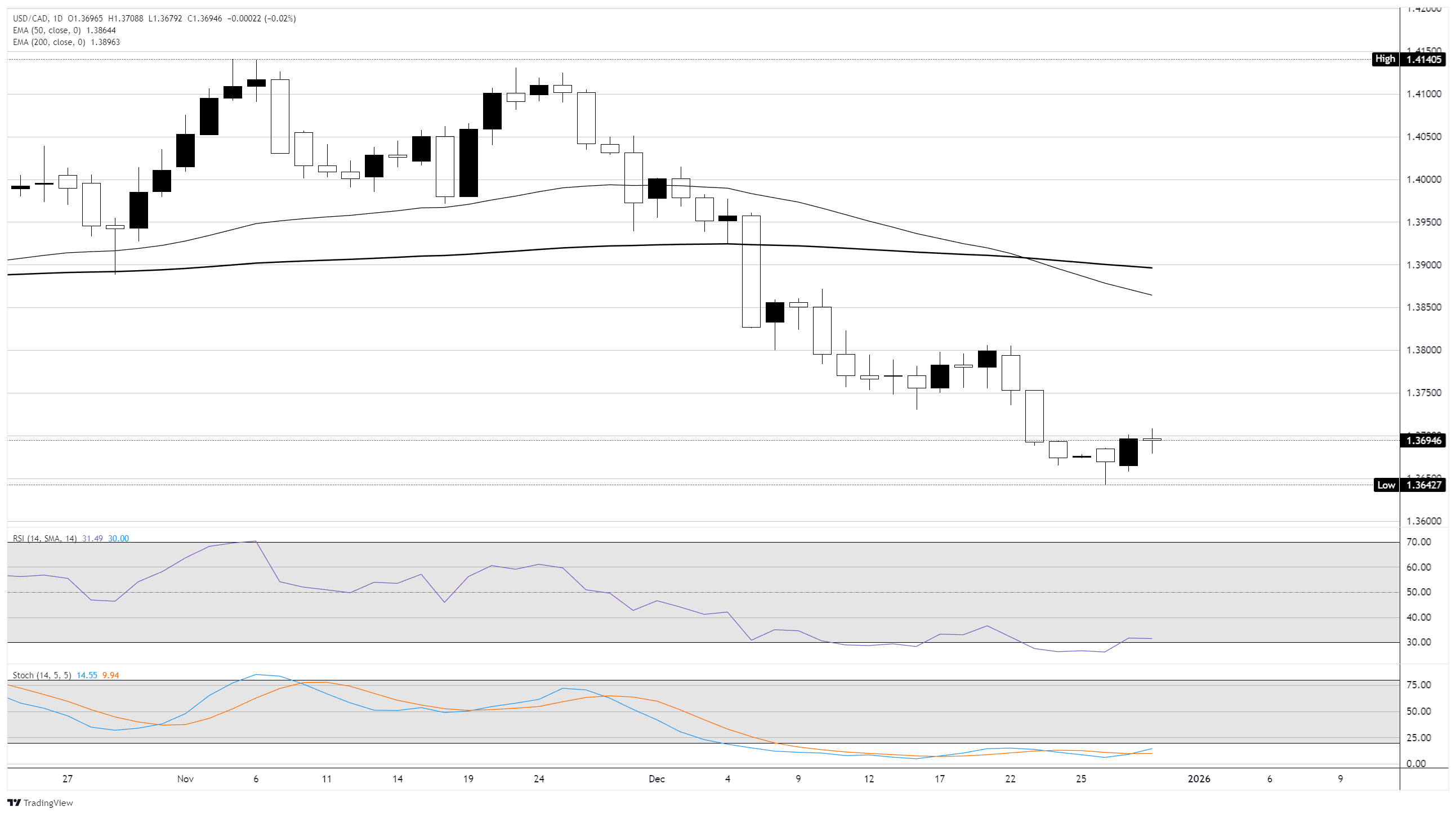
In the daily chart, USD/CAD trades at 1.3697. The pair holds below the 50-day and 200-day exponential moving averages, both pointing lower. The 50-day EMA has crossed beneath the 200-day EMA, reinforcing a bearish setup and keeping rebounds contained. RSI near 32 signals weak momentum after an oversold dip, while the Stochastic turning up from extreme lows hints at fading downside pressure.
Bearish momentum prevails while price remains under the falling averages and RSI stays south of 50. A daily close above the 50-day EMA would ease pressure and open scope for a corrective bounce toward the 200-day EMA, but failure to clear the former would keep risks tilted to fresh lows. Oscillator stabilization could fuel brief recoveries, yet trend signals still favor sellers until those moving-average barriers give way.
(The technical analysis of this story was written with the help of an AI tool)
USD/CAD daily chart
Canadian Dollar FAQs
The key factors driving the Canadian Dollar (CAD) are the level of interest rates set by the Bank of Canada (BoC), the price of Oil, Canada’s largest export, the health of its economy, inflation and the Trade Balance, which is the difference between the value of Canada’s exports versus its imports. Other factors include market sentiment – whether investors are taking on more risky assets (risk-on) or seeking safe-havens (risk-off) – with risk-on being CAD-positive. As its largest trading partner, the health of the US economy is also a key factor influencing the Canadian Dollar.
The Bank of Canada (BoC) has a significant influence on the Canadian Dollar by setting the level of interest rates that banks can lend to one another. This influences the level of interest rates for everyone. The main goal of the BoC is to maintain inflation at 1-3% by adjusting interest rates up or down. Relatively higher interest rates tend to be positive for the CAD. The Bank of Canada can also use quantitative easing and tightening to influence credit conditions, with the former CAD-negative and the latter CAD-positive.
The price of Oil is a key factor impacting the value of the Canadian Dollar. Petroleum is Canada’s biggest export, so Oil price tends to have an immediate impact on the CAD value. Generally, if Oil price rises CAD also goes up, as aggregate demand for the currency increases. The opposite is the case if the price of Oil falls. Higher Oil prices also tend to result in a greater likelihood of a positive Trade Balance, which is also supportive of the CAD.
While inflation had always traditionally been thought of as a negative factor for a currency since it lowers the value of money, the opposite has actually been the case in modern times with the relaxation of cross-border capital controls. Higher inflation tends to lead central banks to put up interest rates which attracts more capital inflows from global investors seeking a lucrative place to keep their money. This increases demand for the local currency, which in Canada’s case is the Canadian Dollar.
Macroeconomic data releases gauge the health of the economy and can have an impact on the Canadian Dollar. Indicators such as GDP, Manufacturing and Services PMIs, employment, and consumer sentiment surveys can all influence the direction of the CAD. A strong economy is good for the Canadian Dollar. Not only does it attract more foreign investment but it may encourage the Bank of Canada to put up interest rates, leading to a stronger currency. If economic data is weak, however, the CAD is likely to fall.
Author

Joshua Gibson
FXStreet
Joshua joins the FXStreet team as an Economics and Finance double major from Vancouver Island University with twelve years' experience as an independent trader focusing on technical analysis.