USD/MXN drops as Fed independence threats spur Peso demand
- Mexican Peso appreciates 0.25%, as traders punish the Greenback on US political noise.
- Mexico inflation falls to 3.51% YoY, strengthening odds for a Banxico cut to 7.50% in September.
- Citi survey: Peso expected to stay strong, USD/MXN seen near 19.50 by year-end.

USD/MXN retreated on Wednesday as investors became worried about the Federal Reserve’s independence, as the Trump administration “doubled up” their pressure on Fed officials, as revealed by Bloomberg. Market participants ignored “hawkish” minutes released by the Fed and punished the Greenback for the benefit of the Peso. The pair trades at 18.76, down 0.25%.
Peso strengthens as Trump pressures Fed’s Cook; Banxico rate cut seen in September
Breaking news reported by Bloomberg revealed that the director of the Federal Housing Finance Agency, Bill Pulte, revealed that Fed Governor Lisa Cook “falsified bank documents and property records to acquire more favorable loan terms, potentially committing mortgage fraud under the criminal statute.”
The US President Donald Trump demanded the resignation of Cook, and some of his aides revealed to the Wall Street Journal (WSJ) that he was considering attempting to fire the alleged Fed Governor.
Consequently, market participants sold off the US Dollar against most G10 FX currencies and also against the Mexican Peso. The USD/MXN fell from around 18.84 to 18.72 ahead of the release of the minutes of the August Federal Open Market Committee (FOMC) meeting.
The Fed minutes showed officials remain worried about inflation and unease about tariffs, as “many (Fed officials) noted full effect of tariffs could take some time,” to be reflected. “Several expected companies would pass tariffs to customers.”
Regarding the neutral rate for the Fed funds rate, “Several participants said that the current target range for the federal funds rate may not be far above its neutral level.”
Across the southern border, the latest inflation reports in Mexico showed that the headline inflation in the twelve months to July dipped from 4.32% to 3.51% year over year, within Banco de Mexico (Banxico)'s 3%—plus or minus 1%—target.
The strength of the Peso and the evolution of the disinflation process make another 25-basis points rate cut by Banxico, almost a certainty at the September meeting. The Citi Mexico Expectations Survey shows that “most participants expect that the next move in the monetary policy rate will be in September 2025, and all expect a 25 bps cut as the next move.”
The survey showed that most economists estimate that Mexico’s interest rates would end at 7.50%, meaning that the next month's cut would be the last for 2025.
Analysts expect the USD/MXN exchange rate to end around 19.50 by the end of the year and see headline inflation at around 4% for the same period.
The Mexican economy is expected to grow 0.4% up from 0.3% in the previous survey, with the high and the low of the projections being -0.1% to 0.8%.
Ahead, the US economic docket will feature the release of Initial Jobless Claims for the week ending August 16 and the Fed Chair Jerome Powell's speech at Jackson Hole. Mexico’s economic schedule will feature Industrial Output figures for June.
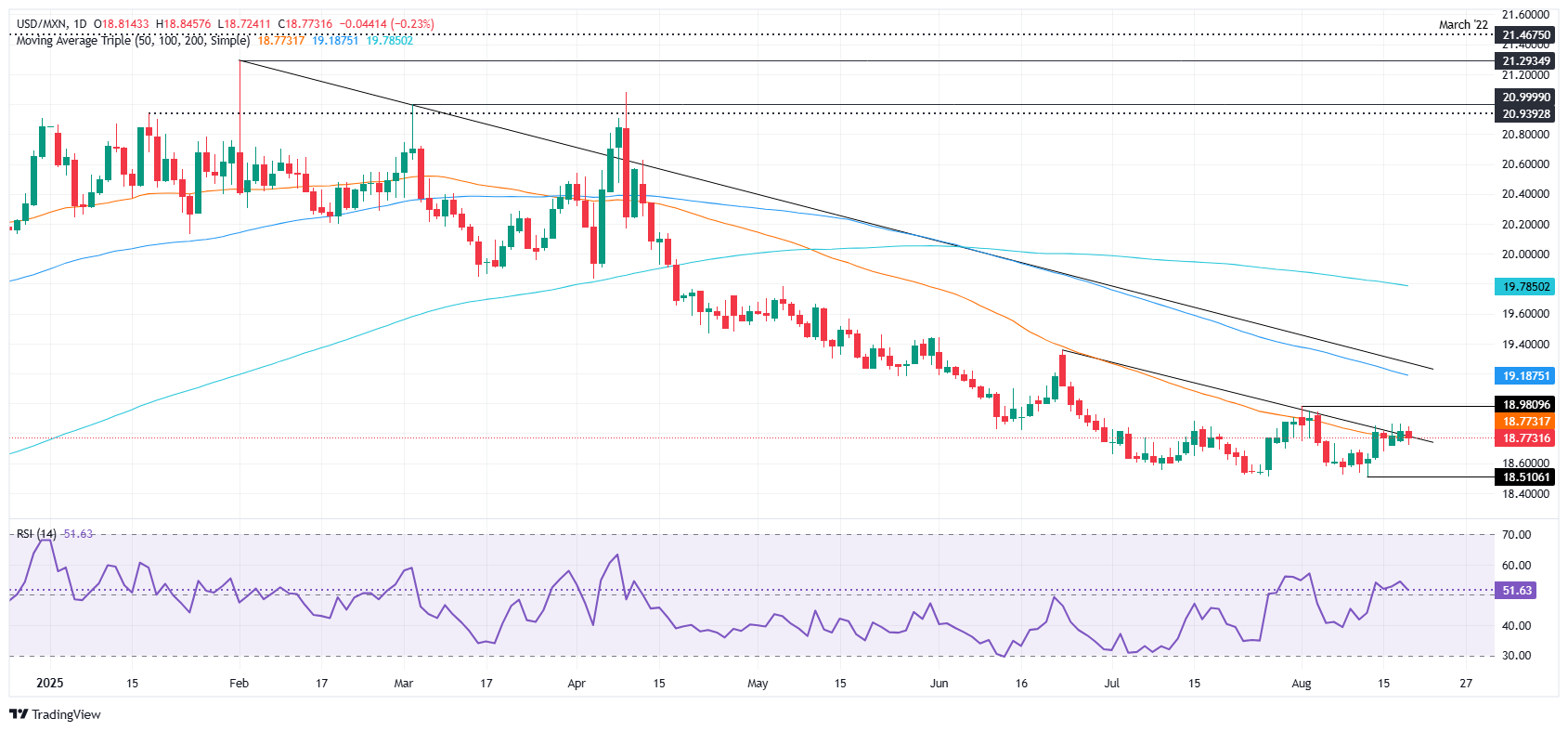
USD/MXN Price Forecast: Recovers after hitting a yearly low of 18.50
The USD/MXN seems to have bottomed out after reaching the yearly low of 18.50 on August 13. Since then, the pair has risen over 1.44%, clearing the 20 and 50-day Simple Moving Averages (SMAs) of 18.72 and 18.76, respectively. Momentum tilted bullish as the Relative Strength Index (RSI) cleared its neutral, suggesting that buyers are in charge.
If USD/MXN clears August’s 19 high of 18.86, the pair could test the 19.00 figure. A breach of the latter exposes the 100-day SMA at 19.16, followed by 19.50 and the 100-day SMA at 19.76. Conversely, a drop below 18.50 opens the path to test the August 1, 2024, low of 18.42, followed by the July 23, 2024, low of 17.90.
Mexican Peso FAQs
The Mexican Peso (MXN) is the most traded currency among its Latin American peers. Its value is broadly determined by the performance of the Mexican economy, the country’s central bank’s policy, the amount of foreign investment in the country and even the levels of remittances sent by Mexicans who live abroad, particularly in the United States. Geopolitical trends can also move MXN: for example, the process of nearshoring – or the decision by some firms to relocate manufacturing capacity and supply chains closer to their home countries – is also seen as a catalyst for the Mexican currency as the country is considered a key manufacturing hub in the American continent. Another catalyst for MXN is Oil prices as Mexico is a key exporter of the commodity.
The main objective of Mexico’s central bank, also known as Banxico, is to maintain inflation at low and stable levels (at or close to its target of 3%, the midpoint in a tolerance band of between 2% and 4%). To this end, the bank sets an appropriate level of interest rates. When inflation is too high, Banxico will attempt to tame it by raising interest rates, making it more expensive for households and businesses to borrow money, thus cooling demand and the overall economy. Higher interest rates are generally positive for the Mexican Peso (MXN) as they lead to higher yields, making the country a more attractive place for investors. On the contrary, lower interest rates tend to weaken MXN.
Macroeconomic data releases are key to assess the state of the economy and can have an impact on the Mexican Peso (MXN) valuation. A strong Mexican economy, based on high economic growth, low unemployment and high confidence is good for MXN. Not only does it attract more foreign investment but it may encourage the Bank of Mexico (Banxico) to increase interest rates, particularly if this strength comes together with elevated inflation. However, if economic data is weak, MXN is likely to depreciate.
As an emerging-market currency, the Mexican Peso (MXN) tends to strive during risk-on periods, or when investors perceive that broader market risks are low and thus are eager to engage with investments that carry a higher risk. Conversely, MXN tends to weaken at times of market turbulence or economic uncertainty as investors tend to sell higher-risk assets and flee to the more-stable safe havens.
Author

Christian Borjon Valencia
FXStreet
Markets analyst, news editor, and trading instructor with over 14 years of experience across FX, commodities, US equity indices, and global macro markets.

















