USD/MXN breaks above 17.0000 as sentiment turns sour, as Banxico likely to hold rates
- USD/MXN pair is trading at 17.0378, up from its daily low of 16.8333 and above its 20-day Exponential Moving Average (EMA).
- Banxico’s Heath said interest rate levels are correct, even though the Fed hikes again.
- USD/MXN remains intact but is subject to correction, with significant resistance near the 17.00 mark and the 50-day EMA at 17.1336.

The Mexican Peso (MXN) weakens as the North American session progresses, down 0.82%, as the USD/MXN exchange rate looms around 17.0000 with strength for the first time since July 21, 2023. The USD/MXN is trading at 17.0378, above its 20-day Exponential Moving Average (EMA), bouncing from a daily low of 16.8333.
USD/MXN advances 0.97% on risk-off impulse, Banxico’s Heath dovish comments
A recent downgrade of debt issued by the United States (US) turned market sentiment sour as Wall Street trades with losses. Private hiring in the US rose by 324K, according to figures published by the ADP Research Institute in collaboration with Stanford Digital Economy Lab, exceeding estimates of 189K. Although the data is encouraging, it hasn’t been a prelude to the Nonfarm Payrolls report, which is expected on Friday, to show the economy added just 200K people to the workforce in July.
Regarding Tuesday’s data, the ISM Manufacturing PMI came at recessionary territory below the 50 figure for the ninth straight month, though it continued to improve; compared to June’s 46, it arrived at 46.4. Even though it was an improvement, the trend appears to slow down.
The USD/MXN resumed its uptrend based on the data bolstering the US Dollar (USD) as shown by the US Dollar Index (DXY). The DXY, which tracks the greenback’s performance against a basket of peers, stands at 102.663, gaining 0.69%, underpinned by US Treasury bond yields advance.
On the Mexican front, the Bank of Mexico (Banxico) Deputy Governor Jonathan Heath said, “restrictive monetary policy stance should be held for awhile to wait of it to have effect,” expressed in a Banorte podcast interview. He acknowledged that core inflation is not easing as the headline, adding that “it’s important for the exchange rate to be as flexible as possible with no intervention to manipulate it to a rate where it shouldn’t be.” He added that interest rates are “correct” even if the Fed hikes again.
USD/MXN Price Analysis: Technical outlook
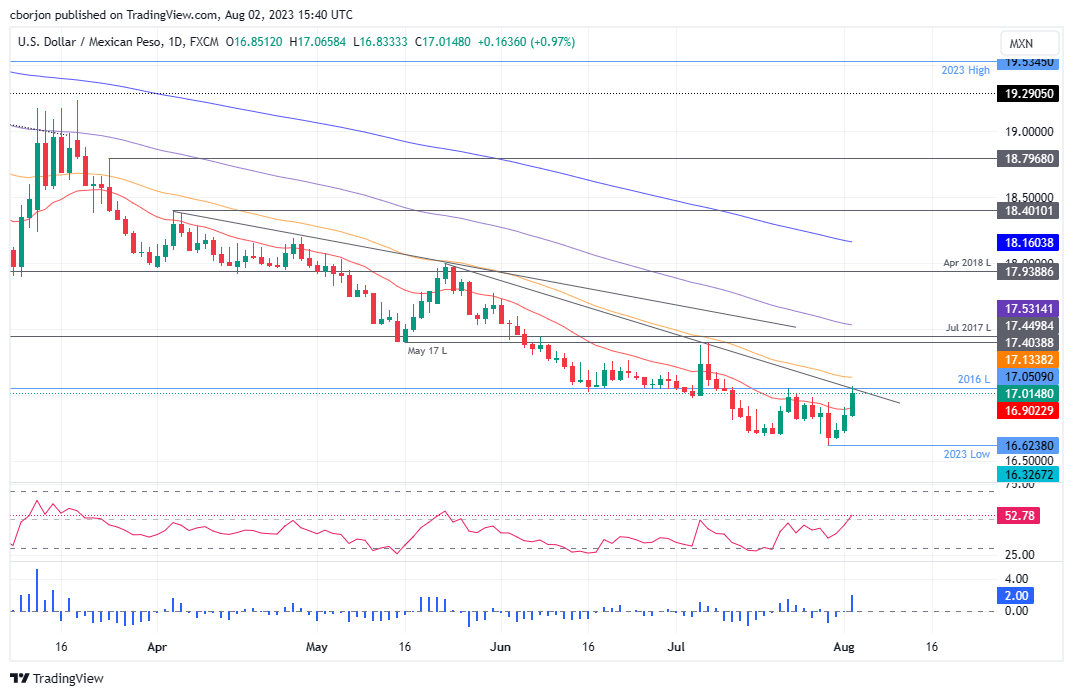
From a technical standpoint, the USD/MXN downtrend remains intact but subject to a correction, as the 20-day EMA at 16.9005 has been left behind, with the exchange rate eyeing higher prices. The USD/MXN would face solid resistance at a three-month-old downslope resistance trendline nearby the 17.00 mark, below the 50-day EMA at 17.1336. Once that area is cleared, the USD/MXN could challenge a crucial resistance area at a May 17 low of 17.4038, which, once cleared, the 100-day EMA at 17.5313 would be up for grabs. On the downside, if USD/MXN drops below 16.9011, the year-to-date (YTD) low at 16.6238 could be tested.
Author

Christian Borjon Valencia
FXStreet
Markets analyst, news editor, and trading instructor with over 14 years of experience across FX, commodities, US equity indices, and global macro markets.

















