USD/JPY Price Forecast: Momentum eases but trend structure stays firmly bullish
- Japanese Yen firms on Friday as renewed intervention warnings from Tokyo trigger mild profit-taking in USD/JPY.
- USD/JPY eases from near ten-month highs around 157.89 but remains on course for a second straight weekly gain.
- Technicals show early signs of cooling, with momentum moderating, but the broader uptrend is still intact.

The Japanese Yen (JPY) strengthens against the US Dollar (USD) on Friday, with USD/JPY snapping a four-day winning streak after fresh verbal intervention warnings from Tokyo prompted mild profit-taking.
At the time of writing, the pair is trading around 156.54, easing modestly from Thursday’s near ten-month high around 157.89, though it remains on track to secure a second consecutive weekly advance.
Japan’s Ministry of Finance reiterated that authorities are ready to act against excessive currency moves, signalling rising discomfort with the pace of Yen depreciation. The warnings come as the Yen hovers near levels where Tokyo intervened in the past.
At the same time, Bank of Japan (BoJ) Governor Kazuo Ueda has acknowledged that the weak Yen is adding upward pressure to prices, fuelling expectations that policymakers may discuss the feasibility of tightening policy as early as December.
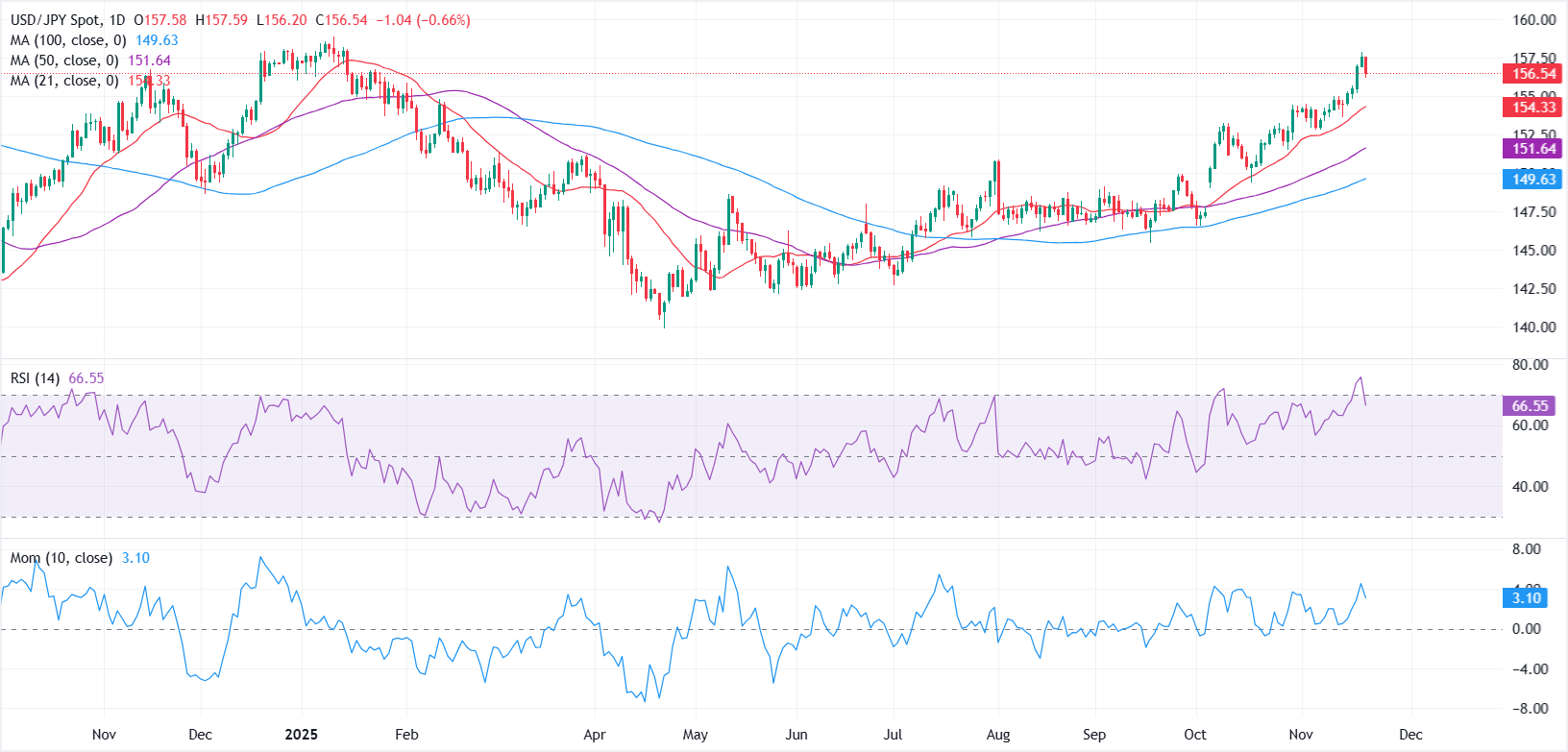
From a technical perspective, USD/JPY is showing the first signs of fatigue after failing to hold above 157.50, with Friday’s pullback marking the initial cooling phase of an otherwise aggressive rally.
The daily chart shows price easing from overbought territory, with the Relative Strength Index (RSI 14) slipping from near 70 to around 66, hinting at fading bullish momentum but not yet signalling a full reversal. Momentum also holds above the zero line and has begun to ease, indicating that buying pressure remains in place but is gradually moderating.
The broader trend structure, however, remains constructive. The pair continues to trade comfortably above the key moving averages, with the 21-day Simple Moving Average (SMA) near 154.30 providing the first layer of dynamic support, followed by the 50-day SMA around 151.60. As long as these zones hold, dips are likely to attract fresh buying interest.
Initial resistance is now seen at Thursday’s high around 157.89, followed by the psychological 158.00 handle. A decisive close above this zone would reopen the path toward the 160.00 area — a level widely watched by traders given the heightened risk of official intervention.
Japanese Yen FAQs
The Japanese Yen (JPY) is one of the world’s most traded currencies. Its value is broadly determined by the performance of the Japanese economy, but more specifically by the Bank of Japan’s policy, the differential between Japanese and US bond yields, or risk sentiment among traders, among other factors.
One of the Bank of Japan’s mandates is currency control, so its moves are key for the Yen. The BoJ has directly intervened in currency markets sometimes, generally to lower the value of the Yen, although it refrains from doing it often due to political concerns of its main trading partners. The BoJ ultra-loose monetary policy between 2013 and 2024 caused the Yen to depreciate against its main currency peers due to an increasing policy divergence between the Bank of Japan and other main central banks. More recently, the gradually unwinding of this ultra-loose policy has given some support to the Yen.
Over the last decade, the BoJ’s stance of sticking to ultra-loose monetary policy has led to a widening policy divergence with other central banks, particularly with the US Federal Reserve. This supported a widening of the differential between the 10-year US and Japanese bonds, which favored the US Dollar against the Japanese Yen. The BoJ decision in 2024 to gradually abandon the ultra-loose policy, coupled with interest-rate cuts in other major central banks, is narrowing this differential.
The Japanese Yen is often seen as a safe-haven investment. This means that in times of market stress, investors are more likely to put their money in the Japanese currency due to its supposed reliability and stability. Turbulent times are likely to strengthen the Yen’s value against other currencies seen as more risky to invest in.
Author

Vishal Chaturvedi
FXStreet
I am a macro-focused research analyst with over four years of experience covering forex and commodities market. I enjoy breaking down complex economic trends and turning them into clear, actionable insights that help traders stay ahead of the curve.